A global company signing a lease for office space in Bengaluru or Hyderabad today may well be committing to floors that are still being built. The agreement sets out an expected handover date, around which the company plans its hiring, fit-out and relocation. Whether that date holds depends largely on how well the architects, structural engineers, services consultants and contractors on the project work together once construction is under way.
India's office market recorded its strongest nine months on record in 2026, with about 66.4 million sq ft leased between January and September, according to CBRE. Global Capability Centres (GCCs) accounted for roughly 42% of that space. Developers have added supply at a record pace as well, but occupiers are asking for larger and more specialised buildings, and more of them are signing before construction is finished. This places greater importance on the ability to coordinate construction schedules and deliver projects on time.
Building for a different kind of workplace
CBRE recorded 32 million sq ft of new completions in the first half of 2026, the most for any H1, and Colliers says new supply across the top seven cities rose 79% quarter on quarter between July and September. Vacancy across the six largest cities had fallen to 13.2% at the end of June, according to Savills, down from 14.7% a year earlier. Occupiers are also favouring newer stock: CBRE found that about three-quarters of the space leased in the third quarter was in buildings less than ten years old, while Savills says deals of 100,000 sq ft or more made up 53% of first-half leasing.
What goes into those buildings has changed as well. GCCs setting up engineering, product development and AI teams usually need labs, server rooms and restricted areas, with higher power and cooling capacity than a standard office floor. Flexible workspace operators, now the largest group of occupiers by CBRE's count, want floor plates they can divide and refit as clients change. Both mean more ducts, cable trays and pipework sharing the same ceilings and risers, and more coordination between the teams that design and install them.
Cushman & Wakefield estimates that pre-commitments made up nearly 12% of gross leasing so far this year, and each of those deals ties a tenant's move to the developer's construction schedule. When the building runs late, the tenant is held up with it.
The challenges on site
Delays on these projects often trace back to clashes that were missed during design, such as a duct routed through a beam or a slab opening left in the wrong place. Each one found on site means rework, and often a wait for another trade to return.
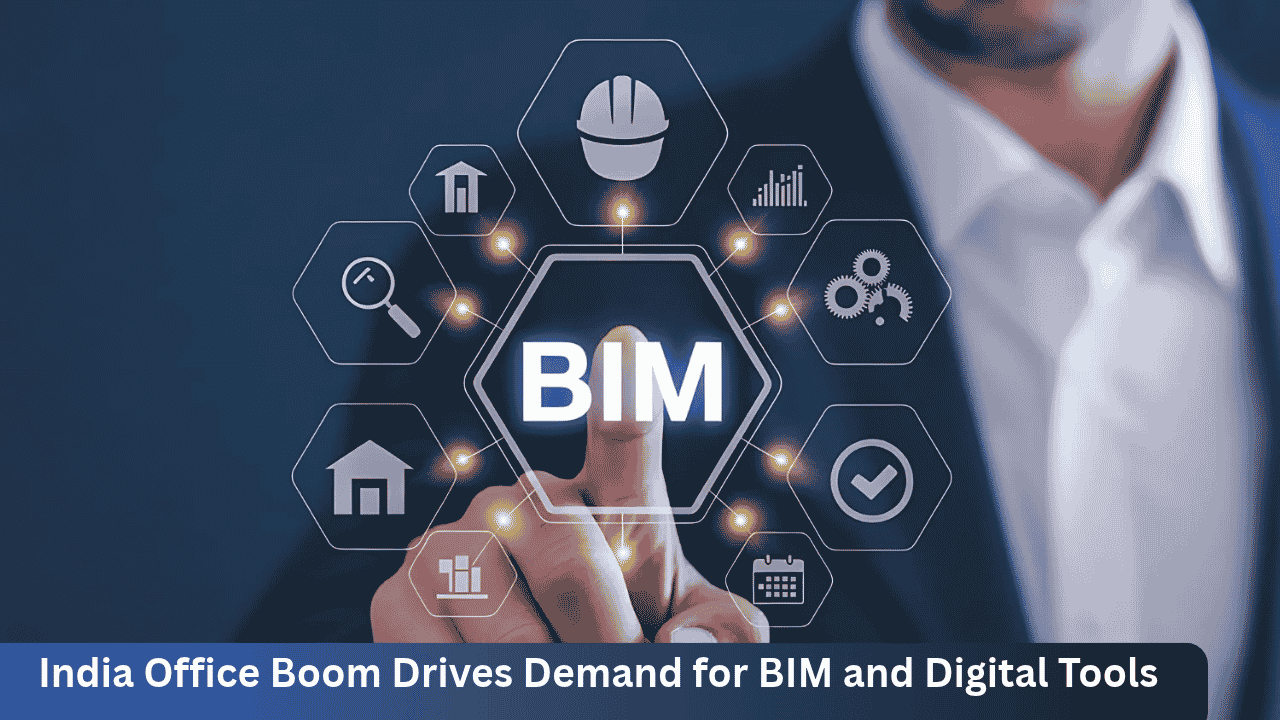
Building Information Modelling (BIM) helps address these problems by bringing architectural, structural and services designs into a coordinated digital model. This allows project teams to identify potential clashes before construction begins, rather than having to correct them on site. A 2010 doctoral study at the University of Maryland, based on US projects, estimated that reduced rework and idle time saved trade contractors about 9% of project costs, with clash detection the largest source of those savings.

Harsh Pareek, Vice President, Direct Sales, APAC at Trimble, said: “Meeting India’s demand for office space depends not just on how many projects are launched, but on how efficiently they are planned, built and handed over. Connected construction brings people, data and workflows together across the project lifecycle, helping teams identify issues earlier, reduce rework and make better-informed decisions.”
Linking decisions across the project lifecycle
On many Indian projects the model stays with the design team, and contractors and subcontractors keep working from printed drawings that are not always current. Connected construction platforms address this by keeping models, drawings and site records in one shared system, so that a consultant's revision can be opened by the site team on a tablet and progress recorded on site is visible to the designers.
Structural modelling tools such as Trimble's Tekla Structures allow engineers to model steel and concrete components in detail, including individual connections and reinforcement. The resulting models can be used to produce fabrication drawings and plan erection sequences, helping contractors work from coordinated project information. Developers running several towers at once can use this to maintain consistent construction standards and quality across sites.
The same project information remains useful after occupation, when it can form the basis of a digital twin: a digital representation of the building that can be updated with information from its systems and operations. While BIM provides the coordinated model and project information, a digital twin can extend this into the operational phase by incorporating data about how the building is being used and performing. It gives facility managers a record of what was installed and where, helping them plan maintenance and assess future changes.
In flex centres and GCC campuses, where layouts and services change several times over a building's life, having reliable project information can make each refit easier to plan without starting with a fresh site survey. It can also help building operators understand how proposed changes to one part of a building might affect its other systems.
Savills expects demand across the six main cities to reach about 74 million sq ft in 2026, close to its supply estimate of 74.6 million sq ft. In a market where demand and supply are so closely matched, the ability to deliver buildings on schedule and make them easier to adapt will become increasingly important for developers.
Pareek said developers should look at the whole project lifecycle, “For developers, the opportunity is to connect design coordination with site execution and, ultimately, building operations. When project information remains reliable and accessible throughout this process, technology can do more than improve individual tasks. It can help make delivery more predictable and buildings easier to adapt over time.”
Building for India's next phase of office growth
India's office market is expected to see continued demand from GCCs, flexible workspace operators and other large occupiers. Developers will need to deliver buildings that meet increasingly specific requirements while managing construction costs, timelines and quality.
Meeting this demand will depend on how effectively project teams coordinate their work, from the initial design through construction and eventual building operations. BIM, connected field workflows and digital twins each have a role to play in this process, provided the information generated at one stage remains accessible and useful to the teams that follow. As office projects become more specialised, the ability to deliver buildings efficiently and keep them adaptable over time will become an increasingly important part of India's commercial real estate growth.