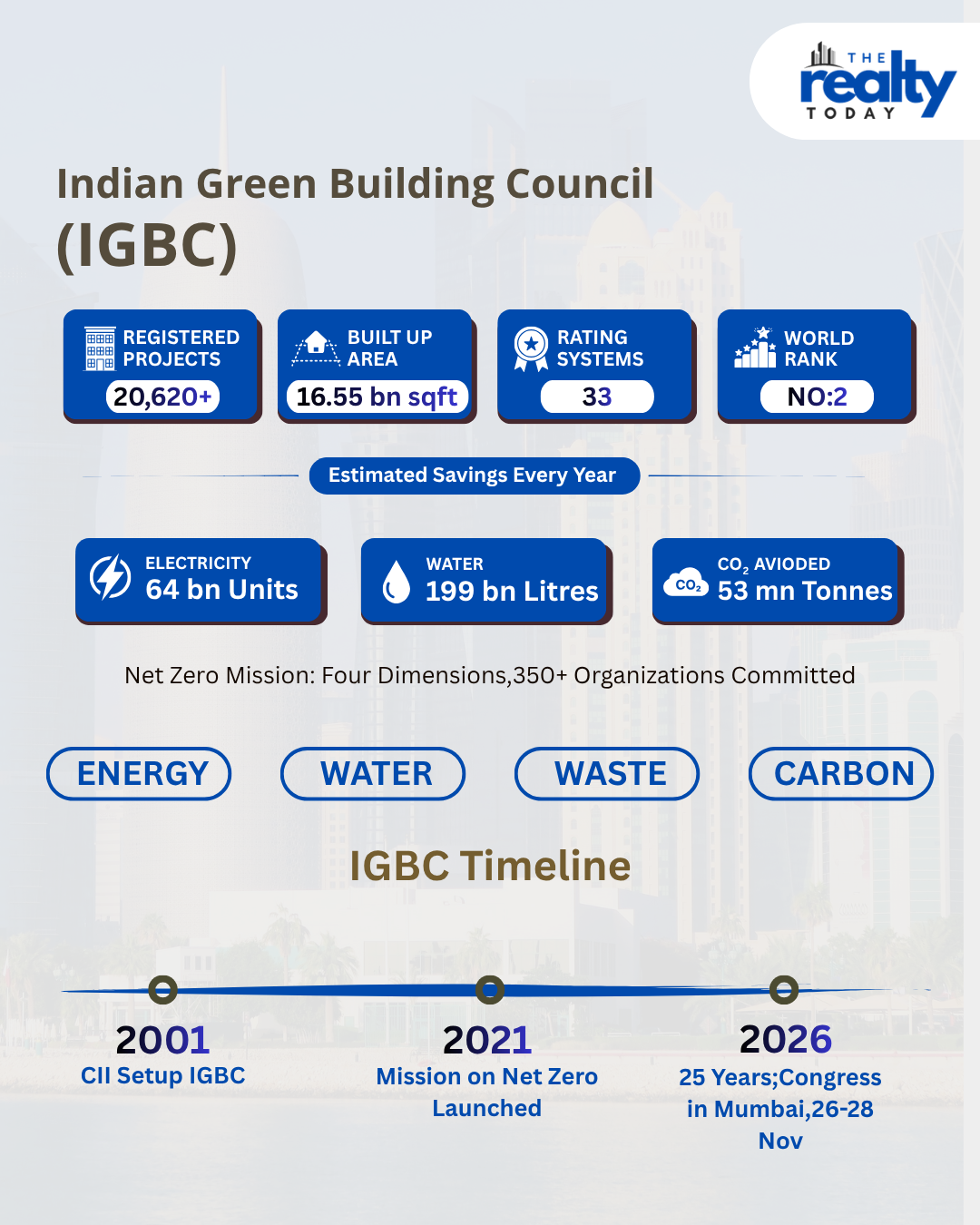
India has 20,620 IGBC-registered green building projects. Together they cover 16.55 billion sq ft. That makes the country the world’s second-largest green building market.
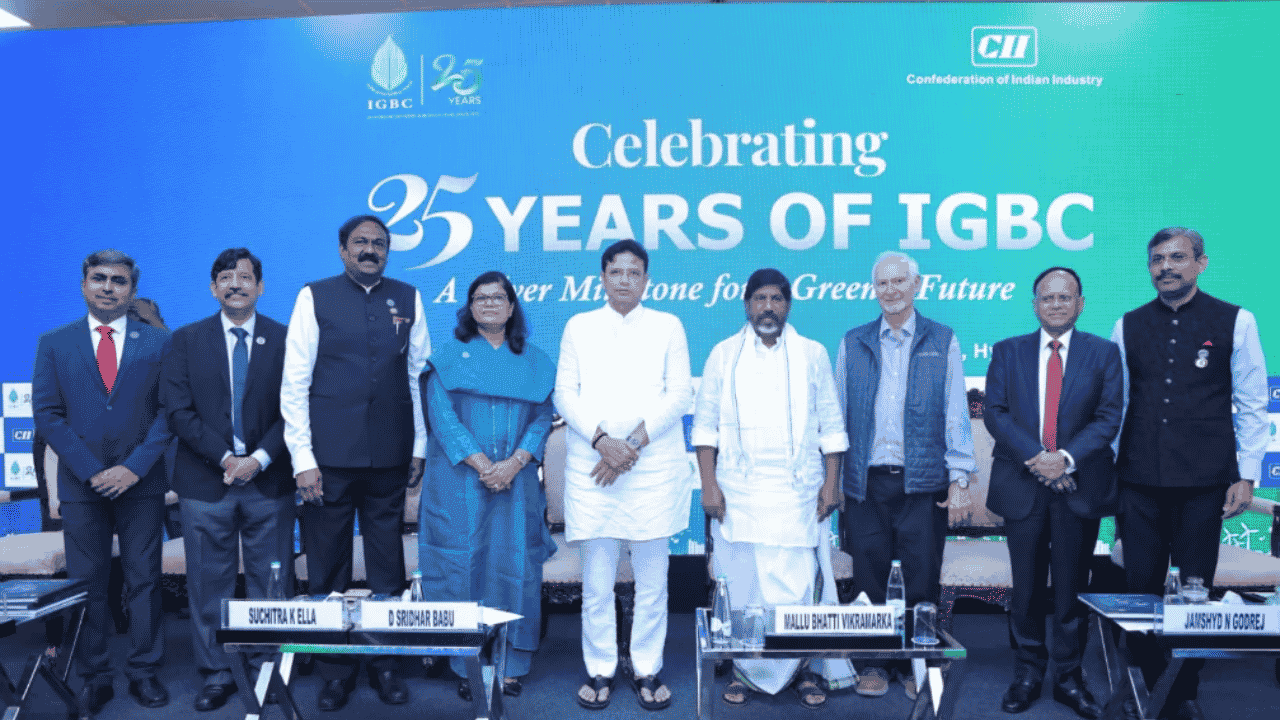
IGBC was set up by the Confederation of Indian Industry (CII) in 2001. It completes 25 years this year. The milestone will be marked at the 24th Green Building Congress, from 26 to 28 November 2026, at the Jio World Convention Centre, Mumbai. Organisers expect over 3,000 delegates and 10,000 business visitors. The theme is “Forging a Sustainable Future – Do Good, Feel Good. Building Greener Worlds Together.”
IGBC estimates that its rated buildings save about 64 billion units of electricity and 199 billion litres of water every year. They also avoid around 53 million tonnes of CO₂ emissions annually.
The council now runs 33 Green and Net Zero rating systems, each built for a different type of project, from homes and offices to factories, hospitals and airports. Here is IGBC today in four numbers.
The office that started it
The idea began in 2001. Jamshyd Godrej, a past president of CII, wanted to show that Indian builders could match global green standards. Not everyone agreed. Few people knew how, it looked costly, and green materials were hard to find.
The plan was a small 20,000 sq ft office in Hyderabad. The team took its idea from a green building in the US, the Chesapeake Bay Foundation headquarters. The project took more than three years. The office got wind towers, low-VOC carpets and non-toxic paints, and the site was disturbed as little as possible.
In 2003 the effort paid off. The office earned LEED Platinum, the top rating of the US LEED system. It was the first Platinum building in India and the first outside the US. Only two other Platinum buildings existed in the world then, both in the US.
In 2004, the then President of India, A.P.J. Abdul Kalam, inaugurated the CII-Sohrabji Godrej Green Business Centre in Hyderabad.
Then came the proof. The building cost 18% more to build, and CII says the extra cost paid back in about seven years. ITC and Wipro soon earned Platinum ratings for their Gurgaon buildings. Each was more than eight times the size of the Hyderabad office.
How the movement grew
By 2007, IGBC was administering the LEED India rating system. Below are some data on 25 yrs of IGBC< the projects vs the area builtup as green footprint in India.
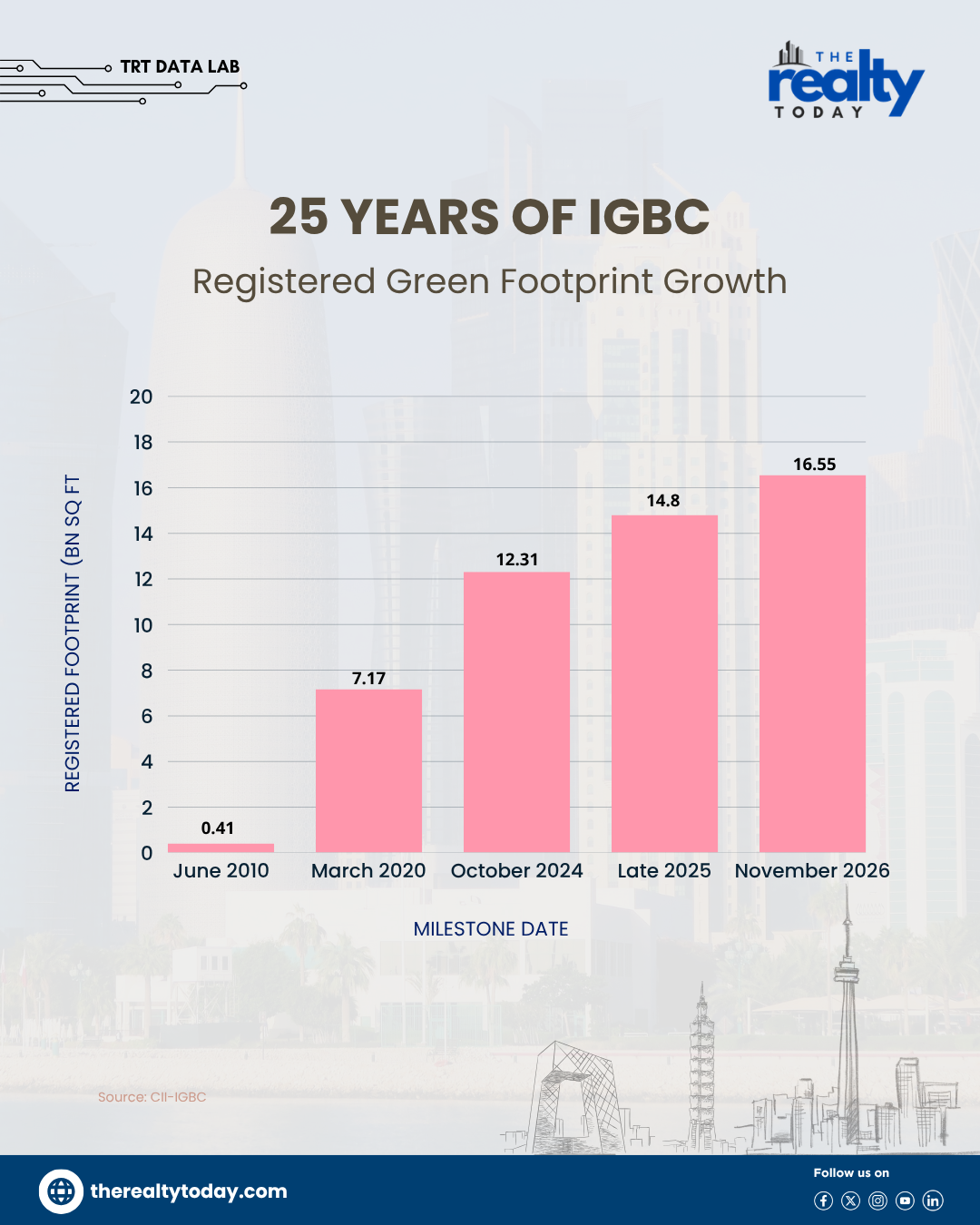
Registered footprint is the total floor area of every project that has signed up for an IGBC green rating. In plain words, how much of India’s built space is going green. “Registered” means signed up, so some projects may still be under construction. Footprint grew about 17x in the decade to 2020. It went from 0.41 to 7.17 billion sq ft. It more than doubled in under seven years since. From 7.17 billion in Mar 2020 to 16.55 billion in Nov 2026 is about 2.3x.
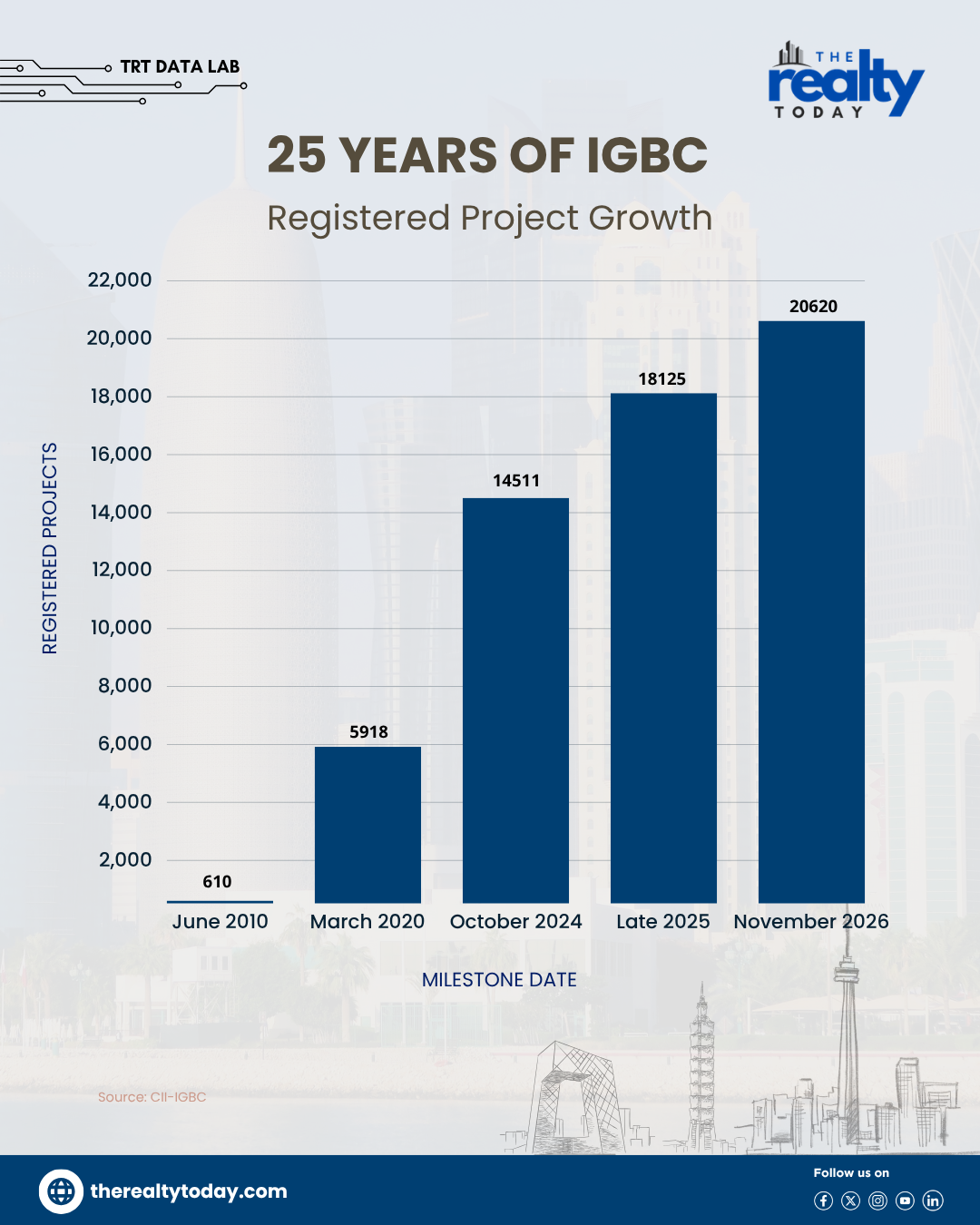
The above chart shows how many projects are joining . A project can be a home, an office, a factory, a school or a campus. There were about 640 in 2010 and 5,918 in 2020. The count has since more than tripled to 20,620.
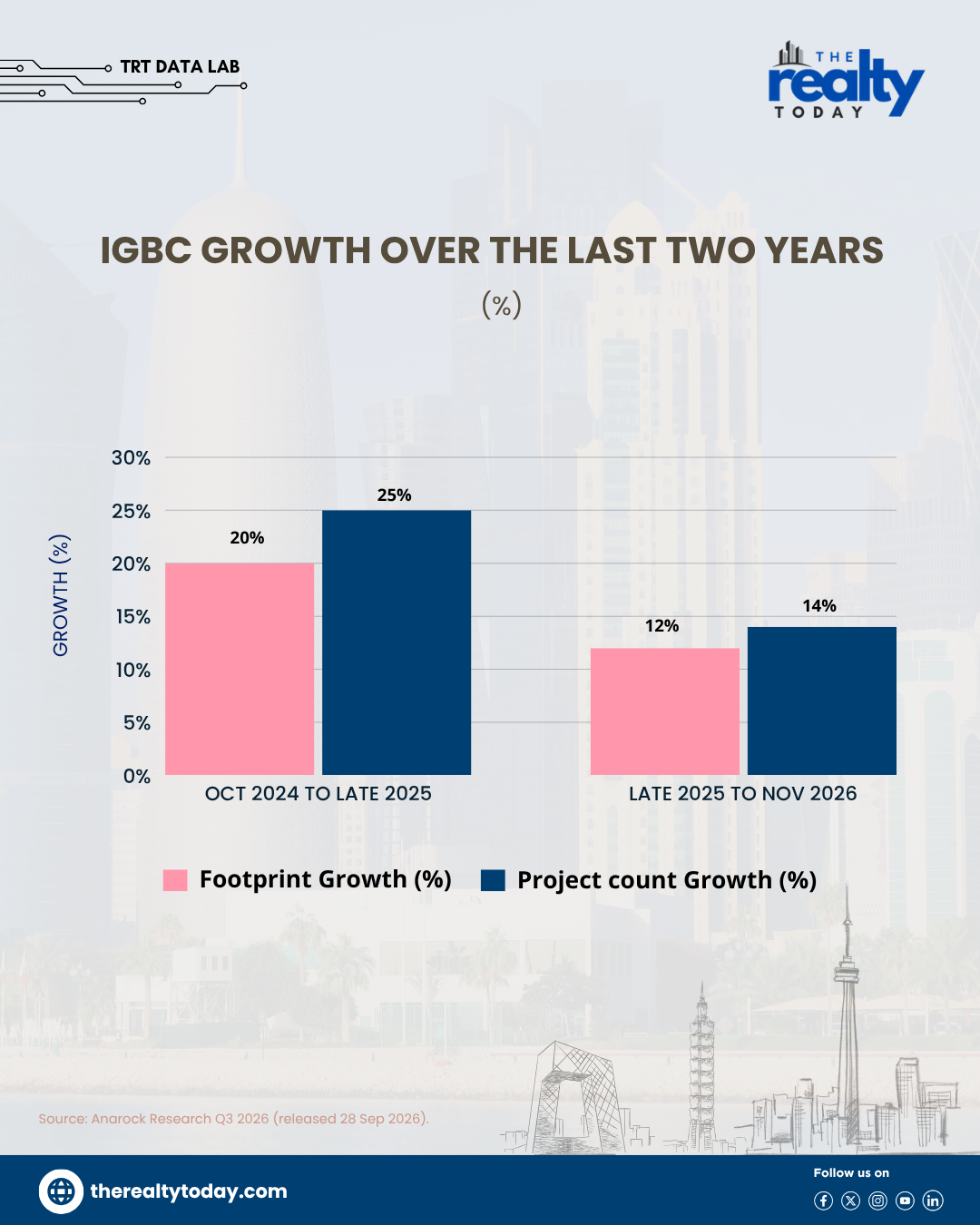
Growth is slowing, but it has not stopped. Last year IGBC added about 2.5 billion sq ft. This year it added about 1.75 billion. The number of projects grew faster than the area they cover. That means new projects are smaller on average than before.
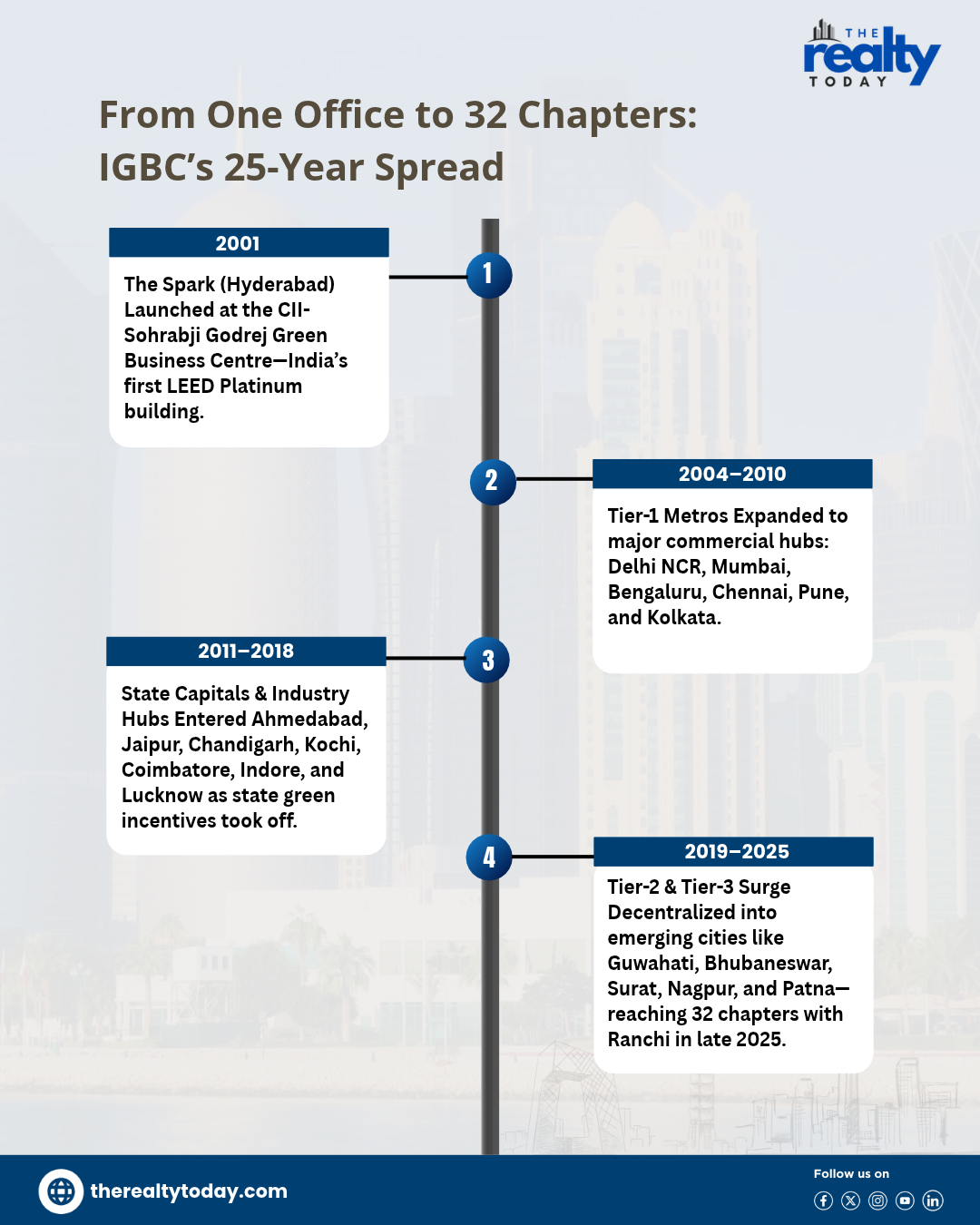
From One Office to 32 Chapters: IGBC’s 25-Year Spread
The next step is Net Zero
In 2021, IGBC launched its Mission on Net Zero across energy, water, waste and carbon, with over 350 organisations committed. Unlike green buildings that simply use less, net zero buildings balance their annual footprint, much like a bank account ending the year at zero.
Net zero energy requires offsetting 100% of annual grid power with renewables, prioritizing efficiency first. New Delhi’s Indira Paryavaran Bhawan (2014), the Environment Ministry office and India’s first net zero energy building, cut demand from 100 to 45 units and saved ~40% on cooling before installing India’s largest multi-storey rooftop solar plant (930 kW). It generates ~14 lakh units yearly, matching its demand, with zero water discharge.
IGBC rates four kinds
Net zero energy: what it uses is covered by renewables
Net zero water: it reuses and recycles enough that it needs little fresh water
Net zero waste: almost no waste goes to landfill
Net zero carbon: its emissions are offset
C Shekar Reddy, National Chairman of CII-IGBC, said the next phase must go beyond single buildings. He wants Net Zero campuses, townships and cities. He also pointed to rising temperatures and cooling demand, and said buildings must be part of the answer to climate risk and energy security.
M Anand, Executive Director of CII-IGBC, said future performance will depend on efficient design, renewable energy and retrofitting existing buildings. He named AI, IoT-based monitoring and smart building systems as tools that can help.
Twenty-Five Years of Impact
What began in 2001 as a single 20,000 sq ft experiment in Hyderabad has grown into a nationwide transformation, scaling more than 800,000-fold to 16.55 billion sq ft. In just a quarter century, IGBC has turned green construction from an expensive curiosity into the mainstream standard, positioning India as the world's second-largest green building market.
Through 32 local chapters, over 60,000 trained professionals, and more than 2,800 government projects, its legacy goes far beyond blueprints and ratings. By proving that sustainability makes economic sense, IGBC has reshaped how India builds, works, and lives. As the country enters its next quarter century of rapid urban growth, that 25-year foundation is no longer just a milestone to celebrate. It is the blueprint for how India will balance development with climate survival.