Self-leveling mortar is a cementitious or resin-based flooring compound used to create smooth and even surfaces over concrete or other substrates. Engineered to flow and spread under its own weight, it fills surface irregularities without the need for extensive manual finishing. With increasing demand for efficient flooring systems across residential, commercial, and industrial segments, self-leveling mortars have become an essential product in modern construction practices.
What is a Self-Leveling Mortar?
Self-leveling mortar is a pre-mixed compound comprising cement or resins, sand, water, and polymer additives. These mortars are formulated to achieve a fluid consistency upon mixing, allowing them to settle into an even surface with minimal intervention. They are primarily used as an underlayment to prepare subfloors before the installation of tiles, wood, carpet, vinyl, or other finishes.
Depending on the application environment, different formulations are available to suit surface conditions, load-bearing needs, curing times, and chemical exposure levels. Once applied, the mortar forms a flat, continuous surface capable of supporting both foot and equipment traffic.
Common Areas of Application
Self-leveling mortars are used across diverse sectors due to their adaptability and performance. Common applications include:
- Residential floors (kitchens, bathrooms, hallways)
- Commercial spaces (offices, retail outlets, hotels)
- Industrial facilities (manufacturing units, machine shops, storage areas)
- Parking decks and garages
- Hospitals and healthcare institutions
- Airports, railway stations, and other transport hubs
- Educational institutions
- Warehouses and logistics centres
- Power generation and utility facilities
They are particularly useful in renovation projects, where the existing subfloor may be uneven, cracked, or unsuitable for direct finishing.
Advantages of Using Self-Leveling Mortar
The adoption of self-leveling mortar offers several practical advantages:
- Requires less manual labour compared to traditional screeds.
- Provides a continuous, seamless layer that helps reduce flooring failures.
- Shorter curing times enable faster project handovers.
- Suitable for a wide range of floor finishes.
- Can be applied over concrete, tiles, plywood, or other substrates.
- Offers structural stability under static and dynamic loads.
- Reduces risks associated with water ingress and material incompatibility.
- Compatible with underfloor heating systems in certain formulations.
- Helps reduce long-term maintenance needs.
Types of Self-Leveling Mortar
1. Cement-Based Self-Leveling Mortar
Cement-based mortars are the most widely used in residential and commercial construction. They provide a strong, durable base for floor finishes and are compatible with a range of subfloor materials. These mortars are used to smooth uneven concrete and prepare the surface for tile, vinyl, laminate, or hardwood flooring. Curing time may vary depending on thickness and ambient conditions.
2. Gypsum-Based Self-Leveling Mortar
Gypsum-based mortars are generally lighter and easier to handle, making them suitable for interior applications where moisture exposure is limited. They are commonly used in apartment buildings and office interiors. However, these mortars are not recommended for wet areas such as bathrooms, basements, or kitchens, as gypsum is susceptible to water damage.
3. Epoxy-Based Self-Leveling Mortar
Epoxy-based formulations consist of resin and hardener components that cure to create a rigid, abrasion-resistant surface. These mortars are ideal for settings that require chemical resistance and high load capacity, such as laboratories, processing plants, or warehouses with heavy machinery. Epoxy mortars also provide good resistance to oils, solvents, and other industrial fluids.
4. Polyurethane-Based Self-Leveling Mortar
Polyurethane mortars are designed for flexibility and impact resistance. They perform well in areas with temperature fluctuations or vibration, such as commercial kitchens, workshops, or production facilities. These mortars also offer protection against chemical exposure and mechanical abrasion.
5. Rapid-Setting Self-Leveling Mortar
Designed for projects with tight deadlines, rapid-setting mortars cure within hours, allowing for early installation of floor finishes. These are preferred in renovation or refurbishment work, where time constraints are critical. The faster turnaround is particularly useful for retail spaces, healthcare facilities, and residential upgrades.
6. Heavy-Duty Self-Leveling Mortar
Heavy-duty variants are engineered for high-performance applications where mechanical strength is critical. These mortars are used in factories, logistics centres, commercial garages, and food processing units. They resist wear and tear, frequent foot traffic, and movement of goods or machinery.
7. Waterproof Self-Leveling Mortar
Waterproof mortars are formulated to prevent water absorption, making them suitable for bathrooms, kitchens, balconies, and wet utility areas. By forming a moisture barrier, they help avoid delamination and deterioration of floor finishes.
8. Lightweight Self-Leveling Mortar
Lightweight mortars are used in high-rise buildings or other weight-sensitive structures. They are easier to transport, mix, and apply, and exert less load on structural slabs. Despite being lighter, they still offer the required strength and coverage.
9. Hybrid Self-Leveling Mortar
Hybrid mortars combine properties of cement, resin, or polymer-based systems to offer a balanced product with specific performance characteristics. These are typically used in custom projects where the mortar must meet a combination of mechanical, thermal, and chemical resistance requirements.
10. Decorative Self-Leveling Mortar
Decorative mortars include pigments or aggregates to create aesthetic finishes. These are used in showrooms, retail stores, or premium commercial interiors where visual appeal is important. Some variants can replicate the look of terrazzo, marble, or polished concrete while offering functional benefits of self-leveling systems.
Method of Application
The effectiveness of self-leveling mortar depends on proper surface preparation and application technique. Below is a general process followed during application:
1. Surface Preparation
- Ensure the substrate is clean, dry, and free from dust, oil, or existing adhesives.
- Repair cracks, remove loose particles, and fill large voids.
- Apply a compatible primer if specified by the manufacturer to enhance bonding.
2. Mixing
- Use a mechanical stirrer to mix the mortar with clean water or designated resin system.
- Maintain proper mixing ratios to avoid inconsistencies in flow and setting.
- Mix until a uniform, lump-free blend is achieved.
3. Application
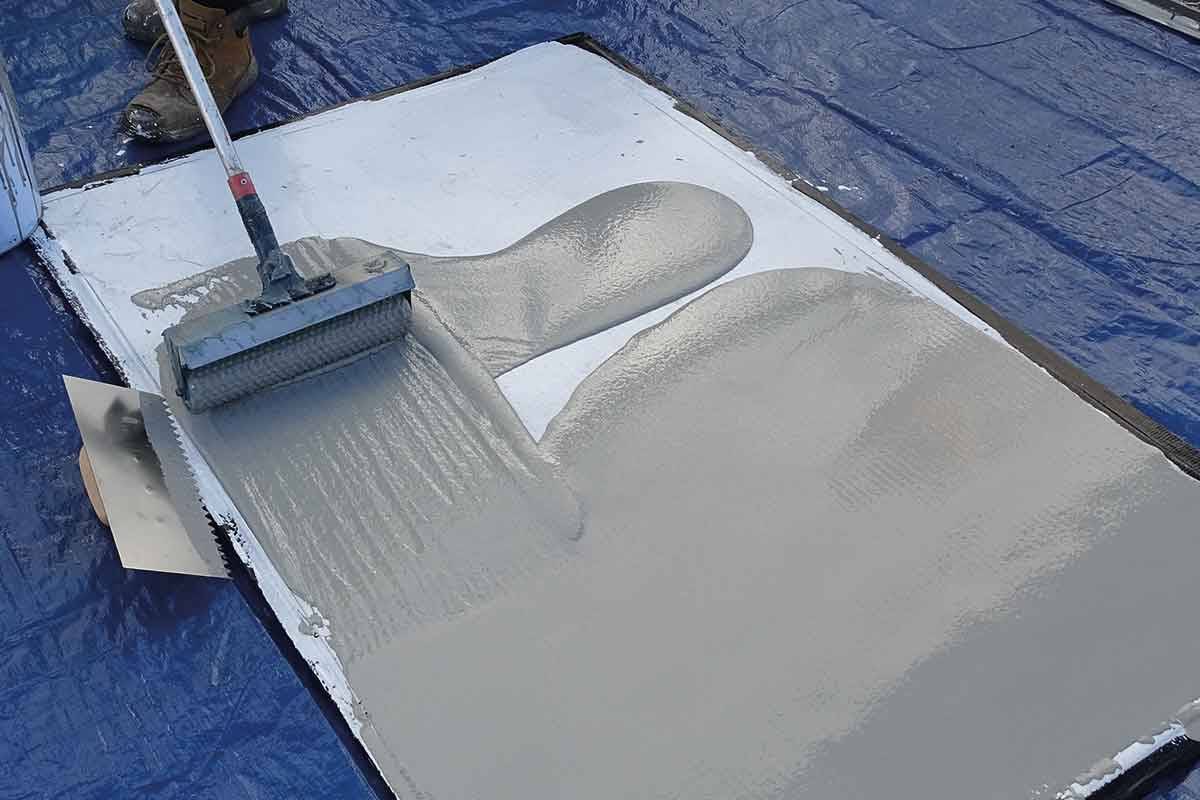
- Pour the mortar onto the subfloor starting from the farthest point.
- Use a gauge rake or spreader to help distribute the compound.
- Work in manageable sections to maintain continuity.
4. Finishing
- Use a spiked roller to remove entrapped air bubbles.
- Allow the mortar to level naturally.
- Avoid walking over the surface during initial curing.
5. Curing
- Allow the floor to cure for 4 to 24 hours, depending on the product.
- Follow manufacturer guidelines for temperature, humidity, and overcoat times.
6. Post-Application Inspection
- Inspect the surface for flatness and any minor defects.
- Once fully cured, proceed with installation of the top-floor finish.
Conclusion
Self-leveling mortar offers a dependable and streamlined method to prepare floor surfaces across various construction environments. By reducing manual work, speeding up application, and ensuring consistency, these mortars address common site challenges related to uneven or damaged subfloors. With a variety of formulations tailored for different conditions — from moisture-prone interiors to heavy-duty industrial sites — they support both new construction and retrofit work. As building standards continue to evolve, self-leveling mortar remains a key solution for achieving floor systems that are functional, durable, and ready for final finishes.