Widespread monsoon rains kept construction activity subdued in July, weighing on dealer offtake and cement procurement, even as government capital expenditure by the Centre, states and CPSEs rose 19 per cent year-on-year in April-May 2026, providing support to the medium-term cement demand outlook and raising expectations of stronger building-material demand from FY27, according to the Equirus capital’s Building Material Monthly Update, July 2026.
Trade-level data showed that cement procurement remained largely need-based during July, with prices flat to slightly lower across several markets. Price hikes announced by mills were largely defensive and difficult to sustain amid weak demand. Equirus expects sluggish volume growth in H1 FY27, as subdued demand and new capacities coming onstream continue to constrain pricing power.
Regional trends remained mixed, with healthy cement demand in the western and southern markets, weaker traction elsewhere, and varied pricing across regions. Prices declined by around Rs 5 per bag in West and Central markets, rose by Rs 8 per bag in Hyderabad, and remained broadly stable in the North and East.
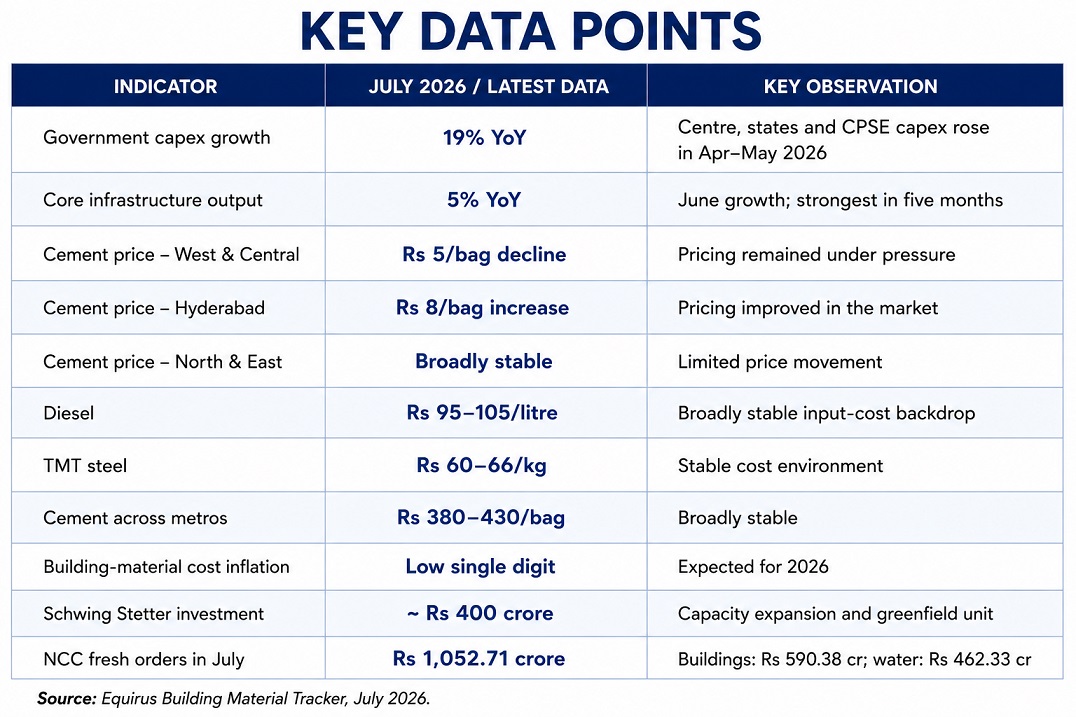
The input-cost environment was broadly stable during the month. Diesel prices remained around Rs 95-105 per litre, TMT steel was in the Rs 60-66 per kg range, while cement prices across metros were around Rs 380-430 per bag. Equirus said the stable backdrop provides some relief compared with earlier cost spikes, but soft demand and competitive intensity continue to keep producers focused on margin protection rather than aggressive price hikes. Overall building-material cost inflation for 2026 is expected to remain in the low-single-digit range.
Despite seasonal moderation in project execution, construction-related investment and order flows remained positive. Schwing Stetter India is investing about Rs 400 crore in capacity expansion and a new greenfield unit to address medium-term infrastructure demand. NCC Ltd reported fresh orders worth Rs 1,052.71 crore in July, including Rs 590.38 crore from buildings and Rs 462.33 crore from water projects.
Infrastructure activity also pointed to underlying resilience. India's core infrastructure index increased 5 per cent year-on-year in June, led primarily by higher output in cement, electricity and iron ore. According to the report, this was the strongest growth in five months and indicates that upstream production in key building-material inputs remained healthy despite monsoon-related weakness at retail construction sites.
The report expects construction and building-material demand to revive as weather-related and near-term demand headwinds ease, supported by the stronger infrastructure pipeline.
Capital-market activity in the sector, however, remained subdued. Equirus reported no M&A deals in the building-material space in July 2026, with the number of M&A deals in CY26 remaining nil till date. The last major transaction cited was Asian Paints' acquisition of 40 per cent of Obgenix Software for Rs 186.7 crore in CY25.
Private equity activity was also muted, with only three deals in the overall building-material segment in CY26. The largest PE deal in CY26 was AllHome's Rs 200-crore fundraise from Bessemer Venture Partners. The report noted that a significant part of the market continues to rely on the unorganised sector, where PE participation remains limited unless there is a distinguished USP.
The equity capital market also remained subdued, with no ECM transactions in the building-material sector in CY26. The last ECM deal cited by Equirus was the Rs 451.3-crore Euro Pratik IPO, while the previous QIP in the sector was by KEI.
Monsoon rains kept construction activity subdued in July, affecting cement offtake and procurement. However, a 19% YoY rise in government capex during April-May 2026 and continued infrastructure activity support the medium-term demand outlook. Equirus expects building-material demand to improve from FY27 as weather-related disruptions ease, although new capacities may keep pricing pressure high.