

Key Clauses to Look for in a RERA-Compliant Sale Agreement
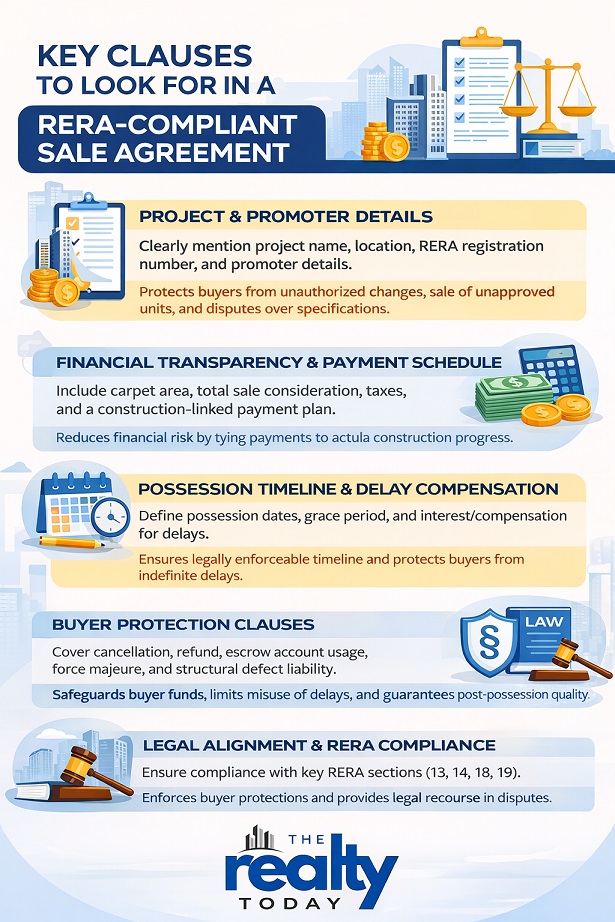
- Project & Promoter Details- The agreement must clearly mention project name, location, RERA registration number, and promoter details to prevent unauthorized changes, sale of unapproved units, or disputes over specifications.
- Financial Transparency & Payment Schedule- Include carpet area, total sale consideration, taxes, and a construction-linked payment plan. This ensures value-for-money pricing, reduces financial risk, and ties payments to actual construction progress.
- Possession Timeline & Delay Compensation- Clearly define possession dates, grace periods, and interest/compensation for delays. This creates a legally enforceable timeline and protects buyers against indefinite project extensions.
- Buyer Protection Clauses- Cover cancellation, refund, escrow account usage, force majeure, and structural defect liability. These safeguard buyer funds, ensure proper use of payments, limit misuse of delays, and guarantee post-possession quality.
- Legal Alignment & RERA Compliance- The agreement must comply with key RERA sections (13, 14, 18, 19), enforcing statutory protections, developer accountability, and providing legal recourse in case of disputes.
Buying a house is one of the most important moments in a person's life. It is is not just a transaction, it is a commitment that lasts a long time and, among other things, decides the degree of one's financial security, family stability, and future planning.In most cases, a home is a representation of the years of a buyer's savings and long term loans, which is why having a clear understanding of the law and necessary protections is vital. Nevertheless, a good number of homebuyers enter into sale contracts without thorough knowledge of the consequences, most of the time relying on brochures, verbal promises, or the reputation of the brand.
The Real Estate (Regulation and Development) Act, 2016 was a legislation designed to inevitably tackle the unbalanced real estate industry. It was a vehicle for consumer protection, transparency, and developers' accountability. The Agreement for Sale is the legal definition of the buyer, promoter relationship, thus considered the core of such a regulatory system.
Although registering a project under RERA is a must, the truth is that the sales agreement is what predominantly shields the buyer by providing a correct and fair reflection of the RERA provisions. Buyer rights may be seriously compromised if clauses are missing, conditions are vaguely worded, or there are builder, friendly interpretations. For this reason, buyers should be aware of not only the clauses that are present in the agreement but also the reasons behind each clause and the ways that they affect them in their day- to- day situations.
What Is a RERA-Compliant Sale Agreement?
A sale agreement adhering to the RERA guidelines is a binding document which, as per the sale agreement guidelines under RERA, is drafted according to the rules set forth under the RERA Act, 2016. It includes:
- Description of project details and the unit on sale.
- Rights and obligations of buyers and developers.
- Timelines for construction and possession
- Financial commitments and payment schedules
- Remedies Available in Cases of Delay, Default, and Defects
The Role of a RERA-Compliant Sale Agreement
It's not just an official formality to create a RERA-compliant sale agreement, but it's something more than just an agreement. It’s an enforceable agreement, and it describes the terms of the timeline, the financial implications, the consequences of delay, or defect. In case of any dispute, delay, or defect, it's the agreement itself on which authorities or the court have
The agreement serves multiple purposes:
- It legally binds the promoter to approved plans and timelines
- It defines the buyer’s financial exposure and payment obligations
- It establishes compensation and refund rights
- It safeguards the buyer against arbitrary changes
Detailed knowledge of the clauses will provide the assurance of not compromising the statutory provisions ensured in RERA.
Clauses That Require Careful Attention and Why They Matter
Project and Promoter Details
The agreement should mention accurately and clearly the identification of a particular project and its promoter. It should include details of a specific project’s name and location, RERA registration number of the respective project, and promoter's details in a legal sense and approved plans. This is because, as discussed, the project particulars are what are legally binding on the developer under the agreement. In the absence of clarity, if there is a deviation from what is registered with the RERA, issues would arise for the prospective buyer if he wants to dispute these changes later on. The first reference would be to the agreement’s alignment with the RERA registration.
Clear project identification protects buyers from:
- Unauthorized changes in project scope
- Sale of unapproved units
- Disputes over promised specifications
Carpet Area and Area Disclosure
RERA provides a mandate whereby the selling of a residence occurs based on the carpet area only. It has been mentioned that the contract must specify the carpet area used in the selling of the apartment, while balconies, verandas, or private terraces have to be stated separately.
This is because the calculation of the area is directly related to the pricing as well as usage. Earlier, home buyers are known to have been forced to pay for increased super built-up space that is unable to deliver any real value.
Accurate area disclosure:
- Ensures value-for-money pricing
- Allows for meaningful comparison across projects
- Eliminates post-purchase disputes on size.
- Notify about right Purchase Area
Unclear buyers often discover discrepancies only after possession, when legal remedies become more complex.
Total Sale Consideration & Cost Transparency
The agreement should clearly detail the all-inclusive amount to be paid by the buyer, covering charges, taxes, and fees. Each and every component of the price must be clearly disclosed.
This matters because ambiguous pricing clauses permit developers to add charges later on, often at an advanced stage of the construction process when buyers' hands are tied. Community amenities, car parking, and deposits required for maintenance are all common areas where hidden costs arise that can trigger disputes.
Construction-Linked Payment Schedule
RERA has specified that the payment should be related to the actual construction progress. The agreement has to mention specific construction phases and payment details.
This is important because advance-heavy payment schemes or payment schemes that involve timing risk carry high risks in terms of financial exposure to buyers. Payment schemes must not be strictly linked to project costs to guard buyers from paying a major part of project costs when a project has come to a stop itself.
Construction-linked payments:
- Reduce financial exposure
- Encourage timely project execution
- Protect buyers in case of delays
In disputes, authorities often examine whether payments were demanded as per construction progress mentioned in the agreement.
Possession Timeline and Completion Commitment
The agreement must clearly mention the committed possession date and any applicable grace period. This date must align with what is declared on the RERA portal. The possession timeline becomes legally enforceable under Section 18 of RERA. This matters because possession timelines are the foundation of compensation claims. Without a clearly defined possession date, buyers may find it difficult to establish delay or claim interest.
A clear possession clause:
- Creates a legally enforceable timeline
- Prevents indefinite project extensions
- Strengthens compensation claims
Interest and Compensation for Delay
RERA establishes parity between buyer and promoter by mandating equal interest rates for delay defaults. The agreement must reflect this principle clearly. This matters because delay compensation is one of the most powerful buyer protections under RERA. If the agreement dilutes or obscures this clause, buyers may lose significant financial relief.
Clear interest provisions:
- Ensure fairness between parties
- Discourage unnecessary delays
- Provide predictable compensation
Cancellation, Withdrawal, and Refund Provisions
It is important that the agreement clearly specifies the circumstances under which the buyer/promoter can cancel the allotment of shares and the financial implications of the same. These are concerns because the scenarios involved are emotionally and financially taxing. Conflicting clauses on refund can cause delays or partial refunds.
Clear Cancellation Provisions
- Maintain buyer liquidity.
- Reducing refund-related litigation
- Accountability in case of project failure
Buyers need to exercise special care regarding phrases that permit excessive deductions, as well as ambiguous refund provisions.
Escrow Account and Fund Utilisation
RERA also directs the promoters to invest a vast majority of the funds in the project in an escrow account, to be used only on the project.
The importance lies in the fact that diversion of funds has been a major factor in project delays in the past, especially because of a lack of financial discipline, where projects would be done, and money from the buyer would end up in another project as a result.
Escrow compliance:
- A separate escrow account for 70% of project fund deposits is mandatory
- The use of the money is restricted to the costs of construction and land
- Withdrawals require certification from an engineer, architect, and CA
This clause has a direct bearing on the reliability of project completion.
Force Majeure Provisions
Force majeure is the definition of exceptional conditions which may cause delay in the completion of a project. The importance of this lies in the fact that loosely worded force majeure clauses are often abused to claim unjustifiable delays. A buyer's claim for compensation stands to be forfeit in case force majeure has been too liberally defined.
A properly drafted clause:
- Limits misuse by promoters
- Protects buyers from unjustified extensions
- Ensures accountability during normal delays
Structural Defect Liability and Quality Assurance
RERA offers buyers the advantage of long-term protection against structural defects and poor workmanship. This is important, because defects in construction often appear after possession, when buyers have already paid most of the cost. In the absence of a formidable clause of defect liability, buyers might need to bear repair costs out-of-pocket.
- Clear defect liability provisions:
- Ensure construction quality
- Provide post-possession protection
- Hold developers accountable
Additional Clauses Which Affect Buyers' Protection
Besides the principal clauses, buyers also have to scrutinize clear land title clauses, statutory approvals, well-defined obligations of parties, and dispute resolution mechanisms under RERA. Any clause that tries to override statutory protections must be viewed with suspicion.
Important RERA Sections to be Known by Every Buyer
- Section 13(2): Registration of sale agreement compulsory
- Section 18: Damages for delay or non-delivery
- Section 19: Rights and duties of allottees
- Section 14: Observance of sanctioned plans and defect liability
Conclusion
A RERA-compliant sale agreement remains the most crucial legal recourse that any home buyer can enjoy. Although the real estate sector has undergone a sea change with the enforcement of RERA, the effectiveness depends on the correct incorporation in the sale agreement. The buyers must go into the agreement with the attitude that it is not merely an ordinary agreement but rather an extraordinary legal tool vital to their rights and security. This requires them to understand why these provisions will affect their lives and why it is vital to be able to make the right decisions to prevent future conflict. When it comes to real estate purchases, an understood agreement constitutes the most potent protection any buyer may have.




.png)