Key Highlights: What Happens If a Builder Violates RERA?
- The Real Estate (Regulation and Development) Act, 2016 imposes strict financial penalties up to 10% of project cost for major violations like non-registration and fund diversion.
- Builders can face imprisonment up to 3 years for continued non-compliance or ignoring Appellate Tribunal orders.
- Buyers are entitled to refund with interest or monthly delay compensation in case of delayed possession.
- 70% of buyer funds must be kept in a separate escrow account, preventing misuse across projects.
- RERA provides a 5-year defect liability period, ensuring builders fix structural or workmanship issues after possession.
- Authorities can cancel project registration, freeze accounts, and stop sales in serious violation cases.
Buying a home is one of the biggest financial decisions in a person’s life. Yet, for years, homebuyers struggled with delayed possession, sudden cost escalations, and unfulfilled promises by developers. The Real Estate (Regulation and Development) Act, 2016 (RERA) was enacted to protect buyers’ rights and ensure fairness, transparency, and timely project completion in the real estate sector.
RERA transformed the sector by introducing greater transparency, accountability, and efficiency. It mandates strict project registration, clear disclosure of project details, adherence to committed timelines, and proper utilization of funds. The Act also ensures that developers cannot make changes to approved plans without buyer consent and must deposit a significant portion of project funds in a separate escrow account to prevent misuse.
Non-compliance with RERA provisions can attract strict penalties. Developers may face heavy fines, revocation of project registration, blacklisting, and in severe cases, imprisonment. These strong enforcement measures have significantly improved buyer confidence and brought much-needed discipline to the real estate industry.
What Are RERA Violations?
- A builder (also called a promoter under RERA) may be held liable if they:
- Do not register the project before advertising or selling units
- Provide false or misleading information during registration
- Fail to update quarterly progress reports
- Delay possession without valid legal reasons
- Change layout or design without buyer consent
- Divert funds collected from buyers
- Fail to deposit 70% of buyer payments in the designated escrow account
- Charge buyers for super built-up area instead of carpet area
- Ignore orders passed by the RERA Authority
Each of these violations attracts specific penalties under the Act.
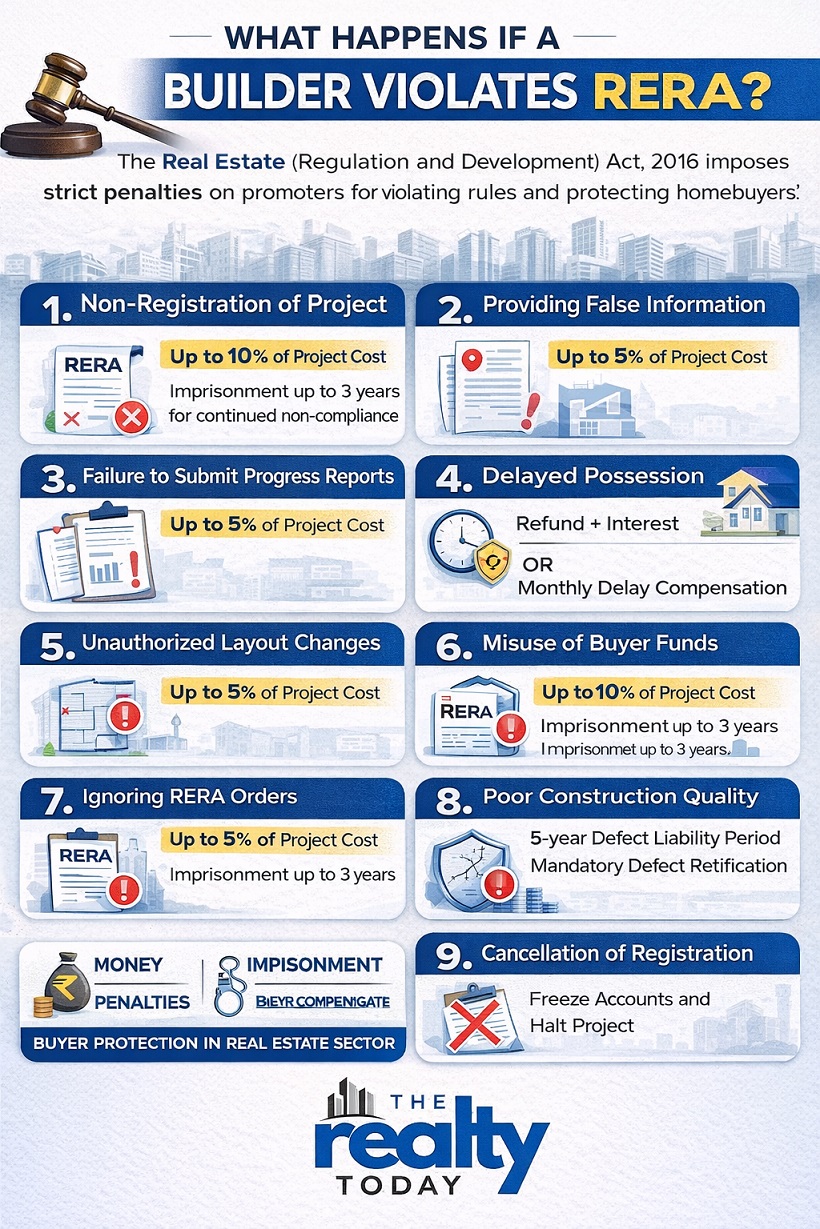
1. Non-Registration of Project
Every real estate project above the prescribed size must be registered with the state RERA authority before marketing or sale.
Penalty:
- Up to 10% of the total estimated project cost
- Continued non-compliance may lead to imprisonment up to 3 years or additional fines
For example, if the project cost is ₹100 crore, the penalty may go up to ₹10 crore.
2. Providing False Information
If a builder hides material facts such as land disputes, approval status, financial details, or construction timelines during registration, it is considered a serious offense.
Penalty:
- Up to 5% of the project cost
- False disclosures damage buyer trust and may lead to further investigation.
3. Failure to Submit Quarterly Progress Reports (QPR)
Builders are required to update project status every quarter on the RERA website, including:
- Construction progres
- Booking details
- Financial updates
- Approval status
Penalty:
- Daily fines
- Capped at up to 5% of project cost
4. Delayed Possession
One of the most common complaints is project delay. If the builder fails to deliver possession within the agreed timeline without valid force majeure reasons, buyers have legal remedies.
Buyer Rights:
- Full refund with interest, OR Monthly interest compensation for delay (if the buyer chooses to stay in the project)
- The interest rate is usually linked to the State Bank of India’s lending rate plus a specified percentage.
Builders may also face:
- Daily penalties
- Compensation orders
- Risk of blacklisting in severe cases
5. Unauthorized Layout or Structural Changes
Under RERA, a builder cannot make changes to:
- Carpet area
- Floor plan
- Structural design
- Amenities
- Number of floors
Without consent from at least two-thirds of the allottees.
Penalty:
Up to 5% of project cost
Buyer compensation
Buyers may also demand refund or restoration to the original plan.
6. Misuse of Buyer Funds
RERA mandates that 70% of the money collected from buyers must be deposited into a separate escrow account dedicated to that project. This amount can only be used for construction and land costs of the same project.
If the builder diverts funds, Penalty will include:
- Up to 10% of project cost
- Possible imprisonment
This provision prevents developers from using funds from one project to finance another.
7. Non-Compliance with RERA Orders
If a builder ignores orders passed by the RERA Authority:
- Daily fine may be imposed
- Capped at 5% of project cost
If the builder fails to comply with Appellate Tribunal orders:
- Imprisonment up to 3 years
- Additional fines
- Or both
8. Poor Construction Quality
RERA provides a five-year defect liability period from the date of possession. If structural defects or workmanship issues arise within this period:
- The builder must rectify defects within 30 days
- If not rectified, the buyer can claim compensation
This ensures accountability even after possession.
9. Cancellation of Project Registration
In cases of serious or repeated violations, RERA has the authority to:
- Cancel project registration
- Freeze bank accounts
- Stop sales and marketing
- Appoint another agency to complete the project
What Can Buyers Claim?
Depending on the violation, buyers can claim:
- Refund with interest
- Monthly delay interest
- Compensation for mental harassment
- Reimbursement of rent and EMI burden
- Litigation costs
- Rectification of defects
How to File a Complaint?
If a builder violates RERA:
Visit your state RERA website
Check project registration details
Gather evidence (agreement, brochures, receipts, emails)
File an online complaint
Attend the hearing
Most cases are resolved within 60 to 120 days.
Conclusion
In fact, RERA has done a fantastic job of enhancing buyer protection in the real estate industry of India. Monetary fines that are hefty, stringent rules for compliance, and the threat of jail ensure that developers stick to their legal duties. There is no ambiguity in buyers' rights now, and homebuyers have access to a well, structured mechanism for redress. Being aware of these penalties is like giving buyers the power to act promptly and to choose wisely when they are making a real estate purchase.