
Key Highlights of TG RERA Ruling
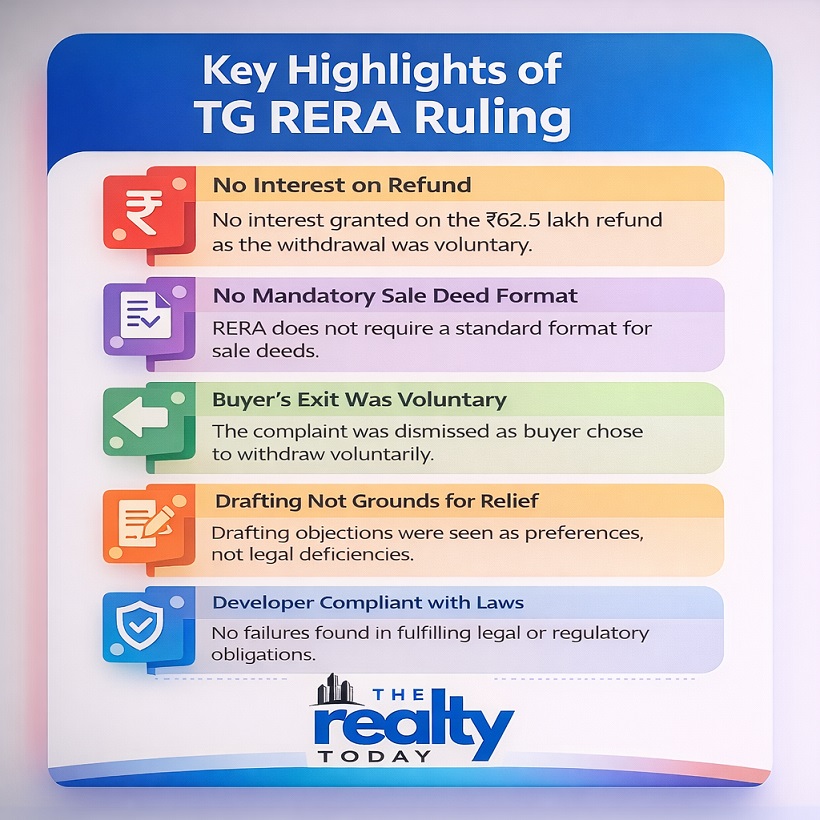
- No Interest on Refund: TG RERA denied the homebuyer’s claim for interest on the ₹62.5 lakh refund since the withdrawal was not due to any proven fault of the developer.
- No Mandatory Sale Deed Format: The authority clarified that the Real Estate (Regulation and Development) Act, 2016 does not prescribe a standard format for sale deeds—only for agreements for sale.
- Buyer’s Exit Was Voluntary: The complaint was dismissed because the buyer chose to back out over drafting concerns rather than any statutory violation.
- Drafting Preferences Not Grounds for Relief: Objections related to wording, structure, or additional clauses in the sale deed were considered personal preferences, not legal deficiencies.
- Developer Found Compliant: TG RERA observed no failure on the developer’s part in fulfilling legal or regulatory obligations.
- Clear Distinction in Legal Documents: The ruling reinforces the difference between RERA-governed agreements for sale and sale deeds governed by mutual contracts and registration laws.
The Telangana Real Estate Regulatory Authority (TG RERA) dismissed the complaint made by the home buyer regarding the interest on the refund of ₹62.5 lakh as the buyer backed out of the real estate project in Hyderabad. The real estate buyer had asked the developer to make changes to the draft of the sale agreement as there were many omissions and inconsistencies in the agreement.
However, TG RERA replied that “Neither the RE(R&D) Act, 2016, nor the Telangana RE(R&D) Rules, 2017, prescribe any mandatory or uniform format for a sale deed.”
The case has its roots in 2024 when the complainant booked a flat and remitted more than ₹62.5 lakh, which was more than 65% of the total consideration, as the total consideration was around ₹93 lakh. The dispute arose when the developer sent a draft sale deed through email to verify it and asked the buyer to communicate any corrections required. According to the TG RERA order, “The promoter’s staff provided a draft copy of the Sale Deed via email for verification and requested the Complainant to communicate any required corrections. Upon scrutiny of the draft sale deed, the complainant noticed several omissions that were required to be incorporated in accordance with RERA and the registration rules.”
The buyer objected to multiple aspects, including details regarding title documents, parking allocation, and TDS references, and insisted that these be incorporated before proceeding with registration. The developer maintained that the draft was compliant with applicable laws and refused to make the requested changes. TG RERA noted, “The staff refused to incorporate the omissions and insisted that the sale deed prepared by the promoter was final and non-negotiable, directing the buyers either to accept it as is or to withdraw from the purchase.”
The buyer, feeling compelled to act, demanded a full refund with interest. The developer, however, offered a full refund of ₹62.5 lakhs but denied any interest on the grounds of having not been wrong in any aspect. The TG RERA authority noted that the dispute was largely centered on drafting preferences.“In the absence of any established violation of the provisions of the Real Estate (Regulation and Development) Act, 2016, and in the absence of proof that the promoter failed to discharge any statutory obligation, this Authority is of the considered view that the Complainant is not entitled to the reliefs sought,” the order dated March stated as per HT.
Key highlights from TG RERA’s ruling:
- No mandatory sale deed format: RERA provides a model format only for the agreement for sale, not the sale deed.
- Discretion in deed content: The sale deed is governed by contractual understanding between parties and general registration laws.
- Drafting preferences not enforceable: Objections to language or layout without proof of statutory non-compliance are insufficient for claiming interest.
TG RERA emphasized the legal position of a sale deed as an instrument of conveyance. “The contents of a sale deed are governed by the agreement between the parties and general registration laws, and an allottee cannot insist on including clauses or formats that are not legally required,” the authority said. The buyer’s objections, the order noted, were primarily related to personal preferences in drafting and did not establish statutory non-compliance. “Accordingly, this Authority holds that the complaint is devoid of merit and is liable to be dismissed,” the ruling concluded.
This decision reinforces the legal distinction between RERA’s pre-sale agreements and the final sale deed. While RERA aims to ensure transparency and protect homebuyer interests, it does not mandate that developers follow a uniform format for executing a sale deed. Legal experts suggest that homebuyers should focus on verifying statutory compliance, clear title, and approvals rather than personal preferences in drafting.
The case also serves as a reminder to developers to communicate clearly with buyers regarding draft documentation. Providing drafts for review, while ensuring legal compliance, helps manage expectations and prevents disputes. Prompt and transparent refund processes, as demonstrated by the developer in this case, are equally important for maintaining credibility and compliance.
Image source- telangana.gov.in





.png)