

The Karnataka Real Estate Appellate Tribunal (KREAT) recently gave a major ruling that has the potential to change the entire real estate market of Bengaluru. Per the Tribunal, the Bangalore Development Authority (BDA) comes under the category of 'promoter' as defined by the Real Estate (Regulation and Development) Act, 2016 (RERA), and is therefore liable to carry out all activities prescribed by the Act, one of which is the registration of its projects.
In this regard, the Tribunal has dismissed the BDA's petition challenging the order of Karnataka Real Estate Regulatory Authority (KRERA) which had declared the BDA as a promoter and had directed it to register the Nadaprabhu Kempegowda Layout (NPKL) project under the Act. "With regard to the extent that RERA provisions are fully applicable to it, BDA's appeal under Section 44 of the RERA Act is rejected even at the admission stage, " the tribunal order stated.
Alongside the fact that BDA is a promoter, this will give the public a chance to participate in the hitherto closed development of the country's capital. Even if the initiatives of public development authorities are in the public interest, there are serious concerns about how their growing activities are leading to urban transformation and its consequences domestically and internationally.
The major concerns of RERA include: registration of promoter project, deposit of 70% of the project cost in a separate account, appointment of a conveyance committee to facilitate quick registration of the conveyance deed, adequate cost of association to be collected, accounts of the association to be audited regularly.
Additionally, the authorities are required to take explicit approvals, search misuse of RERA, maintain transparency and accountability when designing, implementing, executing and maintaining activities related to the redevelopment and more. The decision of the Tribunal also provides clarity to the other public development authorities (similar to BDA) who may have thought that they were beyond the purview of the Real Estate Regulatory Act (RERA).
BDA’s Plea for Exemption
Earlier, BDA had sought exemption from RERA, arguing that the BDA Act constitutes a self-contained legal framework, upheld repeatedly by the Supreme Court of India. The authority maintained that, as a statutory planning and development body rather than a commercial developer, it could not be treated as a promoter under Section 2 of RERA.
In its appeal before KRERA, BDA argued, “BDA is a Planning Authority and therefore does not fall within the definition of the term Promoter under Section 2(zk)(iii). The RERA Authority has failed to appreciate the distinction between a Development Authority and a Planning Authority, such as the BDA. Therefore, it cannot be treated as a Promoter in the normal sense of the term,”, as per HT.
The BDA further contended that the Nadaprabhu Kempegowda Layout project was conceived and land for the same was acquired well before the RERA Act came into force in 2016. “Various Rules and Regulations were framed by the BDA Act, 1976, to regulate its procedures, which make it clear that the BDA is a statutory authority regulated by its own Act and Rules and hence has to be excluded from applicability of the provisions of the RERA Act, 2016,” the authority added.
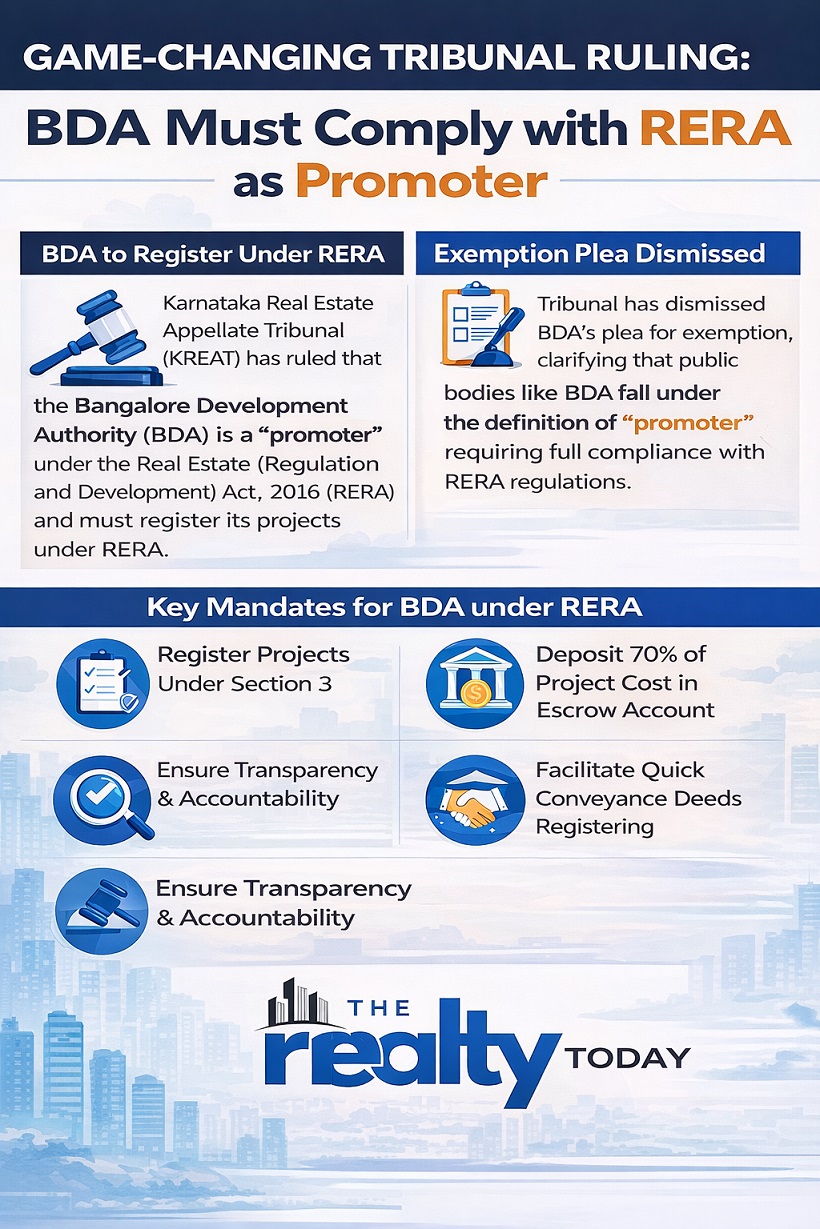
Tribunal Upholds KRERA’s Order
Rejecting BDA’s claims, KREAT clarified that the definition of ‘promoter’ under RERA explicitly includes development authorities and other public bodies that construct buildings or develop plots for sale.
Key observations from the tribunal order:
- The RERA definition of ‘promoter’ is inclusive, covering public bodies developing plots or apartments on land owned or allocated by the government.
- Applicability of RERA is uniform for both private and public developers, ensuring accountability and transparency across the real estate sector.
- Agreements between BDA and allottees are legally binding, similar to private developers’ sale or construction agreements. Both parties must comply with possession timelines and other conditions.
The tribunal highlighted, “In the case of private developers, the relationship between the allottee and the promoter is governed by legally binding agreements, such as the agreement of sale or construction agreement, which specify the project completion timeline and the compensation payable in case of delays. Similarly, the BDA enters into lease-cum-sale agreements with allottees, and both parties are required to comply with the terms related to possession timelines and other conditions outlined in these agreements. These conditions have to be complied with mutually and reciprocally by both the BDA and the allottees.”
Implications for BDA Projects
Following the ruling, BDA must register the Nadaprabhu Kempegowda Layout project under Section 3 of the RERA Act and comply with Sections 11(2) and 18, which define the functions and duties of promoters. This ensures that BDA projects are subject to the same level of scrutiny, accountability, and transparency as private sector developments.
Legal experts see the decision as a milestone in Bengaluru’s real estate regulation, noting that it clarifies that statutory authorities cannot claim immunity from RERA merely because they operate under separate legal frameworks.
The decision could also set a precedent for other state development authorities, signaling that public bodies engaging in the sale of plots or apartments may need to fully comply with RERA, aligning public and private sector obligations in real estate development.
As Bengaluru’s real estate market continues to expand, this ruling reinforces the importance of regulatory compliance and consumer protection, ensuring that statutory authorities are held to the same standards as private developers in promoting transparency, accountability, and timely project execution.







.png)