The Yamuna Expressway Industrial Development Authority (YEIDA) has lined up investment proposals worth Rs. 36,867 crore for Uttar Pradesh’s fifth Ground Breaking Ceremony (GBC 5.0). The proposed projects are expected to generate 53,032 jobs across sectors including electronics, automobile manufacturing, renewable energy, medical devices and food processing. The investment pipeline exceeds the state government's target of Rs. 30,000 crore for YEIDA by nearly 23%. Meanwhile, residential property prices along the Yamuna Expressway have recorded substantial growth in recent years.
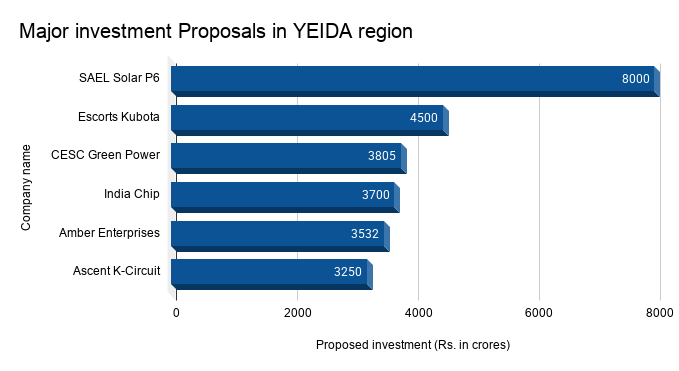
Major Industrial Investment Proposals in YEIDA Region
SAEL Solar P6 has suggested investing Rs. 8,000 crore in solar energy, with an estimated employment potential of around 5,000 people.
Escorts Kubota has proposed an investment of Rs. 4,500 crore. Other major proposals include Rs. 3,805 crore from CESC Green Power, Rs. 3,700 crore from India Chip, a joint venture between HCL Group and Foxconn, Rs. 3,532 crore from Amber Enterprises and Rs. 3,250 crore from Ascent-K Circuit.
Together, these six proposals account for nearly 73% of the total investment pipeline.
In October 2026, YEIDA issued letters of intent to 25 companies for industrial projects spread across nearly 95 acres. The proposed developments involve investments of approximately Rs. 3,155 crore and are expected to generate over 9,000 jobs.
Of these 25 companies, 11 are expected to establish units in Sector 8D, eight in Sector 29 and three in Sector 24, two in Sector 6 and one in Sector 28.
The projects will come up across designated industrial areas, including the Medical Devices Park, Pharma Park, Apparel Park and Handicraft Park.
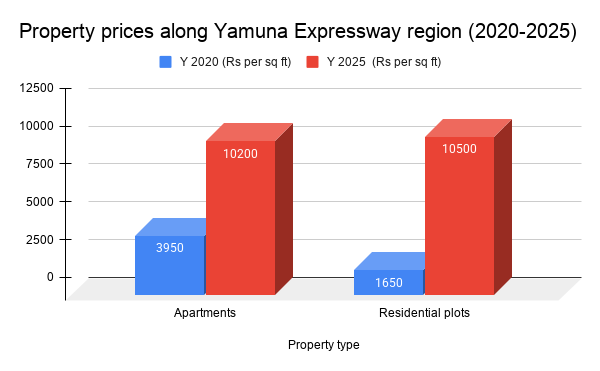
Apartment Prices Along Yamuna Expressway Rose 158% Between 2020 and 2025
The expansion of industrial and transport infrastructure has coincided with rising residential property values along the corridor.
According to the RealX Stats report released by property consultancy InvestoXpert in September 2025, average apartment prices along the Yamuna Expressway increased from Rs. 3,950 per sq. ft. in 2020 to Rs. 10,200 per sq. ft. in 2025, registering an increase of 158%.
Residential plots recorded considerably higher appreciation during the same period. Average plot prices increased from Rs. 1,650 per sq. ft. to Rs. 10,500 per sq. ft., representing a rise of approximately 536%. In 2025 alone, apartment prices increased by 7.37% year-on-year, while plot prices recorded annual growth of 12.31%.
The proposed industrial developments could introduce an additional source of housing demand as companies establish manufacturing facilities and recruit employees in the region.
While plotted developments have attracted buyers anticipating long-term land appreciation, the arrival of a permanent workforce could also create demand for apartments, rental housing and residential developments catering to different income groups.
However, the extent of this demand will depend on the pace of industrial project implementation and the availability of supporting infrastructure around employment centres.
Noida International Airport and Regional Real Estate Demand
Noida International Airport which commenced commercial flight operations in June 2026, which is adding a new transport link to the Yamuna Expressway region
The Yamuna Expressway links Greater Noida to Agra and the Noida-Greater Noida Expressway links to further existing residential and business areas in the NCR.
The airport has a current cargo throughput capacity of 200,000 metric tonnes per year. Its logistics warehouse area will cater for logistics and online businesses and will further enhance the business park and logistics sector prospects in the region.
In addition to business, attractions such as the Buddh International Circuit and the planned International Film City may also boost the hotel, retail and business property sectors in the area.
Demand for housing will largely be affected by how quickly industrial projects are realised and the jobs they create. Access to good quality education, health care, local shopping and efficient transport links will also affect people’s decision to either live locally to where they work or to continue living in more established housing areas within the NCR.