

India Retail Leasing 2025: Key Highlights
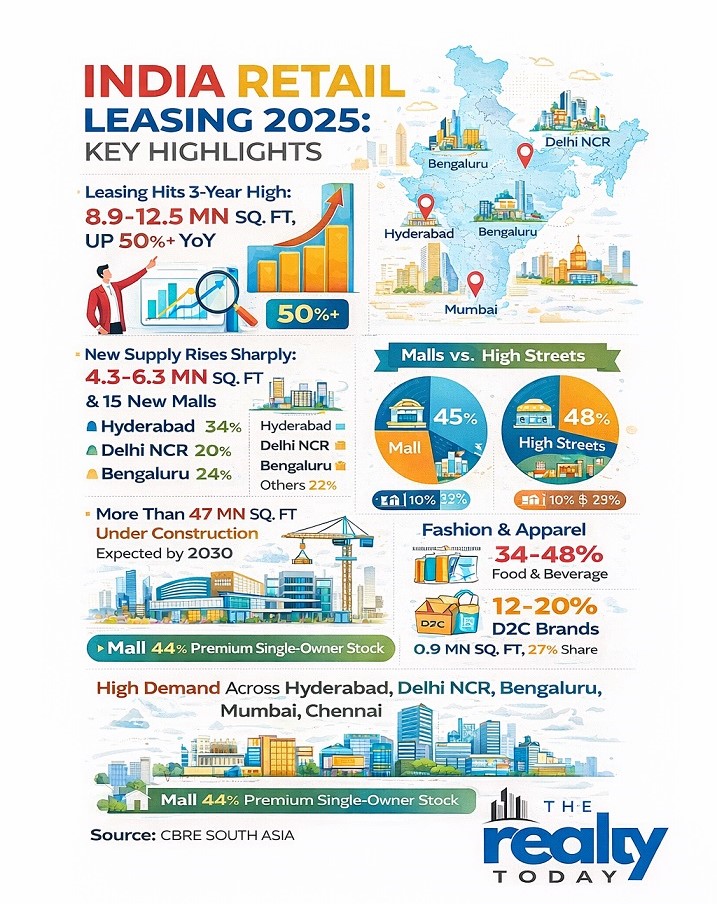
- Retail leasing hits a three-year high, reaching 8.9–12.5 mn sq. ft, up 50%+ YoY.
- New retail supply rises sharply to 4.3–6.3 mn sq. ft, led by Hyderabad, with 15 new malls opening across key cities.
- Hyderabad, Delhi NCR and Bengaluru together dominate leasing absorption, accounting for the bulk of demand.
- Malls and high streets share demand evenly, contributing ~45% and ~48% of total leasing respectively.
- Fashion, F&B and D2C brands drive expansion, while 47+ mn sq. ft of retail space under construction signals strong long-term growth.
India’s retail leasing rose sharply in 2025, reaching between 8.9 million and 12.5 million sq. ft, the highest level in three years, as per report by CBRE South Asia. This marked a year-on-year increase of over 50% compared to 2024, supported by higher retail completions and continued store expansion by brands across major cities.
Supply Sees Sharp Increase
Fresh retail supply during the year ranged between 4.3 million and 6.3 million sq. ft. Hyderabad accounted for more than half of the new additions, followed by Mumbai and Delhi NCR. Delhi NCR, Hyderabad and Mumbai together saw the opening of 15 new shopping malls in 2025. By the end of the year, mall stock across the top seven cities stood close to 92 million sq. ft. In the second half of 2025, around 2.1 million sq. ft of new space became operational, while leasing absorption reached nearly 5.6 million sq. ft.
Hyderabad, Delhi NCR and Bengaluru Lead Leasing
Leasing activity was led by Hyderabad, Delhi NCR and Bengaluru. One estimate showed Delhi NCR and Bengaluru accounting for 24% each of total leasing, followed by Hyderabad at 23%. Another placed Hyderabad at the top with a 34% share, followed by Delhi NCR at 20% and Chennai at 16%. Mumbai contributed about 17%, while Chennai, Kolkata and Pune recorded lower shares due to limited new supply.
Malls and High Streets Account for Most Leasing
Shopping malls accounted for about 45% of total leasing, while high streets captured around 48%. In Delhi NCR and Hyderabad, malls were the preferred format, while high-street locations dominated leasing in Bengaluru.
Mr. Ankit Sharma, SVP-Leasing, Elan Group said, “With India crossing nearly 9 million square feet of leasing in 2025 and a 45 percent rise in the July to September quarter alone to 2.41 million square feet, the strength of the retail leasing market is clearly reflected in the numbers and demand has remained strong across both malls and high streets. Malls are benefiting from well-planned retail formats, fresh supply and growing interest in larger, while established high streets continue to attract brands due to their steady footfall, visibility and close proximity to residential catchments. Brands are building their presence across both formats, indicating a stable and mature phase of expansion for the retail real estate market. This balanced performance shows that the growth of physical retail is becoming more structured and evenly spread.”
Fashion, F&B and Jewellery Drive Demand
Fashion and apparel remained the largest category, accounting for 34% to 48% of total leasing. Store launches included sustainable labels, streetwear, ethnic wear, athleisure, luxury and D2C brands. Food and beverage (F&B) was the second-largest contributor, with a 12% to 20% share. Brands preferred large-format outlets in malls and prominent high-street locations. Jewellery followed with an 8% share, supported by expansion from lab-grown diamond brands.
Mr. Girish Kamble, CEO- West, Tribeca Developers, said, “India’s retail sector continues to demonstrate strong momentum, driven by robust leasing activity and sustained expansion from both domestic and global brands. What’s especially encouraging is the growing demand for modern, branded, and experiential retail environments - formats that elevate convenience, curation, and consumer engagement.
We believe the market is now firmly ready for branded retail and premium commercial destinations, particularly in the luxury segment. This aligns strongly with our own development philosophy at Tribeca, where we are creating next-generation commercial spaces designed for global brands, aspirational consumers, and the future of urban retail. The shift is clear: India is ready - and rising - to embrace world-class retail real estate.”
D2C Brands Increase Offline Presence
D2C brands contributed about 0.9 million sq. ft of total leasing and recorded 48% year-on-year growth. Another estimate showed D2C brands accounting for 27% of total leasing in 2025.
Institutional-Grade Mall Stock
Institutionally owned or premium single-owner malls account for about 44% of total mall stock across the top seven cities.
Technology and Entertainment Zones
Retailers used tools such as virtual try-ons, generative styling platforms and predictive inventory models. Entertainment zones in malls used formats such as edutainment, virtual reality and RFID-based loyalty systems. These zones enabled the use of large interior spaces and supported higher rentals for adjoining F&B outlets, along with longer lease tenures.
Retail Space Under Construction
More than 47 million sq. ft of retail space is under construction and is expected to be operational by 2030. Nearly 20 million sq. ft of this upcoming supply is classified as premium-grade.




.png)