
Tier-2 Housing Market 2025: Sales Dip & Premiumisation Trend
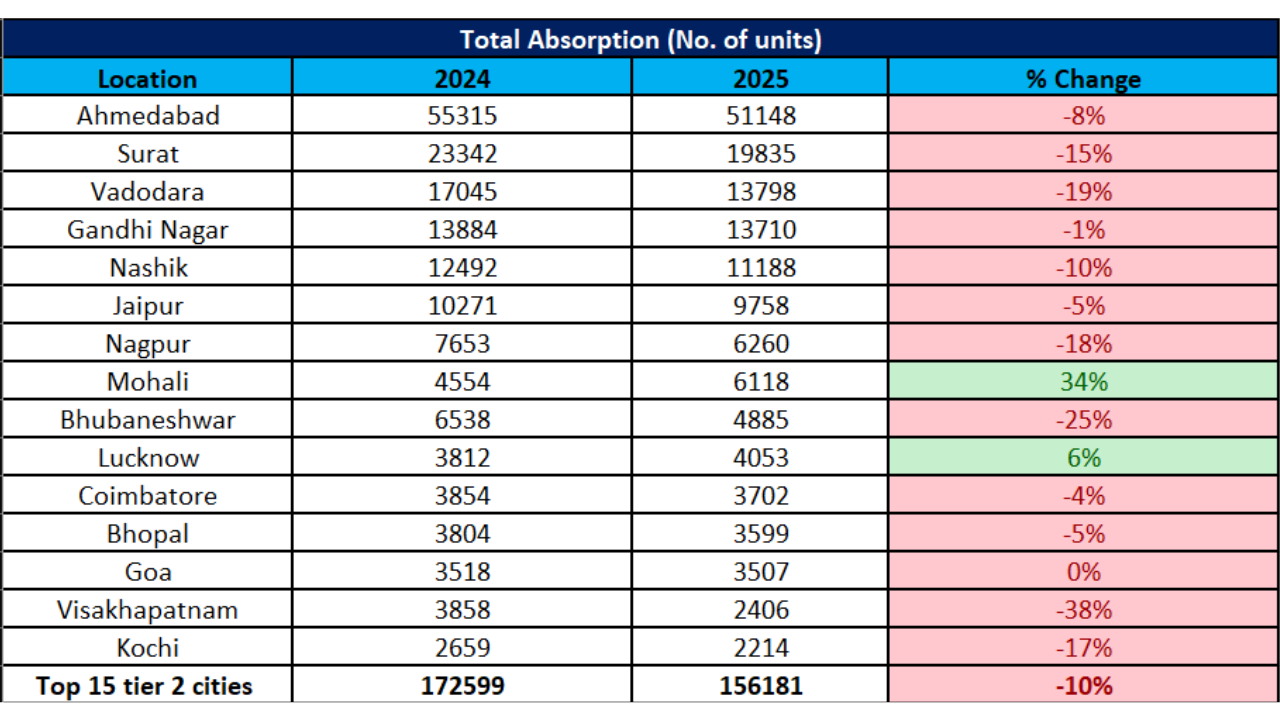
- Overall Decline in Sales & Launches – Housing sales fell 10% YoY to 1,56,181 units; new launches declined 6% to 1,36,243 units, while total sales value remained flat at ₹1.48 lakh crore.
- Shift to Higher-Value Homes – Homes under ₹1 crore dropped 15%, while above ₹1 crore grew 9%, indicating rising premiumisation in tier-2 cities.
- City-Wise Performance – Growth in Mohali (+34%) and Lucknow (+6%), steepest declines in Visakhapatnam (-38%) and Bhubaneshwar (-25%); Gujarat cities dominate sales (63%), Ahmedabad alone 33%.
- Supply Trends & Concentration – Most cities saw decline in launches; Mohali (+108%) and Bhopal (+66%) grew, Gujarat accounted for 64% of total new launches.
- Key Drivers & Risks – Shrinking affordable housing, rising land/construction costs, and government-led urban development push prices up; affordability pressures may slow absorption further
With housing sales value remaining flat at ₹1.48 lakh crore across the top 15 tier-2 cities in 2025, sales volumes declined 10% YoY to 1,56,181 units, reflecting rising housing prices and increasing premiumisation, according to NSE-listed real estate data analytics firm PropEquity.
Except for Mohali and Lucknow, which saw growth in sales volume of 34% and 6% YoY respectively, the other 13 cities saw a decline up to 38% with Visakhapatnam witnessing the maximum fall.
The report further added the growing shift towards high-ticket housing can be ascertained from the fact that homes priced under Rs 1 crore saw 15% YoY decline in volumes in 2025 with its share dipping to 72% from 77% in 2024. Similarly, homes priced above ₹1 crore witnessed 9% growth in sales with its share rising to 28% from 23% in 2024.
Going forward, beginning 2026, Ahmedabad can be regarded as a tier-1 city, having surpassed several established tier-1 markets in both housing launches and absorption. With its scale of development and depth of demand, the city now rightfully merits inclusion among India’s tier-1 urban centres.
In absolute terms, the four cities of Gujarat, namely Ahmedabad, Gandhi Nagar, Vadodara and Surat, together accounted for 63% of the total sales in top 15 tier 2 cities, with Ahmedabad alone contributing 33% with 51,148 units sold.
Samir Jasuja, Founder & CEO of PropEquity, said, “The slowdown in housing sales over the past two years is largely due to a shrinking supply of homes priced below ₹1 crore-a segment that has traditionally driven demand in tier-2 cities. Rising land and construction costs, along with changing buyer aspirations, are pushing new launches into higher price brackets. As a result, tier-2 markets are increasingly mirroring tier-1 cities, where volumes are declining even as prices continue to rise.”
Jasuja added, "Government focus on tier-2 cities—through enhanced urban development, improved connectivity, and the creation of industrial corridors and manufacturing hubs-has driven sustained price appreciation. This has pushed even average housing units in many tier-2 markets beyond the ₹1 crore mark, leading to slower absorption. Going forward, this trend could be a cause for concern, as affordability pressures begin to impact not just premium segments but also affordable and mid-income housing in these cities."
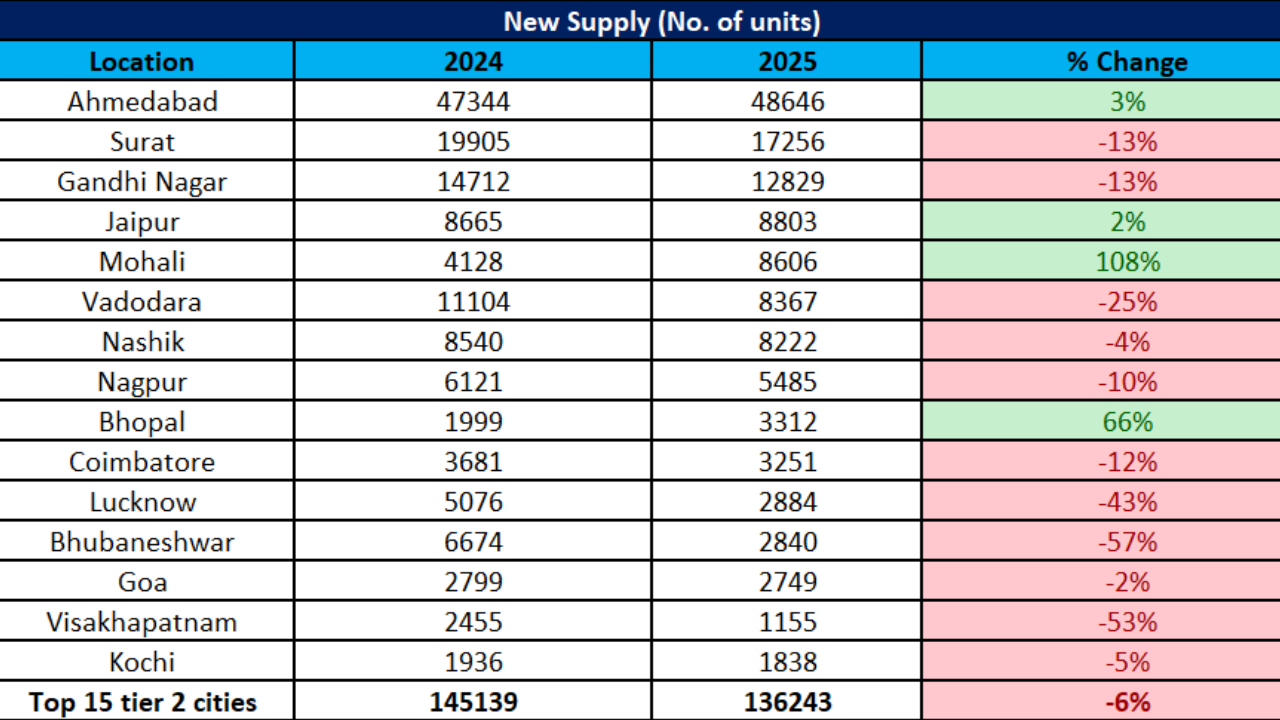
New supply across the top 15 tier-2 cities declined by 6% to 1,36,243 units in 2025, down from 1,45,139 units in 2024. The contraction was seen across price segments, with supply of homes priced under ₹1 crore declining by 5%, and those above ₹1 crore falling by 8%.
Mohali (108%), Bhopal (66%), Ahmedabad (3%) and Jaipur (2%) saw growth in new launches while the other 11 cities saw a decline of up to 57% with Bhubaneshwar witnessing the steepest decline.
The four cities of Gujarat accounted for 64% of the total launches in 2025.



.png)