India’s urban transition is gaining momentum, with over 36% of the population now residing in cities. Once known primarily as a land of villages, the country is experiencing rapid demographic shifts. Key drivers for this expansion include migration fuelled by employment opportunities, consequently leading to rising demand of real estate and infrastructure activities within expanding city precincts. This is expanding the city’s footprint from core to peri-urban areas. These emerging corridors are being shaped by infrastructure upgrades, investment-friendly housing options and enhanced intra-city connectivity.
Colliers’ latest report, ‘Emerging Micro-Markets Driving Growth in NCR’s Investment Landscape: Gurugram’s Sohna Micro-Market Rising as a Preferred Destination’, captures the evolution of the National Capital Region and the formation of satellite cities, where infrastructure expansion and economic activities are unlocking demand and development potential for real estate in emerging micro-markets, comprising of zones flanking Millennium City ‘Gurugram’.
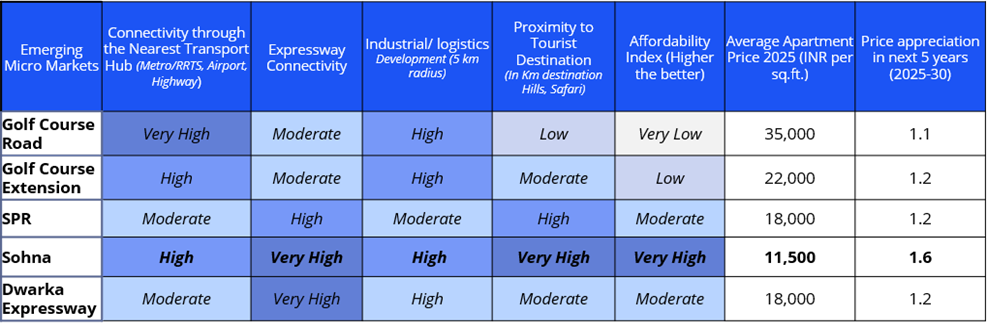
Source: Colliers
Note: Ranking scale across all the parameters are done based on market research, authorized new articles for proposed and existing development and average apartment price are derived based on current market rates and listing from primary and secondary research.
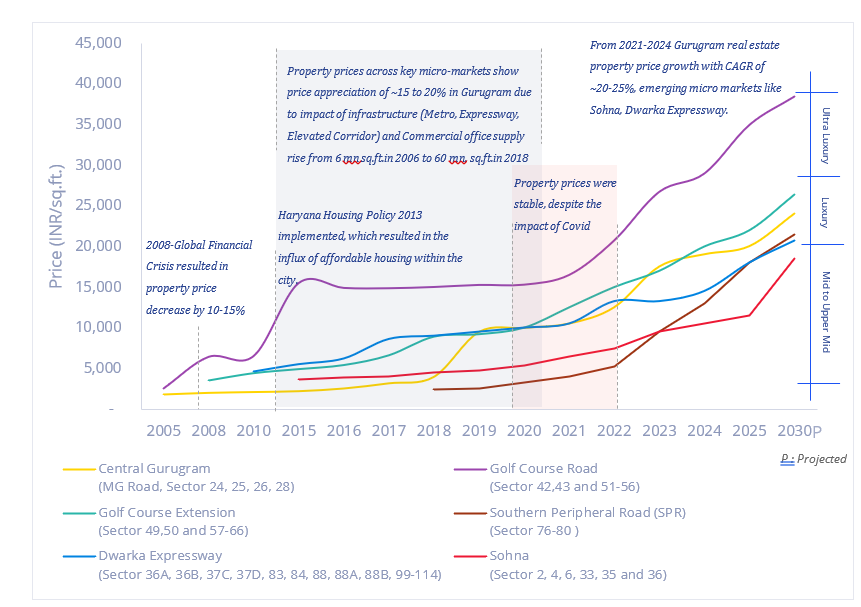
Within the National Capital Region (NCR), urbanization has been most pronounced in satellite cities such as Delhi, Gurugram, Noida, Faridabad and Ghaziabad. Among these, Gurugram has emerged as a leading hub, driven by strong in-migration of professionals and entrepreneurs, large-scale infrastructure upgrades, and luxury residential development. Its transformation began with the establishment of Maruti Suzuki in 1982, gained momentum with the first Gurugram Master Plan 2031 released in 2007, further accelerated by IT/Business Parks, Yellow line Metro expansion, Expressway connectivity and industrial development. With land availability in central Gurugram becoming saturated and commercial hubs such as Cyber City, Golf Course Road, Dwarka Expressway reaching maturity with respect to land area and price, the city’s urban footprint has steadily moved towards South of Gurugram. Which has led to the rise of new micro-markets that are witnessing growing demand for real estate activity.
Source: Colliers
South of Gurugram has emerged as the city’s new frontier for development, with SPR and Golf Course Extension Road and Sohna acting as key growth corridors. Out of which Sohna stands out as a policy- driven Sohna Master Plan 2031 laying the foundation for integrated residential, commercial and industrial development. While Golf Course Extension and SPR corridors cater to premium and upper-mid housing, Sohna is steadily evolving as a complementary hub with its own real estate momentum, shaped by affordable-to-upper mid housing, industrial estates and rapidly improving infrastructure.
Growth Factors of Emerging Micro-Markets
- Sohna is just a 40-minute drive from Gurugram’s key employment hubs like Cyber Hub and Golf Course Road and less than an hour from IGI Airport.
- In the last five years, Sohna has emerged as a preferred residential hub, evolving from affordable housing to mid and upper mid-segment developments, driven by infrastructure growth and strong developer activity - offering ‘right-priced, right-sized’ homes and long-term returns on investment.
- It has recorded a graded residential apartment supply of ~8,200 housing units, with only 45% available in the primary market for sale, highlighting steady demand and absorption rate.
- Residential prices along Sohna Expressway range between INR 10,000–12,000 per sq. ft. (BUA) which is 2.3 X more affordable than other micro-markets of Gurugram.
- The presence of the 1,500+ acre IMT Sohna, buoyed by over 10,000+cr. of PPP investments, quick connectivity of Sohna to the Delhi Mumbai Expressway and evolving presence of manufacturing giants are further accelerating Sohna’s growth as a credible employment-generating micro-market and resultant premium and luxury housing location.
- Sohna is known for its well-established social and tourist infrastructure, which is set to be further enhanced by the upcoming 10,000-acre jungle safari project.
"Delhi NCR’s real estate landscape is gaining momentum, driven by policy support, infrastructure upgrades and robust real estate activity. As expanding cities unlock new areas to cater to growing demand, micro-markets located proximity to city’s business districts are emerging as attractive investment destinations, offering strong potential for capital appreciation. “Sohna, as one of the emerging micro-markets in South of Gurugram, is anticipated to witness price appreciation up to 1.6X by 2030, benefitting both homebuyers and investors,” says Swapnil Anil, Managing Director, Advisory Services, Colliers India.
As Gurugram continues to expand beyond its traditional commercial corridors, the city’s southern belt led by Sohna is poised to play a pivotal role in shaping NCR’s next phase of urban growth. With large-scale infrastructure projects nearing completion, proactive policy frameworks, and balanced real estate pricing, Sohna is expected to witness sustained investment traction from both end-users and institutional investors. Over the next five years, integrated development, last-mile connectivity, and economic diversification will be key catalysts driving this micro-market’s transformation into a self-sustaining urban ecosystem, reinforcing Gurugram’s position as the leading growth engine of the NCR.