

The Ministry of Housing and Urban Affairs (MoHUA) has ordered each Real Estate Regulatory Authority of state, the RERA, to provide four months of extension for registration and completion deadlines of real estate projects which are eligible and facing delays because of the war situation in West Asia. This notice has been circulated to give some interim relief from the regulations that would delay the opening of the real estate development sites that have their delays in part due to disrupted supply chains. The advisory aims at allowing the developers time to overcome the current crisis Still they have to ensure that they do not dilute the provisions of the Real Estate (Regulation and Development) Act, 2016 (RERA).
Extension Based on Force Majeure Provisions Under RERA
The said advisory by the ministry comes after the issuance of Office Memorandum by the Ministry of Finance dated April 29, 2026, treating the ongoing West Asia situation as a "war" for the purpose of claiming force majeure in government contracts. Sections 6 and 7(3) of the RERA Act, 2016 were invoked by the housing ministry stating that registration of such projects could be extended in case of war and similar extraordinary circumstances.
Based on the claims submitted by the developers and industry bodies, the ministry states that due to the conflicts in West Asia, there were issues in the supply chain system in terms of shortage of building materials and increased freight costs and import delays.
Eligibility Criteria and General Orders Recommended for Extensions
The advisory recommends that the State RERAs should allow an extension in the validity period of registration along with extension in the completion periods for all such eligible projects where the original, revised or earlier extended date of completion falls on or after February 28, 2026. In order to cut down the procedural delays, the ministry has recommended that the state regulatory authorities issue a general order for extension of the period.
In this regard, the ministry has invoked the provisions of Section 7(3) of the RERA Act, through which the Authority has been authorized not only to revoke project registrations, but if circumstances so warrant, it may decide not to revoke and instead issue conditions to keep the registration alive as long as these are to help with allottees. The advisory is directed at making sure that the disruptions due to international factors do not push such projects into non-compliance just because developers themselves are not the cause of those disruptions.
Developers Welcome Relief Amid Supply Chain Challenges
Major bodies of the real estate sector, Sspecially CREDAI and NAREDCO, have applauded the action and expressed their opinion that it is a relief needed to assist developers in the face of global logistic disruptions and construction material supply issues. These organisations have mentioned that delays in the delivery of imported materials, higher input costs and uncertainties in foreign trade have led to the prolonging of project completion which in turn has given rise to delays of four months for the delivery of completed projects and given all these the delay for such projects would be a practical way to have an orderly completion of the projects while the regulations are followed at the same time.
Homebuyer Groups Raise Concerns Over Regulatory Relief
On contrary, the advisory has given way to sharp reactions from the homebuyer groups, which maintain that developers enjoy the luxury of a one-size-fits-all kind of regulatory help, whereas buyers who have been expecting delivery of their houses for many years have not been extended even a fraction of the protection that has been given to the developers.
The Forum for People's Collective Efforts (FPCE) claimed that this advisory indicates discrimination in treatment of developers and home buyers. FPCE observed that thousands of buyers are paying on home loan EMIs and house rent on monthly basis while they wait for their handoved to be delayed, and no blanket relief has been announced to protect their interest as HT. FPCE Pres. Upadhyay questioned the legal validity of this advise from the ministry, stating, 'Although the notification makes reference to Sections 6 and 7(3) of the RERA Act, it doesn't specify under what section does the Union ministry have the authority to direct all State RERA Authorities to provide blanket extension There is no war like situation in the country and no material has been produced to prove an outright scarcity of essential construction material.
FPCE Questions Applicability of Force Majeure Provision
If such a position is accepted, in the light of international scenario, that any foreign conflict forms a force majeure condition for every real estate project, then developers would be entitled for similar extensions, the moment, any foreign trouble erupts and disturbs world markets'. The homebuyers' body highlighted that while the project completion timelines are set by the developers themselves, several projects already have timelines of up to five years or more.
It reasoned that, given the duration involved, commercial risks are possible only on short term, and in such a case, delivery expectations should be reasonable enough to factor in supply chain disruptions and logistical hiccups. FPCE queried as to why, Beyond real estate, no other industry was looking to seek blanket regulatory comfort when none other than real estate claimed 'its contractual obligations cannot be honored because of the west Asia situation'.
Concerns Over Compensation Rights Under Section 18 of RERA
Developments under Section 18 of the RERA Act, which entitle homebuyers to compensation from developers for delays in the delivery of their flats, is one issue the homebuyers highlighted. As FPCE, although the government has moved swiftly to assist developers, a general advisory has still not been issued asking builders to directly adhere to Section 18 and financially compensate affected buyers. As a result, homebuyers carry out long judicial processes with RERA authorities and courts to enforce their statutory rights through the courts. The organisation also pointed out that this extension is the second major blanket measure following the lockdown period due to the pandemic and that the Centre has time and again come to developers' rescue while homebuyers were left in limbo to find out an individual solution to their problem after waiting for years for their possession.
Impact on Homebuyers and Project Delivery Timelines
This advisory could extend possession timelines for homebuyers by at least four months. Buyers who had planned to move into their homes, stop paying rent, or manage their finances based on earlier completion dates may now have to revise their plans. The delay could also increase their financial burden, as they may have to continue paying both rent and home loan EMIs.
Supply Chain Disruptions May Affect Housing Completions in 2026
Market experts suggest the geopolitical scenario is not likely to be very different and could continue affecting project execution throughout 2026. As per Anarock report, if the unrest in the Middle East continues for quite a long time the housing project delivery schedules will be severely affected in the form of the breakdown of supply chains and the increase in construction costs. In 2020, when the country was under lockdown due to the coronavirus, only 2.14 lakh homes were delivered against a target of 4.66 lakh homes. This shows how a major disruption can negatively affect housing completions.
The Mumbai, Pune and Bengaluru trio makes up almost 70% of the home completions expected in 2026 as per this report. So if the problem of the supply chain continues, these cities will be hit the most on delays. Around four months extension of the time period of completion of those eligible Projects whose scheduled completion date/s falls on or after February 28 2026 has been already announced by Telangana Real Estate Regulatory Authority ( TG - RERA ), who followed the guidance of the Centre. Similar notifications are anticipated from State RERAs of other states, in the next few weeks.
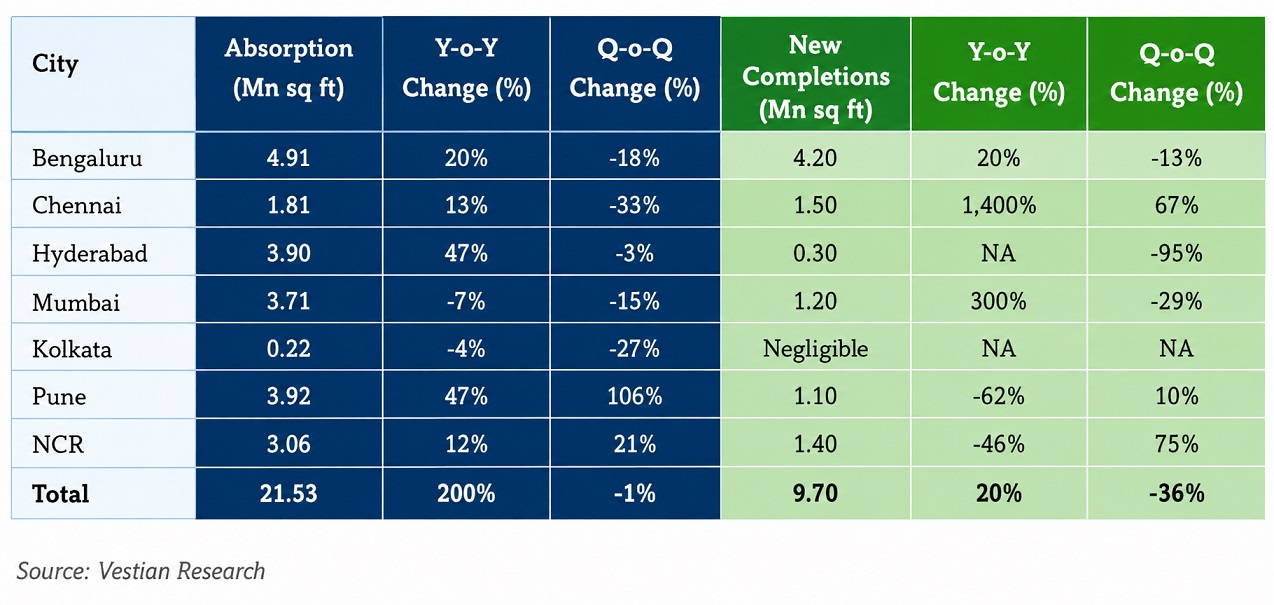
As per Vestian report, new completions declined sharply by 36% quarter-on-quarter to 9.7 Mn sq ft in Q1 2026, the lowest level recorded in the past four quarters. Bengaluru, Hyderabad, and Mumbai cities contributed significantly to this decline as developers adopted a cautious stance amid prevailing uncertainties. For instance, new completions contracted sharply in Hyderabad to a mere 0.3 Mn sq ft in Q1 2026 compared to 6.0 Mn sq ft in Q4 2025, registering a decline of 95%.
State RERAs Expected to Implement Extension Advisory
In fact, the advisory of the Center has been expectedly most effective in places where there are a huge number of housing projects. Only Uttar Pradesh has about 1199 projects that can take advantage of the extension of time, including 301 projects in Noida and 148 projects in Ghaziabad. The rest of the major real estate markets have probably similar types of relief provided.
Industry Expert Opinions

Rajan Yadav, Director, Roots Developers
"For builders, this regulatory intervention provides essential breathing room to manage severe material shortages and input cost inflation without compromising structural quality or execution standards. Forced delivery deadlines under supply crises often compel developers to cut corners to rush procurement.
A blanket timeline extension allows construction firms to recalibrate supply chains, secure crucial raw materials like steel and cement at reasonable rates and maintain proper site operations. This ultimately shifts the focus back to quality execution and orderly project delivery, protecting both long-term developer reputation and homebuyer trust.
This 4 month extension under RERA is a pragmatic, homebuyer-friendly move. For them it means fewer forced litigations, reduced risk of project abandonment, and a higher likelihood of eventual possession rather than prolonged uncertainty.
However, it is advisable for buyers to stay vigilant, track revised completion dates on RERA portals, and ensure developers use this window genuinely for construction completion and not as a blanket excuse for delays. Transparency and regular updates from builders will be key in maintaining buyer confidence during this extended period."

Rishabh Periwal, Senior Vice President, Pioneer Urban Land and Infrastructure Ltd.
"This advisory is a crucial legal and financial lifeline for developers navigating severe external supply disruptions. By recognising these global supply shocks, regulators remove the immediate threat of unfair penalties and litigations for delays completely outside a builder's control.
Crucially, introducing a single common order eliminates bureaucratic hurdles and tedious project-by-project compliance filing. This uniform statutory relief allows developers to maintain RERA compliance, stabilising project balance sheets, and focus capital on completion rather than legal defence, ensuring the real estate industry remains resilient without penalising proactive builders.
For homebuyers, this regulatory framework is a double-edged sword that prioritises long-term project viability over short term possession dates. While a four month delay creates immediate inconvenience by forcing buyers to manage extended rent or delays in move-ins, it shields them from far worse alternatives of abandoned projects, compromised project quality, and developer insolvency under severe global material shortages.
By legalising this timeline cushioned under RERA's force majeure provisions, the government ensures developers can finish homes properly without cutting corners, giving buyers seamless delivery of a quality asset rather than a rushed, litigated project."

Sudeep Bhatt, Director – Strategy, Whiteland
"The Ministry of Housing & Urban Affairs' advisory is a timely and pragmatic step that acknowledges the impact of extraordinary global events on project execution.
Recognising war under the Force Majeure framework provides much-needed regulatory clarity while safeguarding the interests of homebuyers and ensuring that customers are protected from unintended implications arising from circumstances beyond the control of developers.
It reinforces RERA's objective of creating a fair, transparent and balanced ecosystem, strengthening trust, accountability and long-term confidence in India's real estate sector."
Balancing Developer Relief and Homebuyer Protection
The recent announcement demonstrates the government's initiative to safeguard large scale infrastructure projects in the country from being affected by unexpected international happenings. Developers But accept the extension of timelines as an inevitability so that the construction work does not halt in the face of supply chain bottlenecks. Yet again, this move throws up the issue of the tension between providing relief to the construction sector regulators and ensuring that homebuyers are adequately protected through stringent housing laws. With increasing number of State Real Estate Regulatory Authorities putting this order into effect, we can expect more and more legal aspects and project delivery issues, consumers' rights, as well as confidence in the market will be intensely monitored in the near future.