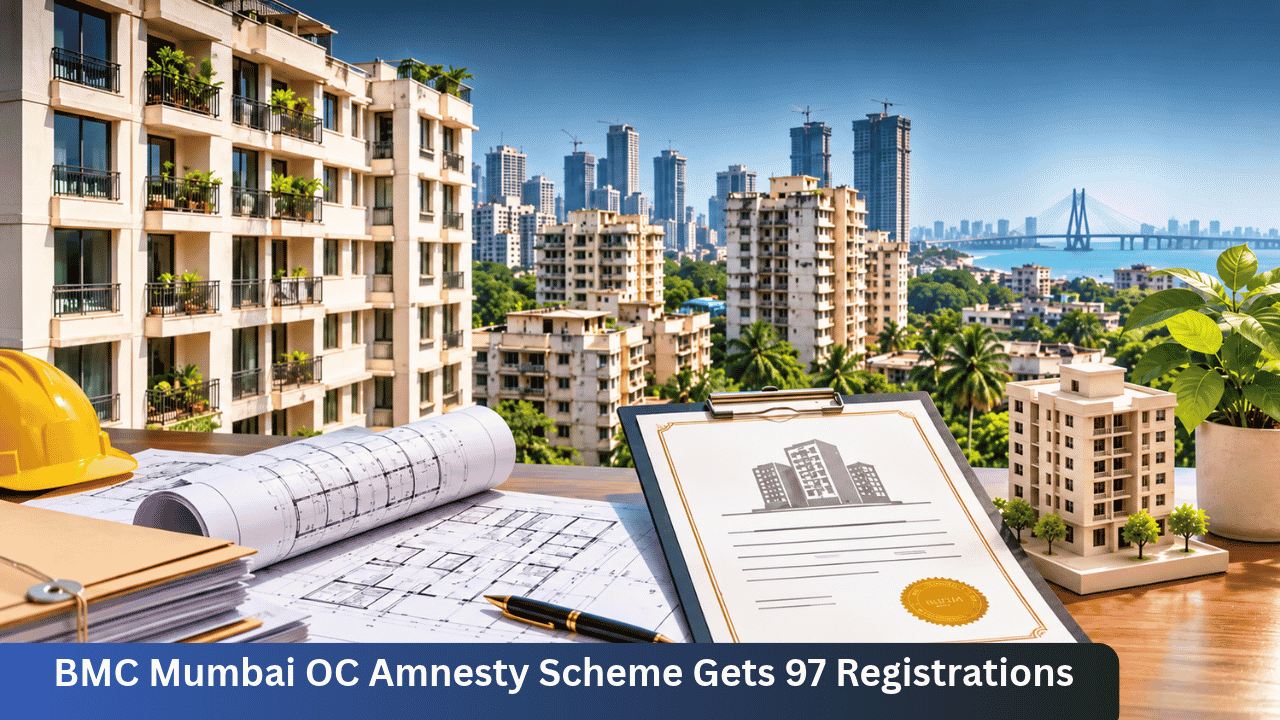
The Brihanmumbai Municipal Corporation (BMC) has received a total of 97 registrations under its Occupancy Certificate (OC) amnesty scheme for Mumbai buildings. However, only four of them have submitted all the necessary documents. To encourage more housing societies to apply, the civic body is planning to organise awareness programmes in the city.
The scheme was launched on September 9, 2026, under which eligible housing societies and certain other establishments can get their pending OCs at concessional rates of penalty and charges on eligible properties.
Only Four Applicants Submit Complete Documents
Of the 97 applicants who registered their interest in the scheme, only four have submitted applications with the complete set of documents. These four applications are now due to be processed by the civic body.
The BMC will organise awareness camps in different parts of the city in collaboration with the National Real Estate Development Council (NAREDCO) and Practising Engineers, Architects and Town Planners Association (PEATA).
BMC officials said that documentation requirements and clearances, including Fire NOCs, have posed challenges for applicants. The civic body has also introduced special provisions in its AutoDCR system, including allowing certain enclosures wherever possible.
The awareness programmes are aimed to explain the scheme's conditions and help housing societies understand the documents they need to submit.
Which Buildings Can Apply for the Scheme?
The scheme covers eligible residential buildings, hospitals and schools that were occupied before November 17, 2016, and have the necessary approvals, including a valid Intimation of Disapproval (IOD), approved plans and Commencement Certificate (CC).
Residential units will generally be required to have a maximum carpet area of 80sq metres to qualify for the financial concessions. Commercial units within predominantly residential buildings may be considered for an OC, however they will not qualify for the financial concessions. A building will be considered as predominantly residential if it is used for residential purposes for more than 50%. An NOC from the original developer or applicant is also required.
The scheme is not intended to regularise illegal construction. Buildings must meet the eligibility conditions and comply with the applicable planning and safety requirements. Applicants may also need to provide clearances such as fire-safety approvals, depending on the property.
An Occupation Certificate is issued by the local authority after a building is assessed against the approved plans and relevant requirements. It confirms that the premises can be occupied for their intended use. The absence of an OC can create difficulties for residents when dealing with property transactions and financial institutions.
Penalty Waiver Offered for the First Six Months
The BMC's scheme provides a 100% waiver of the applicable penalty for the first six months from its launch. The BMC's Development Plan department has said that the penalty has been reduced to zero during this initial period to encourage eligible societies to apply.
Alongside housing societies, the scheme also covers eligible hospitals and schools. Shops and commercial units in predominantly residential buildings may be considered for an OC, but are not eligible for the financial concessions.
The civic body has made provisions in its AutoDCR system, including allowing certain enclosures wherever possible. Applicants must still meet the applicable building and safety requirements. The penalty waiver does not mean that all deviations or unauthorised construction will be accepted.
BMC Seeks Wider Participation From Housing Societies
The BMC estimates that around 25,000 residential buildings in Mumbai, housing nearly 12 lakh people, do not have Occupation Certificates. However, the current scheme's eligibility conditions are expected to cover around 5,000 housing societies within the city's limits. Not every building without an OC can apply or qualify.
The civic body's awareness programmes will therefore be important in reaching societies that meet the conditions but have not yet completed the application process. The four complete applications will be among the first cases to move forward under the scheme.