

The Maharashtra Real Estate Regulatory Authority [MahaRERA], has managed to recover around ₹269 crore for the consumers in the home buying industry in the state since its formation in May 2017, thus indicating the increasing importance of the regulatory body in inculcating a sense of responsibility in the home buying industry in the state. According to the government statistics, a sum of ₹268.87 crore was recovered by the MahaRERA along with the district collectors.
The amount recovered is based on complaints filed by homebuyers against developers for causes such as delay, non-adherence to agreements, or dishonoring refund demands. Over the eight and a half-year period, MahaRERA has passed orders worth ₹792 crores in recovery in favor of 1,291 complainants. Though a major portion of this amount has already been recovered, recovery proceedings worth ₹103 crores are pending due to cases before the National Company Law Tribunal (NCLT).
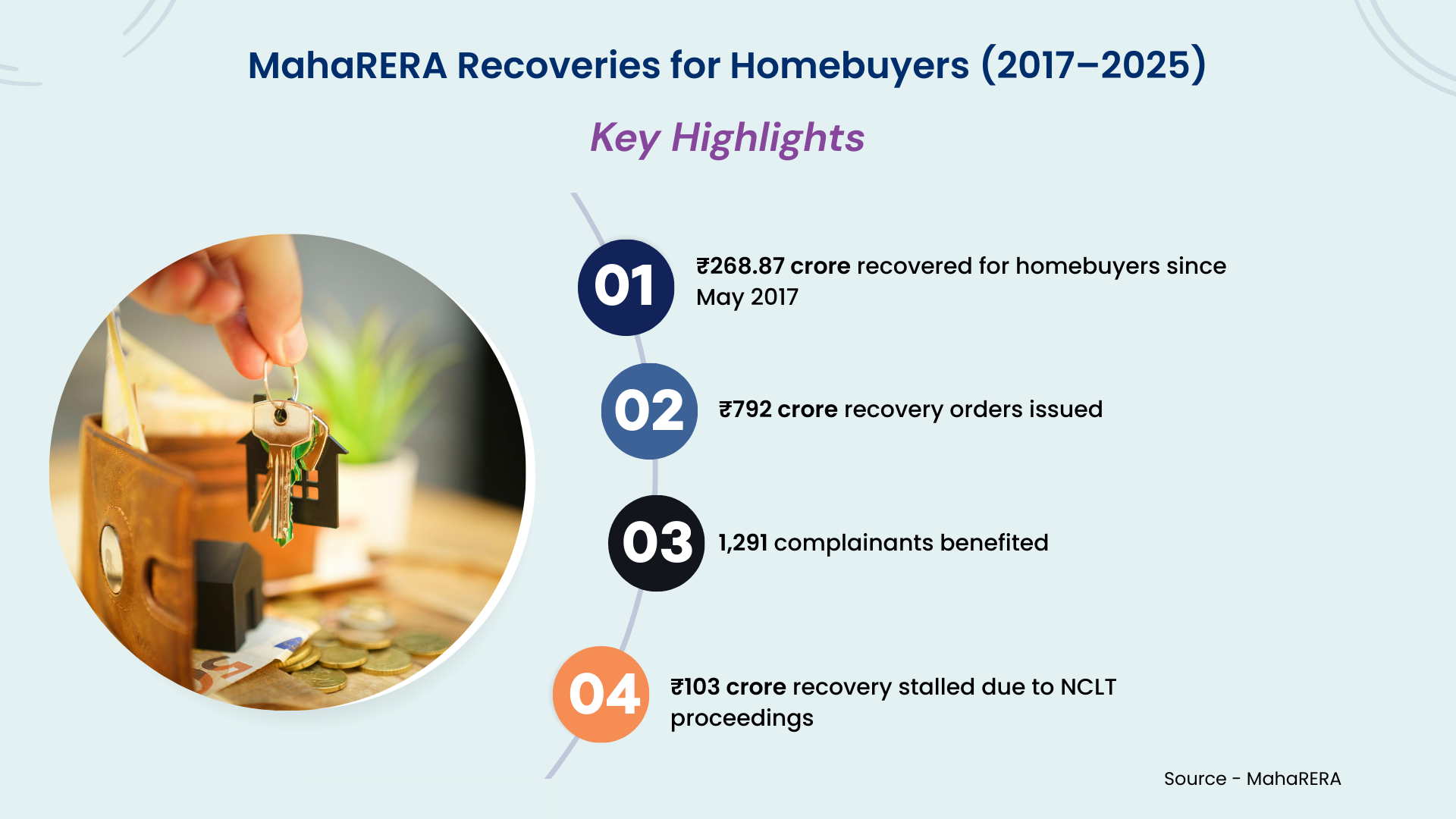
Officials said these stalled cases are largely linked to developers undergoing insolvency proceedings, where the NCLT has imposed restrictions on the execution of recovery actions. As a result, even though MahaRERA has passed orders in favour of homebuyers, the enforcement of those orders is subject to the outcome of insolvency processes, often delaying relief to affected buyers.
It becomes more interesting because a district-wise breakup of the recovered amount underlines an uneven pace of enforcement across regions. The top contributor is the Mumbai Suburban district with recoveries of ₹112 crore against a due amount total of ₹352 crore. That reflects both the high concentration of real estate projects in the region and the large number of disputes involving delayed or stalled developments.
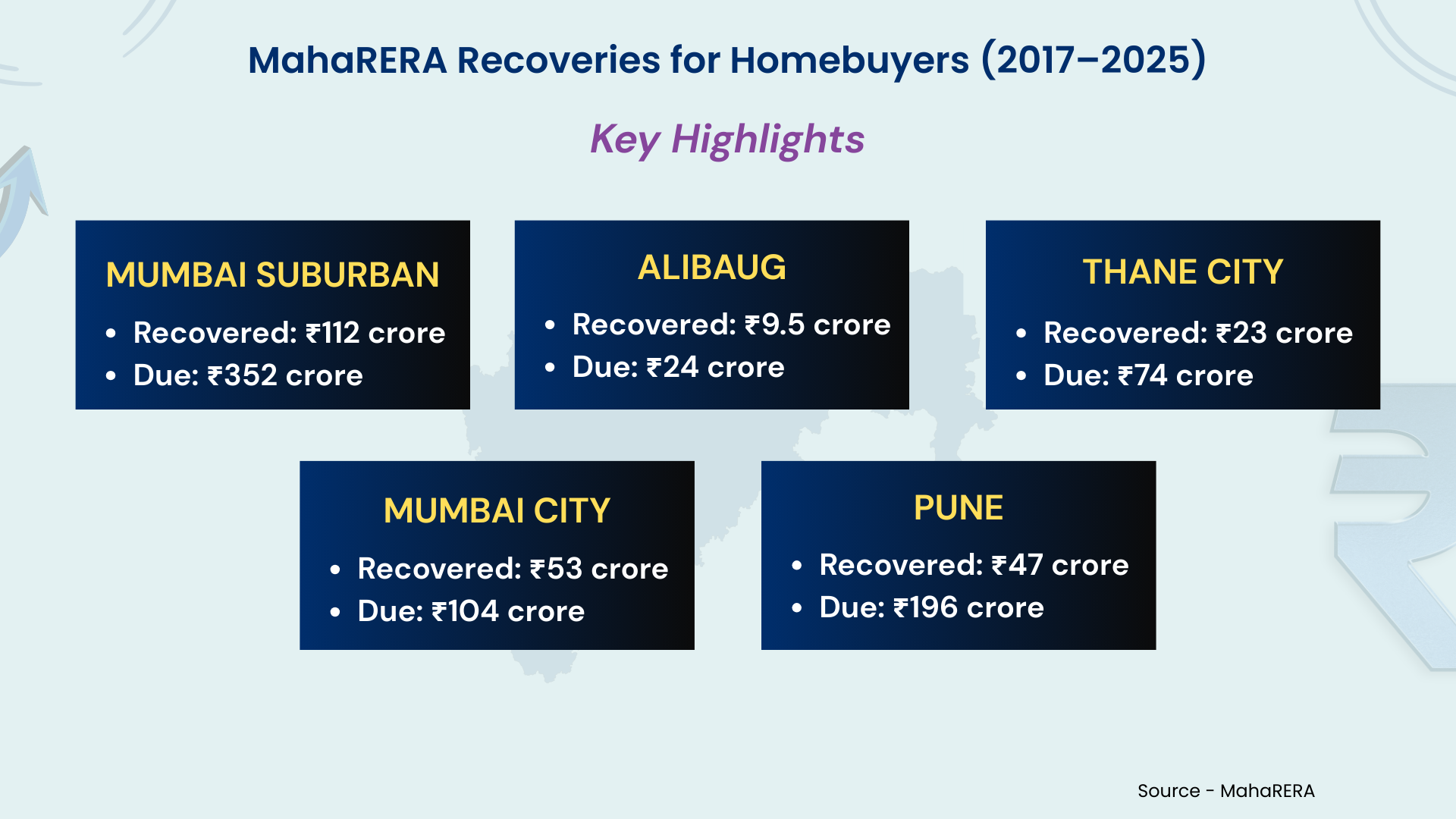
This is followed by recoveries made by Mumbai City, which has recovered ₹53 crore out of ₹104 crore due. Pune, one of Maharashtra's largest residential markets, saw recoveries of ₹47 crore against dues of ₹196 crore. Thane City recorded recoveries of ₹23 crore out of ₹74 crore, while Alibaug has recovered ₹9.5 crore from a due amount of ₹24 crore.
On the other hand, a few smaller jurisdictions have been able to successfully recover the entire amount of compensation awarded to their respective applicants by MahaRERA. Recoveries of the total amount of compensation have been successfully achieved to the tune of ₹4.90 crores in Nashik, ₹72 lakhs in Sindhudurg, ₹12 lakhs in Solapur, and ₹9 lakhs in Chandrapur.
MahaRERA operates as a quasi-judicial authority under the Real Estate (Regulation and Development) Act, 2016. Its actual job involves deciding cases for dispute between buyers and builders, passing directions for a refund or compensation, and passing orders for recovery in case of non-compliance by builders. But the recovery cases cannot be initiated by the concerned MahaRERA.
The enforcement of the recovery order has to be done by the revenue machinery of the state as a whole and is essentially the responsibility of district collectors. The recovery warrant delivered by MahaRERA has to be transmitted to the district collector concerned. As per Section 40(1) of the RERA Act, district collectors have been provided the mechanism to recover the amount as arrears of land revenue as provided by the provision of the Maharashtra Land Revenue Code.
Experts say that although the statistics represent the effectiveness of the regulator, there is, however, a cause for concern in the difference between the total orders for recovery and the recovery achieved. The total order for recovery of ₹792 crores against the recovery of ₹268.87 crores is a pointer towards the challenges faced.
The increased number of cases with the NCLT has also added complexity to the recovery of funds. If any developer has gone into insolvency, then home buyers are also likely to be among the creditors, and recovery becomes uncertain. However, officials in MahaRERA claim that the authority has increased coordination with district administrations in terms of expedited recoveries wherever that is possible.





.png)