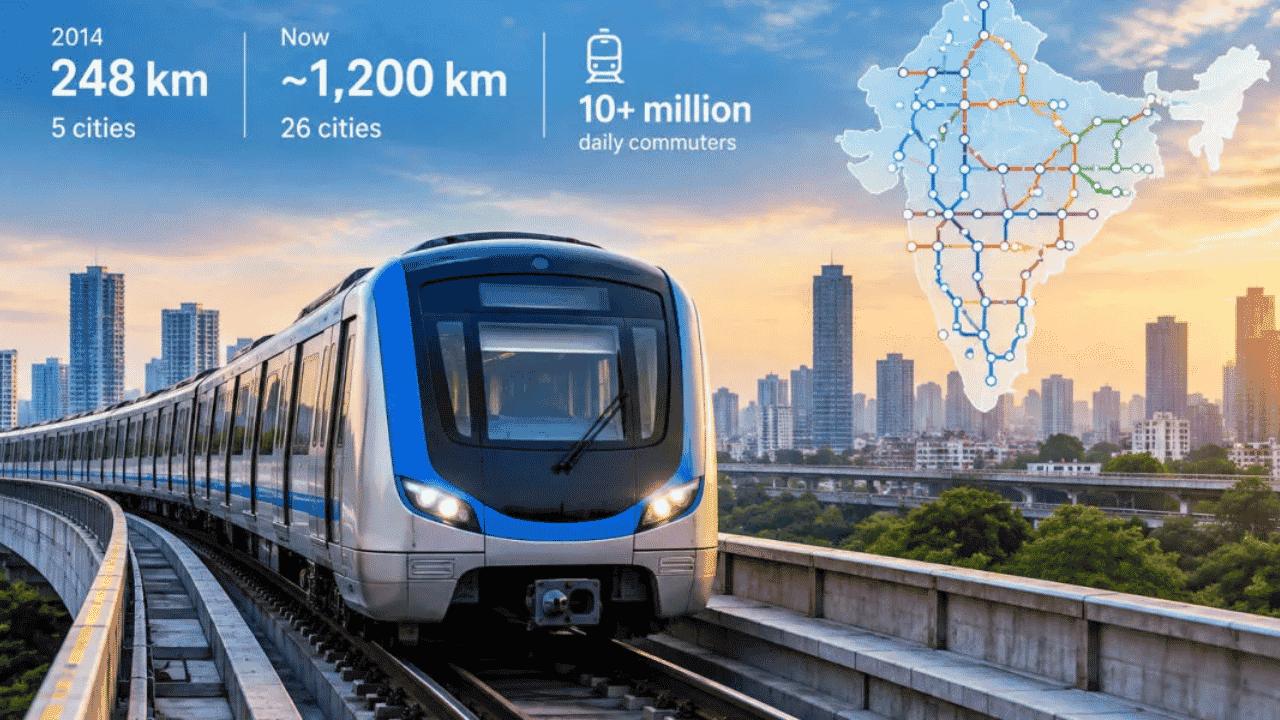
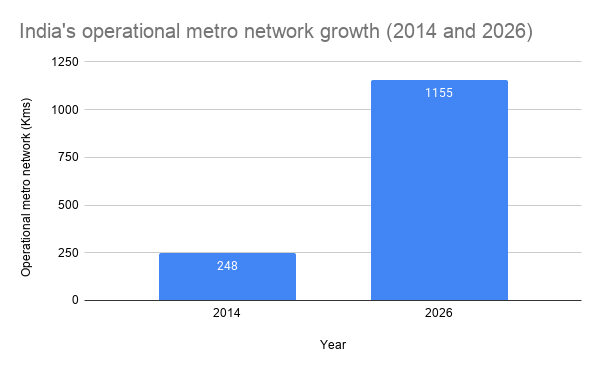
India’s metro rail network has grown substantially from 248 km in five cities in 2014 to almost 1,200 km in 26 cities now. Over one crore people are travelling daily using the metro rail facilities.
In his statement on November 5, 2026, Prime Minister Narendra Modi said that over the last decade there has been great expansion in metro rail connectivity. The number of people using the facilities has increased, new corridors have been opened more quickly and there has been a large investment in urban transport.
Metro Network Grows from 248 Km to Nearly 1,200 Km
India had 248 km of operational metro lines across five cities in 2014. By March 2026, the network had expanded to 1,155 km across 26 cities, according to government data. On November 5, the Prime Minister mentioned that the network has expanded to almost 1200 km. This has helped India to become the third largest metro network in the world.
Moreover, the rate at which the network is being commissioned has increased significantly. While the network was being expanded at an average rate of 0.68 km per month before 2014, it now stands at almost 6 km per month.
Daily Metro Ridership Crosses One Crore Passengers
Along with the expansion in network length, there is also a huge rise in the daily passenger numbers. Metro services carried around 28 lakh passengers a day in 2013-14, compared with more than 1.15 crore daily passengers in 2026.
This is due to the increasing use of metro systems to commute between residential to employment areas.
Kolkata has an underwater metro tunnel under the Hooghly River. Kochi also has a Water Metro system using electric hybrid boats between its islands.
Pune Metro Expansion Adds New Urban Connectivity
Pune Metro Line 3, also known as the Pink Line, was inaugurated by Prime Minister Narendra Modi on November 3, 2026. The 23.203-km elevated corridor connects Maan with District Court Metro station, providing metro connectivity between the Hinjewadi IT hub and Shivajinagar.
Developed under the public-private partnership (PPP) model, the project has an estimated cost of Rs. 8,313 crore. The line is designed to be operated entirely by women train operators, while around 30% of its electricity requirements are expected to be met through solar power.
The foundation stone for Pune Metro Phase-II was also laid on November 3, with an estimated cost of around Rs. 13,500 crore. The expansion comprises Lines 2A, 2B, 4 and 4A, including the proposed Kharadi-Khadakwasla corridor and extensions towards Chandani Chowk and Vitthalwadi. The new routes are expected to improve connectivity across residential, commercial and IT hubs.
Metro Connectivity Supports Real Estate and Urban Development
Metros can improve connectivity between residential areas, commercial areas, educational and employment areas and reduce travel times to existing business areas.
In Pune, it is important that Hinjewadi is connected to the central areas as it connects a large employment area for IT workers. In other cities this can impact where businesses want to have their offices and where people want to live. This will vary depending on the location and other factors within the market. Such similar trends have been observed along Bengaluru's Yellow and Pink metro lines, where office demand is expected to rise by 5–7 million sq. ft.
The government has increased funding for metro projects. Funding has grown from approximately Rs. 5,798 crore in 2013-14 to almost Rs. 29,550 crore in 2025-26. It will continue to expand based on funding of the projects, construction of the metros, integration with other public transport systems and passenger demand.
With more cities connected to the metro system, the metro system will be useful based on how well it integrates with bus stations, suburban rail, walking routes and residential/commercial areas. This is a major milestone for the network, but depends on its integration with the last mile of the journey.