
Key Highlights – January 2026 Mumbai Residential Market:
- Volume Softening: Property registrations fell 8% YoY to 11,219; December 2025 saw a 22% higher volume due to seasonality.
- Price Resilience: Stamp duty collections rose 2% YoY to ₹1,012 crore, showing stable property values despite lower sales.
- End-User Dominance: Residential transactions comprised ~80% of all registrations, highlighting strong demand from ultimate buyers.
- Premium & Luxury Uptake: Homes above ₹5 crore grew to 7% of total registrations; mid-premium (₹2–5 crore) also gained share.
- Compact Homes Preferred: 83% of apartments were ≤1,000 sq ft, with 500–1,000 sq ft units most popular among buyers.
- Stable Upper Segment: Larger homes (>2,000 sq ft) remained niche but steady in demand.
- Western & Central Suburbs Lead: Western Suburbs accounted for over 50% of transactions; Central Suburbs captured ~35–36%.
- South & Central Mumbai Lags: Limited new supply and high prices restricted transaction volumes to ~10% of total registrations.
The residential real estate market in Mumbai witnessed a mixed scene at the beginning of 2026. On the one hand, there was a short term weakening in transaction activities. On the other hand, property prices held up well. Data for January 2026 released by the Maharashtra Inspector General of Registration (IGR) indicates that the city had 11, 219 property registrations during the month, which is 8% lesser on a year on year basis than January 2025.
The fall in volumes may be a source of worry at the first sight, but a closer look at the revenue trends and buyer behaviour indicates that the market is not losing strength, but adjusting itself.
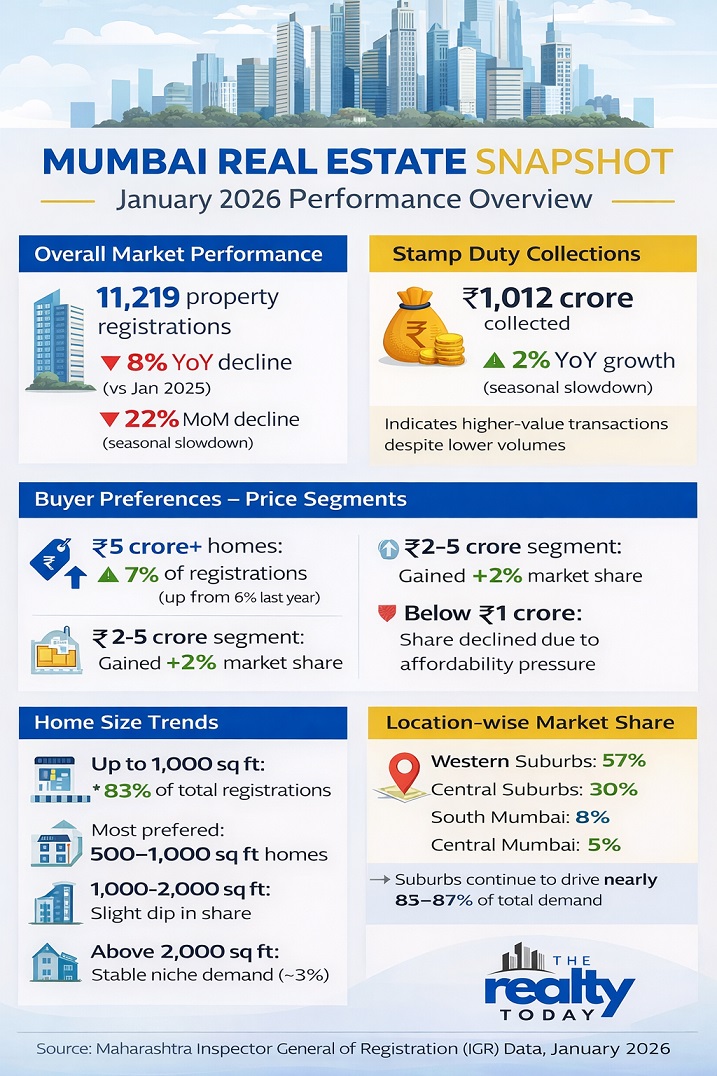
Most importantly, the decrease in property registrations did not cause a decline in government revenues. In January 2026, stamp duty collections increased by 2% year over year to 1, 012 crore, thus confirming that property values remain resilient and that the trend towards higher value transactions continues. The divergence of volumes and values throws light on a major structural change in Mumbai's housing market where buyers are more and more prioritizing quality, location, and long term value over just affordability.
Comparing month over month, the slowdown in growth was even more visible. Property registrations dropped by 22% over December 2025, while stamp duty revenues decreased by 19% sequentially. Nevertheless, most of those involved in the industry attribute this decrease to seasonality factors rather than a real lack of growth. December normally enjoys the benefit of deals being closed at the year end, the festive period, and developers giving the last push to the inventory before a balance sheet reset, hence January being a naturally quieter month. Moreover, administrative disruptions and fewer working days at the end of January had a further negative impact on the registration activity, thus deepening the short term drop.
Despite a milder monthly performance in this segment, the overall market story is still steady and driven by demand. Indeed, residential properties made up almost 80% of all property registrations which reflects how end user purchases continue to dominate over those by speculators or merely investors. It is a trend that has been noticed also by real estate consulting firms like Knight Frank India, which keeps referring to good macroeconomic conditions, stable rates of interest, and ongoing infrastructure spending as the main reasons behind buyers' trust in the housing market of Mumbai.
Key structural signals emerging from January 2026 data include:
- Volumes softened, but transaction values remained firm
- End-user demand continued to dominate overall activity
- Premium and luxury housing segments gained incremental share
- Compact, efficiently sized homes remained the preferred choice
A more detailed look at price segmentation uncovers a distinct and persistent switch towards higher, ended properties. Homes priced above 5 crore made up 7% of the total property registrations in January 2026, as opposed to 6% during the same time last year. Although the rise in percentage may seem insignificant, it is quite substantial in a market as big and developed as Mumbai. This avenue sheds light on the coupling of glamorous and upscale housing sectors that are being fuelled by the rich ultimate users, business proprietors, senior corporate professionals, and high income families who demand larger, better, located, and amenity rich dwellings.
The mid, premium segment, consisting of houses priced between 2 crore and 5 crore, also grabbed a bigger chunk of the market, thus mirroring a general upgrade trend among buyers. On the other hand, properties that are priced below 1 crore recorded a fall in registrations in relative terms. Shifting the spotlight on the first, time buyers and lower, income families who are grappling with the affordability issue, this continues to be especially true in a metropolis where the scarcity of land, increasing costs of construction, and regulatory requirements, which together push the base prices, are the main factors of limitation.
Preferences for apartment sizes further reflect the practical nature of the market. Small apartments of up to 1, 000 sq ft made up an overwhelming 83% of total registrations, with the 5001, 000 sq ft segment being the most popular choice. These apartments offer a good compromise between price efficiency and functional livability, thus they are attractive to both nuclear families and upgrading buyers who are limited by the overall ticket size rather than by per, square, foot pricing.
Apartment size trends observed in January include:
- ≤1,000 sq ft homes formed the bulk of demand
- 500–1,000 sq ft units remained the sweet spot for buyers
- 1,000–2,000 sq ft homes saw a marginal dip in share
- Homes above 2,000 sq ft stayed stable but niche
From a location perspective, the narrative of Mumbais real estate ascendancy has been largely centred on the Western and Central Suburbs, which, combined, have accounted for approximately 8587% of total registrations during the month.
The Western Suburbs led the market with over half of all transactions, supported by strong social infrastructure, connectivity improvements, and a steady pipeline of redevelopment and new projects. The Central Suburbs came in a close second, enjoying the advantages of the metro expansion, better road networks, and somewhat more attractive price, value propositions.
On the other hand, South Mumbai and Central Mumbai together accounted for a little over 10% of the total registrations. These old micro markets are still struggling with very limited new supply and extremely high ticket sizes, which naturally keep transaction volumes low despite strong underlying demand.
Looking at all the facts, the data from January 2026 indicates that the residential market in Mumbai is not only holding on to its momentum but also changing its nature. A leading industry point of view has rightly observed that the gap between the number of transactions and the amount of revenue collected shows a situation in which the buyers may be less in number, however, they are more decided and financially strong.
So, these are the signs of maturity in the market, stable earnings, and a long-term belief in the basics of the real estate market of Mumbai, which are the characteristics that will most probably set the path of the city's home market not only through 2026 but also after that.





.png)