

Pune Real Estate Market Key Highlights – January 2026
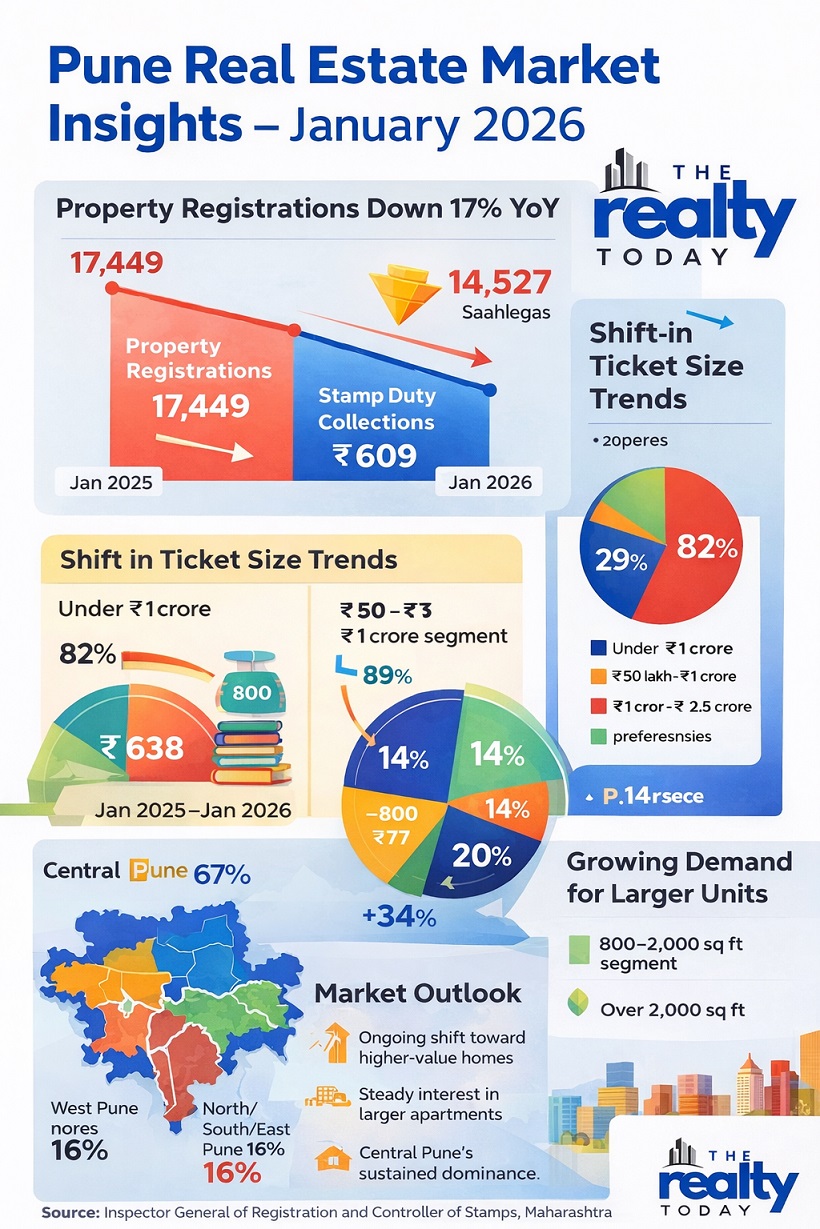
- Property registrations declined 17% YoY in January 2026, falling to 14,527 units compared to 17,449 in January 2025.
- Stamp duty collections dropped only 5% YoY to ₹609 crore, indicating resilience in higher-value transactions.
- Sequential recovery was visible, with January showing strong improvement over December 2025 figures.
- Demand for mid and premium homes increased, with the ₹1–2.5 crore segment accounting for 14% of total registrations.
- Preference for larger apartments strengthened, as units above 800 sq ft saw a marginal rise in overall share.
Pune's real estate market had a rather cautious start to 2026, with property registrations declining 17% on a year, on, year (YoY) basis in January. Figures from the Inspector General of Registration and Controller of Stamps, Maharashtra, show that the city had 14, 527 property registrations, which was less than 17, 449 a year ago during the same period. Stamp duty collections were also down a little, dropping five per cent to 609 crore, as against 638 crore in January 2025.
Even though there was a YoY slowdown, the month on month (MoM) figures point to a recovery after the year end slump. In December 2025, Pune had a record of 12, 079 registrations and 444 crore in stamp duty collections. Such sequential growth in both registrations and revenue is the sign of the market resuming buying activity after the festive and fiscal year end pause.
“The shift toward mid and premium segments, along with steady demand for larger homes, indicates that end-user confidence remains intact even as volumes normalise from last year’s elevated base,” said Shishir Baijal, International Partner, Chairman, and Managing Director, Knight Frank India.
He added, “While registrations moderated YoY, the relatively lower decline in revenue reflects continued momentum in higher ticket-size transactions. On a sequential basis, the sharp rebound in both registrations and collections signals renewed buying activity after the year-end slowdown.”
Shift Towards Higher-Value Homes
Although homes priced below ₹1 crore continued to be the most visible in the market, the cumulative percentage of homes in this segment eased to 82% in January 2026, which reveals that homebuyers are now also looking at mid and higher-end homes. According to the report, the following trends have been observed in ticket sizes:
- ₹50 lakh – ₹1 crore segment: 29% of registrations.
- ₹1 crore – ₹2.5 crore segment: 14% of registrations.
This reveals that although affordable homes are the major force in the market, the demand for higher-value homes is gradually increasing.
Steady Demand for Larger Units
With the distribution of home sizes also illustrating a small but clear preference for bigger apartments, the percentage of units less than 500 sq ft fell from 26% in January 2025 to 23%, whereas the 500, 800 sq ft range is still in the lead at 46%. The bigger apartments, including the 800, 1, 000 sq ft and 1, 000, 2, 000 sq ft categories, increased slightly by one percentage point each to 14%, and the homes exceeding 2, 000 sq ft stayed at 3%.
It is inferred from these changes that buyers are moving towards more roomy and pleasantly sized living spaces, however, they are not totally giving up the smaller or mid, sized apartments. Knight Frank's report states that these trends show that the market is stable and that the requirements of the end users are changing towards larger unit sizes and luxury layouts.
Geographical Trends
Central Pune which includes areas of Haveli Taluka, Pune Municipal Corporation (PMC) and Pimpri Chinchwad Municipal Corporation (PCMC) was the top residential transaction location by a big margin, its share of the market having reached 67% in January 2026. West Pune or the areas of Mawal, Mulshi and Velhe accounted for 16% of the market. At the same time, North, South, and East Pune together accounted for the remaining 16%.
The massive concentration at the center is a clear indication that Central Pune continues to be the main residential hub. While the suburban areas, which are the ones in their early stages of development, are still managing to attract buyers who are looking for a cheap house or a bigger land plot. In fact, the biggest majority of the homebuyers choose Central Pune mainly for the reasons of the excellent infrastructure, proximity to the workplaces and availability of numerous social amenities
“Pune’s residential market has started 2026 on a measured note, with over 14,500 property registrations and ₹609 crore in stamp duty collections in January. While registrations moderated YoY, the relatively lower decline in revenue reflects continued momentum in higher ticket-size transactions. On a sequential basis, the sharp rebound in both registrations and collections signals renewed buying activity after the year-end slowdown," said Shishir Baijal.
Looking at the overall market situation of Pune, January 2026 data shows a real estate market that is normalizing after the vibrant activity of the previous year. Even though property registrations have gone down on a yearly basis, the relatively smaller fall in stamp duty revenue indicates that higher, value and larger transactions have still been going on.
Experts believe this is a good sign for the residential market, which is healthy and strong, in the long run. Some of the main points from the discussion are that buyers have continued to opt for mid and premium ticket size properties which is a very positive sign of consumer confidence. Besides that, lifestyles are changing and people's living spaces need are growing, therefore, there is a rising attraction to larger apartments. Central Pune remains the favorite location while the peripheral areas are slowly becoming more popular.
"The market is getting used to a slower and more regular pace, " Baijal noted. "It seems like overall demand is stable and buyers are showing a little preference for larger units but they are also still very much interested in mid-sized apartments."
Pune's real estate sector has started 2026 on a firm and ground, breaking note in terms of returning to a stable trend scenario. The city is at equilibrium mode where a decline in trading volume is being offset by the strength in revenue generation. The gradual increase in the share of mid and premium homes along with the strong and consistent demand for larger apartments conveys that even if the number of transactions might slow down, the confidence of end users will be high, thus the residential market in the coming months is projected to be healthy and sustainable.




.png)