

Key Highlights from the Residential Price Monitor
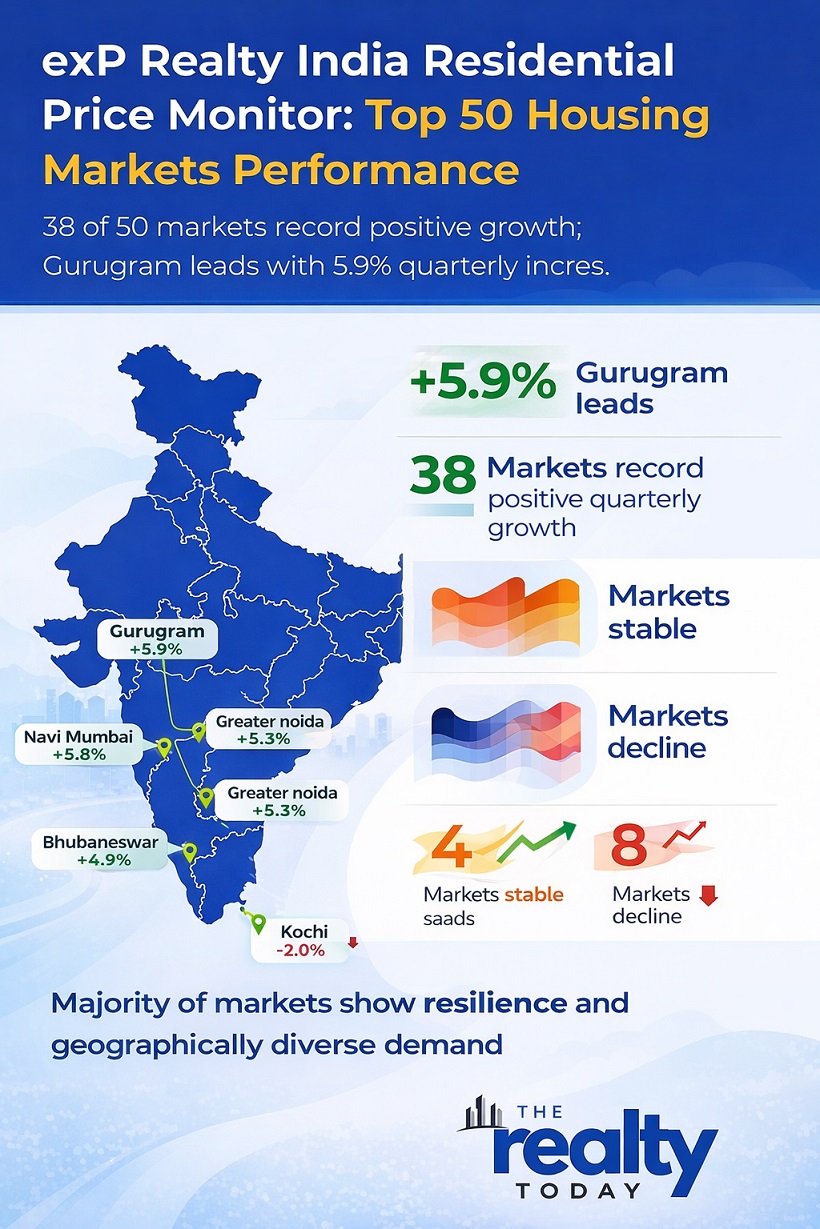
- 38 out of 50 housing markets recorded positive average quarterly price growth, reflecting broad-based resilience across metro, regional, and commuter-driven markets.
- Gurugram led the performance rankings with 5.9% average quarterly growth, followed closely by Navi Mumbai at 5.8% and Greater Noida at 5.3%, driven largely by infrastructure and end-user demand.
- Price appreciation is geographically diversifying, with cities like Bhubaneswar and Noida posting 4.9% growth, indicating stronger absorption beyond traditional metro hubs.
- Only eight markets registered modest declines, with Kochi seeing the steepest fall at -2.0%, suggesting corrections remain localised rather than systemic.
- Market stability outweighs short-term volatility, as the majority of cities demonstrated sustained growth trends supported by infrastructure expansion, employment hubs, and urban migration.
eXp Realty India's latest Residential Price Monitor, analyses average quarterly housing price movements across 50 residential markets nationwide over the past year. The study evaluates sustained price trends by measuring average quarterly growth, offering a longer-term view of market performance.
The analysis indicates that 38 out of 50 markets recorded positive average quarterly price growth, four markets remained broadly stable, and eight registered modest declines. The findings reflect broad-based price resilience across metro, regional and commuter-driven housing markets.
Gurugram emerged as the strongest-performing housing market in the study, registering an average quarterly price growth of 5.9% over the past year. The city’s performance reflects sustained end-user demand, supported by its corporate ecosystem and continued infrastructure additions. Navi Mumbai followed closely with average quarterly growth of 5.8%, driven by connectivity improvements and long-term development activity. Greater Noida recorded 5.3% growth, supported by relative affordability within NCR and expanding transport linkages.
Beyond the top three markets, Bhubaneswar and Noida each posted average quarterly growth of 4.9%, indicating strengthening residential absorption in regional and peripheral urban corridors. The spread of price appreciation across cities suggests that housing demand is no longer concentrated in a limited number of large metropolitan centres but is becoming more geographically distributed.
At the lower end of the performance spectrum, price corrections were limited to a small number of locations. Kochi recorded the steepest average quarterly decline at -2.0%, followed by Raipur at -0.9%, while Kanpur, Guwahati, Delhi and New Town Kolkata saw marginal softening over the same period. The overall pattern indicates that downward adjustments remain localised and linked to market-specific supply conditions rather than broader structural weakness.
Sam Chopra, President and Country Head, eXp Realty India, said "the findings highlight the importance of viewing housing market performance through a long-term lens. While short-term price changes often dominate public discourse, the underlying trend across most markets points to stability rather than stress."
He noted that strong performances in markets such as Gurugram, Navi Mumbai and Greater Noida reflect genuine end-user demand rather than speculative activity. At the same time, the limited number of markets seeing modest price declines shows how broad-based stability remains across the country.
Even in cities where prices have softened, Chopra pointed out that these movements are highly localised and do not undermine long-term confidence in India’s residential sector.
Industry participants attribute strong pricing trends in NCR markets to recent and upcoming infrastructure additions. “While Gurgaon is a mature market where price increases have been supported by new infrastructure developments like the Dwarka Expressway and the opening of UER 2, Noida is rapidly developing as a luxury-focused market, with new launches benefiting from the upcoming international airport and superior infrastructure. These trends are reflected in the increasing average sale prices in both key NCR markets,” said Ashish Jerath, President – Sales & Marketing, Smartworld Developers.
The broader findings indicate that residential demand continues to be shaped by infrastructure expansion, employment concentration and urban migration across regions. With the majority of markets recording stable or positive growth, the data suggests a phase of measured, geographically diversified expansion across India’s housing sector.