

Economic Survey 2025–26: Urban Housing- Key Highlights
- Over 96 lakh urban homes have been constructed and delivered under PMAY-U, out of 122 lakh approved, significantly reducing India’s urban housing shortage for EWS, LIG and MIG households.
- Affordable housing has been supported through tax benefits, GST concessions, priority sector lending, and infrastructure status, improving project viability and easing access to home loans for first-time buyers.
- More than 90% of 8,067 Smart Cities projects have been completed with investments of around ₹1.64 lakh crore, improving urban mobility, utilities, public spaces and digital governance.
- Outstanding individual housing loans have grown to ₹37 lakh crore, over 11% of GDP, reflecting deeper financialisation, stronger buyer confidence and a more transparent residential market.
- While affordability has improved, many housing projects on city outskirts face poor connectivity and inadequate civic and social infrastructure, highlighting the need for integrated, systems-based urban planning.
India's urban housing mission has greatly progressed with more than 96 lakh houses being given to the beneficiaries under the Pradhan Mantri Awas Yojana, Urban (PMAY, U), states the Economic Survey 2025- 26 presented to the Parliament on 29th January. The survey recognized the government's continued efforts on affordable housing, urban infrastructure, and financial inclusion while also pointing out the challenges in urban liveability and infrastructure gaps.
Concerned with the urban housing shortage, two phases of PMAY, U were launched which in total have given approval of 122.06 lakh houses in the country. Along with this, 96.02 lakh houses have already been built and handed over to the beneficiaries by November 24, 2025. The scheme was made mainly for the economically weaker sections (EWS), low income groups (LIG) and middle income groups (MIG) with the aim of not only providing them with decent housing but also raising the standards of living in the urban areas.
The Economic Survey through its main message shed light on the fact that affordable housing has been made accessible to the public through various kinds of policy interventions over the years. They include among other things tax incentives, GST concessions, priority sector lending, and infrastructure status for housing projects.
The priority sector classification has made it possible for the banks to grant the homebuyers higher loan, tovalue ratios which in turn means that the homebuyers' first financial burden is reduced and also the credit is made more accessible to the first time buyers.
Nirmala Sitharaman, the Minister of Finance and Minister of Corporate Affairs of the Government of India, posted in X, "The Economic Survey 2025-26 gave an economic overview of the past year and ideas for the road ahead. In a world defined by geopolitical fragmentation and economic turbulence, India stands as a global bright spot - resilient, stable, and surging forward."
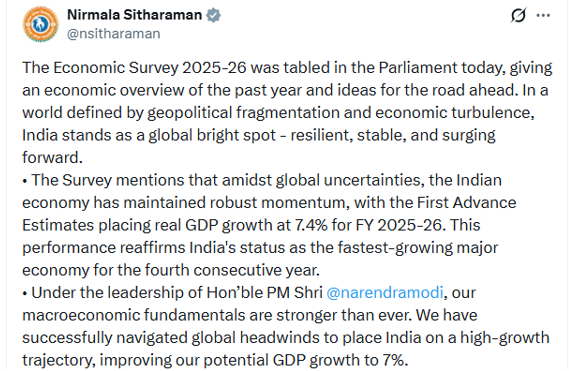
According to her, "The Survey rightfully notes that the government's calibrated fiscal strategy, anchored in credible deficit reduction, resilient revenue mobilisation, and a decisive reorientation of spending toward capital formation, has strengthened macroeconomic stability and supported growth in the post-pandemic period. Importantly, this fiscal resilience reflects prudent fiscal policy choices and careful fiscal management."
• The govt. remains committed to fiscal consolidation without compromising on growth. The fiscal deficit target of 4.4% for the current FY 2026 is well on track, a feat recognised by 3 sovereign rating upgrades this financial year.
• Our capital expenditure has risen by nearly 89% since FY22, reaching a budgeted ₹11.21 lakh crore in FY26. The effective capex has risen from 2.7% (pre-pandemic average) to 3.9% of the GDP (post-pandemic).
• The national highway network has expanded by nearly 60%, rising from 91,287 km in FY14 to 1.46 lakh km by FY26, while operational high-speed corridors have grown almost tenfold to 5,364 km, sharply reducing freight bottlenecks.
• Rail capacity creation has accelerated, with annual commissioning more than doubling over the last decade. Port infrastructure has expanded in tandem, with cargo handling increasing from 1,052 MMT to 1,602 MMT and total capacity reaching 2,771 MMT, alongside a reduction in average container vessel turnaround time from 43.44 hours to 30.88 hours.
• The strongest transformation is visible in Inland Water Transport, where cargo movement has surged from 18 MMT in 2013–14 to 146 MMT in 2024–25, signalling a structural shift toward cheaper, greener, and more efficient freight logistics.
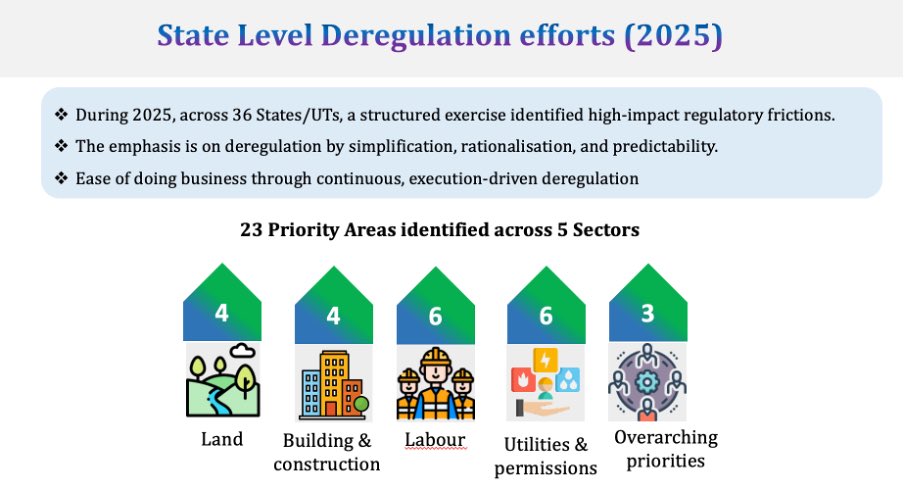
• The Survey has also highlighted that cities succeed not only through infrastructure but through trust, predictability, and civic cooperation. When rules are clear, services reliable, and public spaces respected, growth becomes easier to live with—and easier to sustain. We are committed to building the cities that bring ‘ease of living’ for our citizens.
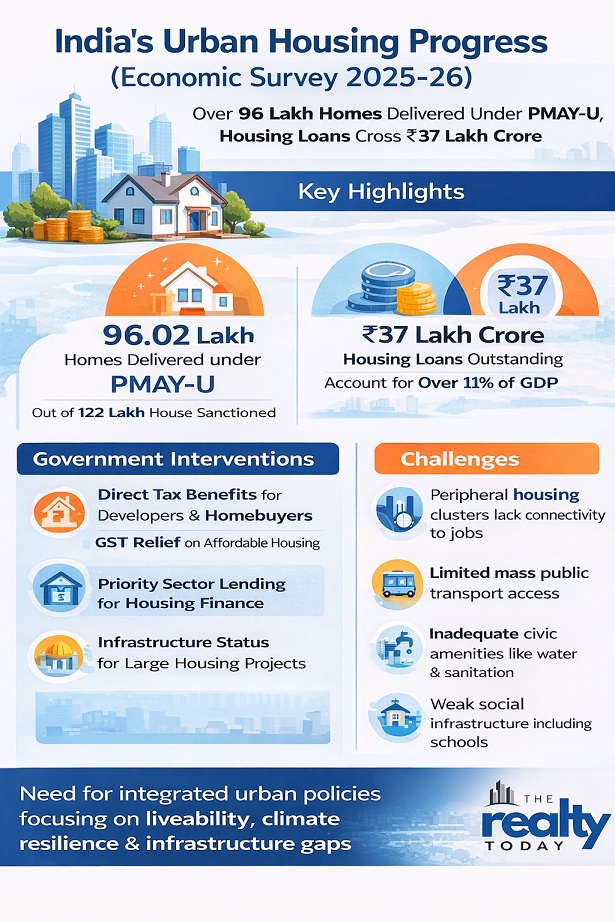
According to the Survey, key government interventions supporting urban housing include:
- Direct tax benefits for both developers and homebuyers
- GST relief on affordable housing projects
- Priority sector lending, allowing easier access to housing finance
- Infrastructure status, which improves funding availability for large housing projects
Besides housing, the Economic Survey also took into account the progress of the Smart Cities Mission (SCM). It was reported that as of May 9, 2025, cities chosen under the SCM collectively finished over 90 per cent of the 8, 067 projects approved, and the investments were close to 1.64 lakh crore. The SCM projects include smart roads, cycle tracks, integrated command and control centres, upgraded water and sewerage networks, and the setting up of public spaces for better urban living.
The Survey further acknowledged the contribution of complementary urban schemes like the Pradhan Mantri Street Vendors Atmanirbhar Nidhi (PM SVANidhi) in the development of cities. This initiative has been instrumental in helping street vendors in cities to return to and re-establish their livelihoods by providing working capital loans without the need for collateral, thus, strengthening the informal urban economy which is the backbone of city life.
Mr. Yateesh Wahaal, Director Finance, M3M India, said, The Economic Survey 2025–26 highlights the central role of real estate in enabling urban growth through housing, mobility, and infrastructure-led development. Its emphasis on improving urban capacity and accessibility is directly relevant across premium housing, branded residences, commercial, and mixed-use developments. At M3M India, we see strong alignment between policy-led urban planning and the need to deliver high-quality, sustainable built environments. As Indian cities evolve, demand will increasingly favour well-designed developments that combine lifestyle, connectivity, and long-term value, supporting balanced and future-ready urban growth."
Nonetheless, the Survey raised some concerns about the new ways in which cities are developing. It noted that most of the affordable housing projects are gradually being located in the outer parts of the cities where land is cheaper and bigger plots are more easily available. Of course, this helps to make housing prices more affordable for the low and middle income households, but it quite often results in the sacrifice of basic infrastructure.
Many peripheral housing clusters suffer from:
- Poor connectivity to employment hubs
- Limited access to mass public transport
- Inadequate civic amenities such as water, sanitation, and healthcare
- Weak social infrastructure including schools and public spaces
Therefore, affordability has been the major driver of strong demand in these locations, it is not uncommon for them to be challenged with liveability and long, term sustainability issues. The Survey referred to this as a policy dilemma where the affordability gains may be threatened by the shortage of urban services.
Mr. Shrivallabh Goyal, CEO & Whole-Time Director, Model Economic Township Ltd. (Reliance MET City), said, "The Economic Survey rightly reframes cities as economic infrastructure rather than just population centres. India’s next phase of growth will depend on how effectively we integrate manufacturing, logistics, skills and urban living into a single ecosystem. This is where integrated industrial urban platforms like Reliance MET City become relevant. The future shall not be about only services, but on ground enablement of production, exports and employment at scale. India, today is in possession of a distinct opportunity where we can build economic cities combining infrastructure readiness, sustainability frameworks and policy, to compete at a global stage. That shift will be critical for India to deepen its position in global value chains and sustain high growth to become Vibrant Bharat by 2047."
Going forward, the Economic Survey pointed to the necessity of changing the way urban policy is conceived. It argued against separate projects and advocated for a systems, based approach that would link housing with mobility, sanitation, climate resilience, and municipal finance. According to the Survey, next generation urban development should emphasize performance outcomes rather than just infrastructure creation.
The report stated that an urban India of tomorrow will be a society characterized by cities that are economically vibrant, socially equitable, environmentally sustainable, and institutionally efficient. It was thought that the key enablers lie in integrating these facets through climate, resilient planning, good governance, and well, coordinated investment.
One more interesting fact that has come out in the Survey is the growing housing finance sector in India. The total individual housing loans outstanding have increased from around Rs 10 lakh crore in March 2015 to around Rs 37 lakh crore in March 2025 over the last ten years.
At present, housing loans account for over 11% of the country’s GDP, as compared to 8% a decade ago, which is a definite indicator that the housing demand is increasingly being financialized.
The Survey highlights the fact that housing sales volumes have been above the pre, pandemic levels seen during FY22, FY24, thereby indicating that housing sales have been strong during and after the pandemic. This has been possible due to stable income growth, formal credit expansion, and improved buyer confidence. The increasing significance of institutional finance is transforming the Indian residential real estate market, thus making it more organized and transparent.
Mr Sidharth Chowdhry, Managing Director, Dalcore, said, "The Economic Survey 2025–26 reinforces confidence in India’s medium-term growth trajectory, projecting GDP growth of 6.3–6.8% in FY26, supported by domestic consumption, infrastructure investment, and structural reforms. For the real estate and alternative assets sector, the Survey’s focus on urban infrastructure, capital formation, and efficient land use highlights the growing role of institutional capital in shaping India’s next phase of development.
At Dalcore, we see a strong alignment between the government’s push for resilient urban ecosystems and the rising demand for professionally managed, future-ready commercial assets. As India’s cities evolve into integrated economic engines, capital will increasingly gravitate toward high-quality developments that combine sustainability, operational efficiency, and long-term value creation. This shift is critical to supporting India’s broader ambition of becoming a Viksit Bharat by 2047."
The Economic Survey 2025- 26 of India depicts an overall positive trend of India's urban housing journey although it also suggests some areas for improvement. The journey comprises the scale and delivery success under PMAY, U as well as a stronger housing finance penetration and substantial urban infrastructure investment. At the same time, it highlights the pressing need to bridge the infrastructure gaps and to plan cities that are affordable and liveable in which the needs of the people are considered the most important.





.png)