

India's real estate story has shifted from cyclical recovery to structural expansion. The market is worth roughly US$0.66 trillion today and is on course to reach about US$1 trillion by 2030, growing close to 10% a year, with its share of GDP set to climb from around 7% toward 13%. The residential engine alone makes the point: buyers in the top seven cities absorbed nearly ₹5.68 lakh crore of homes in 2024, a 16% jump in value over the prior year. This is not a price blip, it is urbanisation, rising incomes and a decade-long housing shortfall compounding together.
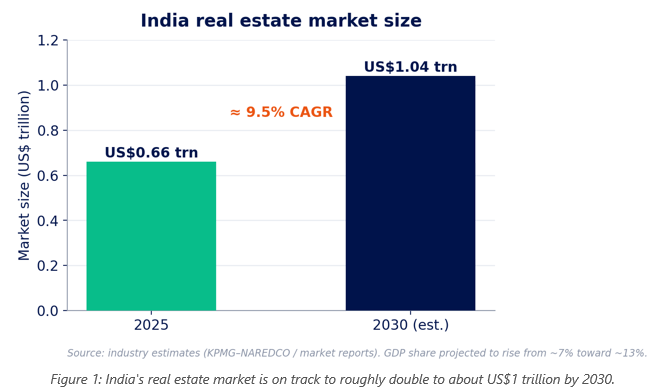
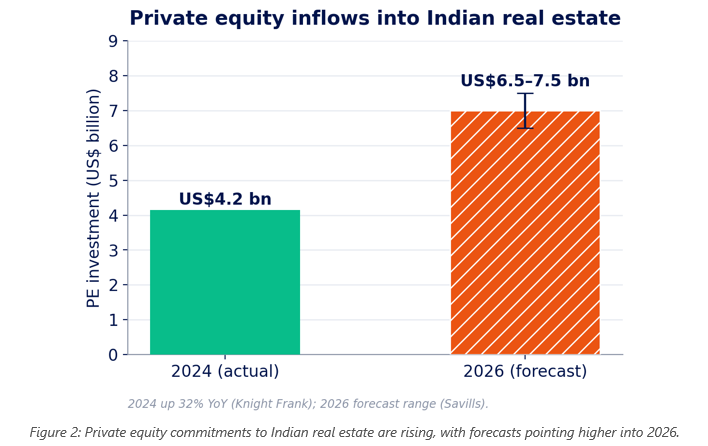
For private equity, a market of that scale and duration is the whole attraction. A trillion-dollar sector growing steadily generates far more capital demand than banks can meet on their own and much of that demand is for equity and growth capital, precisely what private equity provides. The money is already moving: PE inflows into Indian real estate rose 32% to about US$4.2 billion in 2024, and are forecast to reach US$6.5–7.5 billion by 2026.
Two forces amplify the need. Bank lending to developers remains cautious after years of sector stress, leaving a financing gap that private capital is stepping into. And post-RERA consolidation has thinned the ranks of weaker builders, leaving a more organised, better-governed set of counterparties actively seeking institutional partners. Private equity is not merely welcome in this market; it is increasingly the capital of choice.
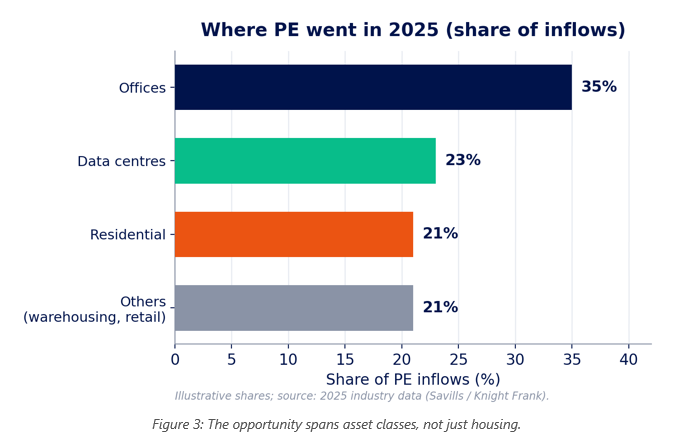
What makes the opportunity unusual is its breadth. The boom is no longer confined to apartments. In 2025, offices drew the largest share of PE capital at roughly 35%, followed by data centres near 23% and residential at about 21%, with warehousing and retail close behind. An investor can now assemble exposure across occupier-led offices, digital-infrastructure data centres and demand-led housing inside a single market, a spread of risk and return that did not exist a decade ago. The geography is widening too, as Tier-2 cities such as Pune, Hyderabad and Ahmedabad graduate into credible institutional markets in their own right.
Formalisation is what turned that breadth into an investable proposition. RERA brought disclosure and discipline, GST simplified taxation, and the arrival of REITs gave institutional owners a public-market route to monetise completed, income-producing assets. A credible path to exit, long the missing piece in Indian real estate now exists, and it changes the calculus for any fund weighing an entry.
But a golden opportunity is not the same as an easy one. A market this large is also uneven: returns cluster around particular micro-markets, particular developers and particular asset classes, and they are neither uniform nor assured. Execution and selection decide the outcome. Blanket exposure to ‘Indian real estate’ is not a strategy; disciplined, active ownership is. That is the difference between capital that merely arrives and capital that is managed.
This is where a manager's model matters, and where Arbour Investments concentrates its work. The opportunity rewards three disciplines: rigorous selection of markets and partners before a rupee is committed; governance that holds developers to plan on sales, costs and approvals through the life of a project; and active asset management that protects and compounds value rather than waiting passively for an exit. A boom lifts the average, it is hands-on ownership that separates the strong outcomes from the ordinary ones.
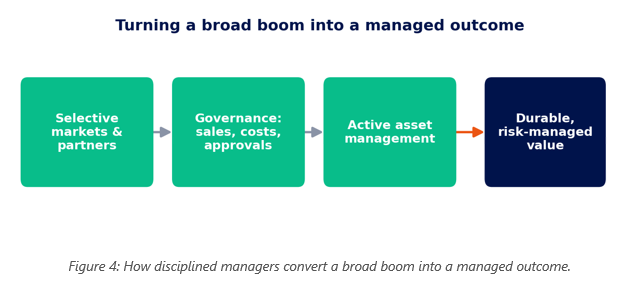
For private equity weighing India, the case is straightforward. The demand is structural, the runway is long, the asset classes are broad, and the market is finally transparent enough to underwrite and exit with confidence. Few markets globally offer that combination of size, growth and improving governance. The opportunity is genuinely golden but it is one to be selected and managed, not simply bought.
For informational purposes only. Not investment advice or a solicitation to invest.
Authored By;