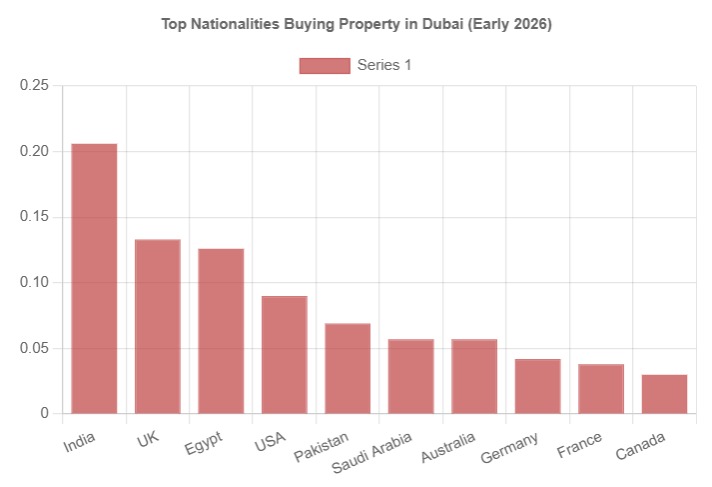
Dubai's real estate story used to be told mostly in dirhams and skyline photos. Increasingly, it's being told in passports. Every quarter now brings a fresh ranking of which nationality is buying the most, and the answer rarely changes anymore.
Indians are now among the largest groups of overseas buyers in Dubai's residential market accounting for an estimated 20.6% of all foreign purchasing activity in early 2026, ahead of British and Egyptian buyers, according to Harbor Real Estate's analysis of DXBinteract transaction data reported by Khaleej Times
And the reasons are pretty obvious and straightforward. There's no property tax, no capital gains tax on resale and even rental yields in several communities run higher than most Indian metro cities.
But a market this easy to enter is also easy to enter badly. Deals here can close in three weeks which means the scrutiny has to happen before that clock starts, not during it.
Start with where you're allowed to own
Dubai splits property into freehold and leasehold zones. Foreign nationals, including Indians, can buy full ownership only in designated freehold areas like Dubai Marina, Downtown Dubai, Business Bay, Jumeirah Village Circle, Dubai Hills Estate and Palm Jumeirah among more than 60 such zones. If a broker offers you a great deal outside these zones, ask what form of ownership you're actually getting. Usufruct and leasehold only give the right to use a property for a fixed term, often up to 99 years, after which it reverts to its original owner; the buyer never holds full title. That distinction rarely comes up at the time of sale, but it matters a great deal later, when reselling, financing or applying for residency.
Understand what your budget actually buys, residency-wise
Buying property in Dubai can also get you a UAE residence visa but the visa you get depends on how much you spend but the rules recently changed in 2026. Buy any freehold property on your own and you now qualify for a 2-year visa, with no minimum price on what you spend (until April 2026, you needed to spend at least AED 750,000 to qualify).
Buying with someone else? Each person needs to put in at least AED 400,000 and If you're 55 or older, you have to put in AED 1 million and you get a 5-year visa.
For the 10-year Golden Visa, you need AED 2 million or more in property. Two things changed here in February 2026 and both make it easier to qualify:
Off-plan property now counts. Earlier, only a fully built, title-deeded property counted toward the AED 2 million. Now, an off-plan unit counts too; based on its full contract value, even before it's built.
You no longer need half the money upfront. Earlier, if you took out a mortgage, you still had to pay 50% of the AED 2 million in cash yourself before the rest could count. That rule is gone now, the full property value counts toward your AED 2 million, mortgage included.
Here's why this matters in practice. Say your budget is AED 1 million and your goal is the Golden Visa. A common approach is to first buy a smaller unit that earns rental income, then buy a second one within 12–18 months to cross the AED 2 million mark together.
Since off-plan now counts, this can include a unit that's still under construction, provided its Oqood contract value is on record though the Dubai Land Department still checks how far along the project is before confirming eligibility, so it's worth getting that confirmed with the DLD before you commit rather than assuming it.
The route differs depending on where you're buying from
Indian buyer is not one profile for Dubai Market. An Indian already living and working in Dubai buys largely like any UAE resident, so funds move in AED, mortgages come easier and the main thing to watch is Indian tax residency status if that ever shifts back to resident.
While a resident Indian buying from India is remitting under the RBI's Liberalised Remittance Scheme, faces steeper mortgage terms as a non-resident and often needs a properly attested Power of Attorney if they can't be present for signing.
The due diligence checklist is the same for both; the paperwork trail isn't.
Budget beyond the headline price
The listed price is never the full cost. Set aside roughly 7–8% on top of the purchase price: the Dubai Land Department charges a 4% transfer fee, there's an agency commission (typically 2%) and smaller registration and trustee fees apply on top. If you're financing through a mortgage as a non-resident, expect banks to ask for 50% or more as down payment on the first property, sometimes less for residents. None of this is hidden, but it's routinely left out of the WhatsApp pitch.
Don't skip the developer and escrow check
Dubai has its own RERA, the Real Estate Regulatory Agency, operating under the Dubai Land Department and it's worth being clear that this is a separate body from India's RERA under the 2016 Act. The name is the same by coincidence but the underlying idea is familiar to any Indian buyer: a regulator that licenses developers and brokers and requires off-plan money to sit in a protected account rather than the developer's general funds.
Every off-plan project in Dubai is supposed to run through a RERA-regulated escrow account, meaning payments go toward construction of that specific project, not the developer's other ventures or debts. Before signing anything, check the project's RERA registration number and escrow account details on the Dubai Land Department's own portal and not just on the developer's brochure.
Also, look at the developer's history: how many of their past projects were handed over on time, and how many slipped by a year or more.
Factor in what happens back home
If you're a resident Indian taxpayer, this property has to be declared in your income tax return, under what's called Schedule FA, the foreign assets section. If you rent it out, that rental income is taxable in India too. You won't be taxed twice on it, a treaty between India and the UAE takes care of that but it still needs to be reported and accounted for correctly.
And if you're sending money from India to pay for the property, you can only send up to USD 250,000 per person per financial year, under the RBI's remittance rules which is why larger purchases often get split across family members or across years. The details shift depending on your exact tax status, so it's worth getting a chartered accountant who has actually handled Dubai property cases involved early, not after the purchase.
What experienced buyers do differently
They visit the project site, or have someone reliable do it, before transferring anything.
They read the Sale and Purchase Agreement fully, especially the handover date and penalty clauses for delays.
They compare at least two similar units in the same building for pricing sanity rather than trusting a single broker's number.
And they treat the golden visa as a genuine bonus of ownership, not the sole reason to buy because a residency permit tied to a property you regret buying is not much of a win.
Dubai remains a legitimate, well-regulated market for Indian buyers, arguably more transparent today than it was five years ago. The deals that go wrong are rarely the fault of the market. They're the fault of the two weeks nobody was willing to spend before wiring the first dirham.