

RWAs Initiatives to Improve Air Quality in Gurugram- Key Highlights
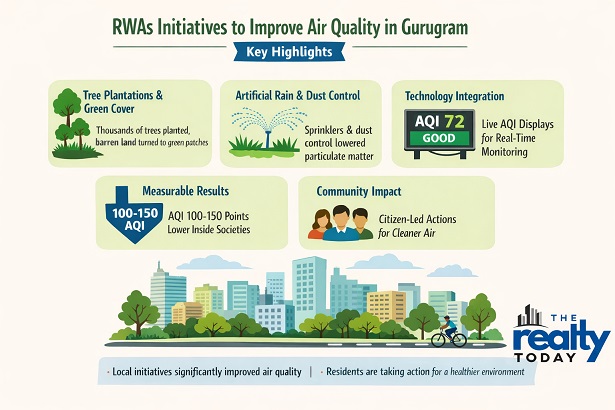
- Tree Plantations & Green Cover: Societies planted thousands of trees and converted barren land into grass patches to reduce dust and pollution.
- Artificial Rain & Dust Control: Sprinklers and dust mitigation measures lowered particulate matter and improved AQI.
- Technology Integration: Digitized AQI displays help monitor air quality in real time.
- Measurable Results: AQI inside societies is 100–150 points lower than nearby arterial roads.
- Community Impact: Citizen-led initiatives demonstrate that local participation is essential for sustainable urban air quality management.
More and more Gurugram residents are stepping up and taking control of their own situations as air pollution levels keep rising. During the second monthly HT First Gurugram dialogue, Residents' Welfare Associations (RWAs) came forward with their stories of how local level community driven initiatives have significantly improved the air quality in their respective areas.
Local housing associations of Sectors 48, 50, and 52 have come up with some pretty creative solutions to tackle the problem of cycling and vehicle emissions such as massive tree plantations, artificial rain sprinklers, and more efficient dust management. These efforts led by citizens vividly show how community play is becoming an indispensable element of environmental good practice.
Key initiatives by RWAs:
Vipul Greens (Sector 48): Planted and groomed around 600 trees ahead of peak winter. The society installed a digitized AQI display and implemented rapid sprinkling systems. RWA president Amit Jindal noted, “The citizen-led initiative to do extensive plantations, setting up a digitized display of live AQI in the vicinity and rapid sprinkling systems have brought a visible and sustained improvement in hyperlocal air quality levels.”
Ardee City (Sector 52): Implemented 1,000 tree plantations this rainy season and enhanced green cover. Loose soil was lowered and barren land converted into grass patches, reducing dust emissions. RWA member Chaitali Mandhotra said, “Residents expect, rightfully, to breathe fresh air. Our society has undertaken around 1,000 tree plantations this rainy season to stop AQI from off-shooting, unlike at major city hubs.”
Nirvana Country (Sector 50): Developed 4,500 trees over 150 acres. Regular dust mitigation measures, including sprinkling and paved road shoulders, maintain lower AQI levels within the society.
These initiatives have produced measurable improvements. On certain days, the AQI inside these societies is 100–150 points lower than nearby arterial roads, allowing residents—including senior citizens—to safely enjoy outdoor activities.
DLF Primus, another society, reported the effectiveness of artificial rain sprinklers in reducing local dust and particulate matter. RWA president Aachal Yadav shared, “Last year, the sprinklers mimicking artificial rainfall improved AQI by almost 50% within the society. Greens are watered regularly, along with maintaining a proper rainwater harvesting system.”
In December 2025, as a measure to keep the environment clean, the Haryana State Pollution Control Board had mandated high, rise societies to centrally install artificial rain sprinklers.
On the other hand, residents say that inherently, when people close to ground themselves give the healing touch, bigger things come to their senses and thus, if only government top, down mandates have to be sustained, they might not be enough.
Why RWAs Initiations Matter?
Effective measures for addressing pollution locally should be environmentally friendly, and hence, have a low carbon footprint. There is significant potential for local community projects to be at the forefront of environmental pollution minimization by advocating a clean environment for everyone's benefit. Giving one's time and effort in environmental projects such as tree, planting, generating less waste, and using public transport or non, polluting modes of transport can enable the community to work collectively in to a cleaner environment by improving the air quality.
Also, such initiatives could serve as a source of inspiration for other cities to regulate and take up such projects, particularly when they are faced with problems such as smog during a certain season. With the increasing number of similar cases like Gurugram, it becomes even more critical as these initiatives are becoming necessary in these burgeoning cities. In addition, the initiatives are indispensable as they guarantee a clean and healthy living environment, and even a sustainable future.
RWAs are demonstrating that by combining city development, technology and citizen participation, India`s urban areas can adequately address their environmental concerns and promote sustainable living.
Winter pollution being an annual problem, the above case studies clearly point to a situation where together with the authority interventions, local people are essential and their promise is so very pertinent as the main stakeholders in the environment.




.png)