

India has made a significant stride in the aspect of strategy and development with the central government having given in-principle approval for the first-ever underwater road-rail tunnel connecting the Brahmaputra River in Assam. This ambitious project, which aims to connect Gohpur in the northern bank of the Brahmaputra River with Numaligarh, located on the southern bank, is expected to improve connectivity in Northeast India as well as the defence logistics of the country.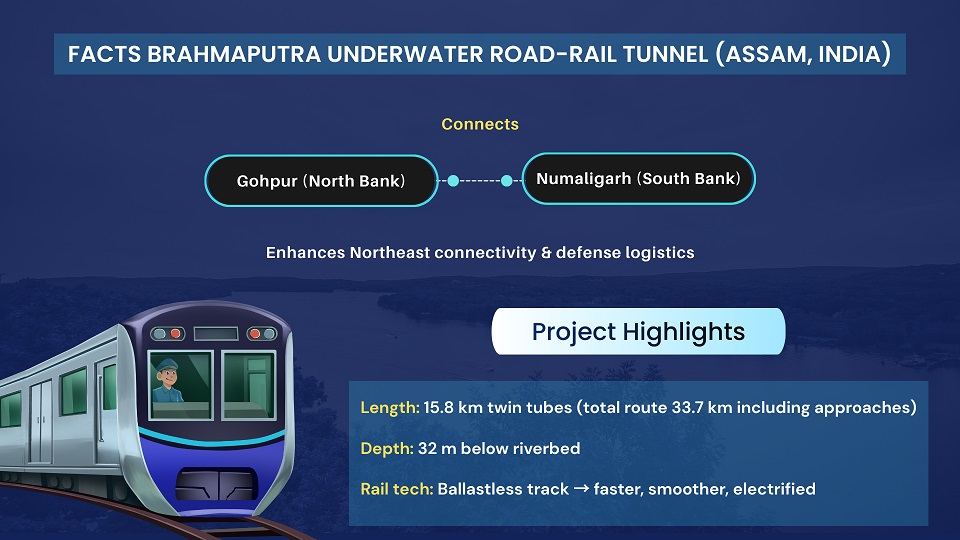
The sanction has been given by the inter-ministerial committee headed by the Expenditure Secretary, marking a major milestone in the progress of a project which has always been considered important in view of the location of Assam, which is geographically significant, especially since Assam shares a strategic boundary with China in the neighborhood state of Arunachal Pradesh. The completion of the tunnel would significantly cut down the distance as well as the time involved in crossing the Brahmaputra River.
The essence of this project lies in the 15.8 km twin tubes undersea tunnel, which is a component of the 33.7 km comprehensive route featuring approaches as well as a railway line. These tubes are designed as single-way tunnels, each having two vehicle lanes. In one of these tubes, there would only be road traffic, whereas the second would have one electrified railroad track. In this second tunnel, during train travel, there would be no traffic in the rail-equipped tubes.
It will be built at a depth of around 32 metres below the deepest level of the Brahmaputra Riverbed, making it amongst the most complex infrastructural constructions in the history of India as a whole. It will be designed using the best techniques for such a structure under the presence of the high water table as well as the alluvial soil present in the region.
One of the notable components of this project is the implementation of the ballastless rail track, which will enable easier train movement with higher speed. These rail networks will also be fully electrified, which aligns with the trends of environmentally friendly transport being adopted in India.
Once the tunnel is ready for use, the time required for traveling between the two points of Gohpur and Numaligarh will decrease from the current Six and a Half hours to just 30 minutes. The traveling distance will also decrease from the existing close to 240 kilometers to just 34 kilometers. This will certainly assist the connectivity between the states of Assam, Arunachal Pradesh, Manipur, as well as the Northeast states, thereby enhancing business as well as tourist travel between the countries.
From a strategical point of view, the tunnel has immense importance for the security of the nation. The quicker and simpler transportation of defense personnel, heavy machinery, and ammunition will significantly enhance the security readiness of India in the Northeast region. Building the tunnel has been regarded as one of the most crucial steps to make the ‘chicken neck’ area a secure corridor between the Northeast region and the rest of India.
The total cost for the project has been estimated to be around ₹18,600 crores. The financial contributions for this project have been jointly decided to be channeled through the Ministry of Road Transport and Highway, Ministry of Railways, and the Ministry of Defense. According to officials, this cost has risen compared to the previous estimates owing to the inclusion of railway infrastructure in the tunnel.
The proposal is expected to be tabled before the Union Cabinet soon for final clearance, which is expected to come before the upcoming Assam Assembly elections. Once this happens, work on this project will commence soon, with a total completion period of five years for completion of this project.
The Brahmaputra tunnel is among the three road-cum-rail tunnel projects the central government has identified, where such integration is technically feasible. The transportation ministry has identified similar proposals for key stretches in the Northeast and along the Maranahalli–Addahole (Shiradi Ghat) corridor in Karnataka.
As India ramps up investment in complicated high-impact infrastructure, the Brahmaputra underwater tunnel is turning out to be one of its landmark projects-one that combines engineering ambitions with strategic foresight and promises to reshape connectivity across one of the most vital regions of the country.





.png)