

Key Highlights of Shakuntala Bhagat’s Engineering Legacy
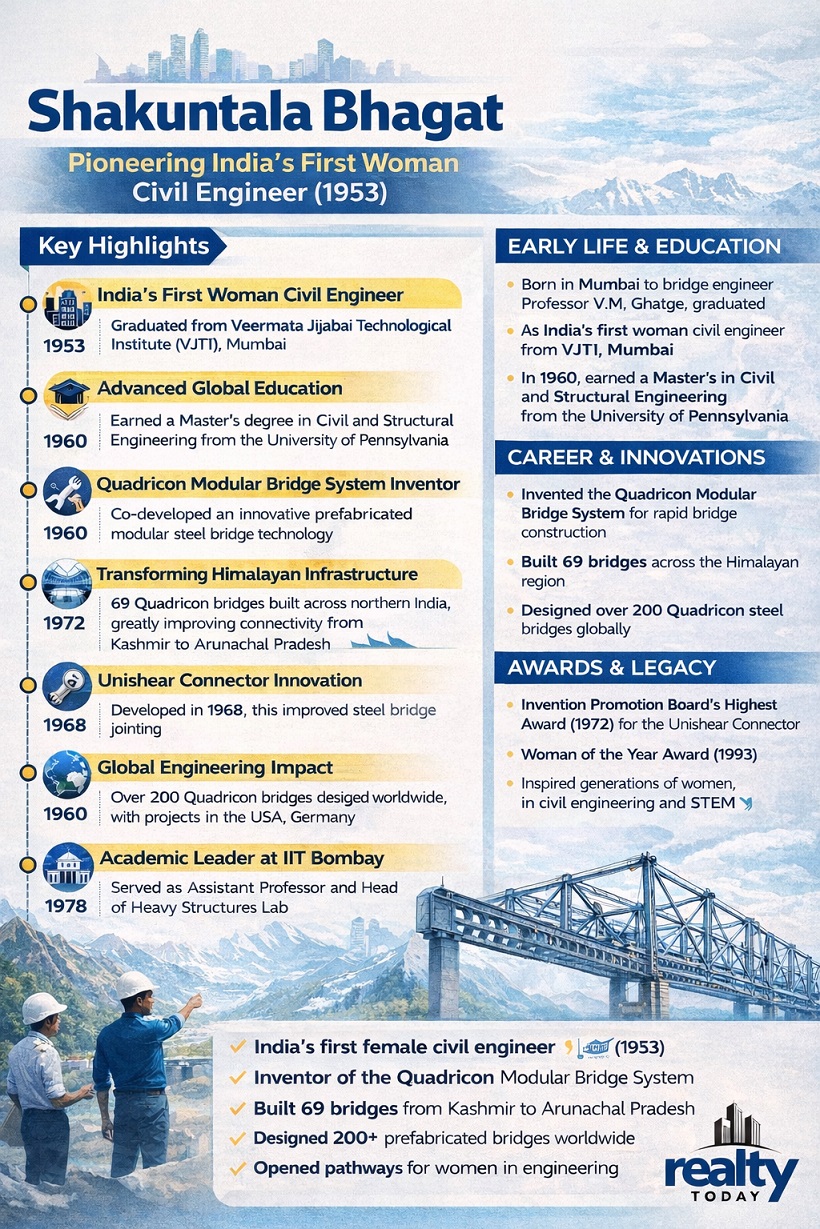
- ndia’s First Woman Civil Engineer (1953) – Graduated from Veermata Jijabai Technological Institute (VJTI), Mumbai, breaking gender barriers in a male-dominated engineering field.
- Advanced Global Education – Earned a Master’s degree in Civil and Structural Engineering from the University of Pennsylvania (1960), gaining international exposure to modern structural engineering practices.
- Academic Leadership at IIT Bombay – Served as Assistant Professor of Civil Engineering and Head of the Heavy Structures Laboratory, contributing to research in structural analysis and materials engineering.
- Inventor of the Quadricon Modular Bridge System – Co-developed an innovative prefabricated modular steel bridge technology that allowed rapid bridge construction in remote and mountainous regions.
- Transforming Infrastructure in the Himalayas – The Quadricon system enabled the construction of 69 bridges across northern India, significantly improving connectivity from Kashmir to Arunachal Pradesh.
- Global Engineering Impact – Over 200 Quadricon bridges were designed and constructed worldwide, with projects implemented in countries such as the United States, Germany, and the United Kingdom.
- Unishear Connector Innovation (1968) – Developed a revolutionary connector that improved steel bridge jointing, replacing conventional riveting and welding methods.
- National Recognition – Received the Invention Promotion Board’s Highest Award (1972) for engineering innovation, along with multiple professional honours.
- Inspiring Women in Engineering – Her achievements opened pathways for future generations of women in civil engineering and STEM fields in India.
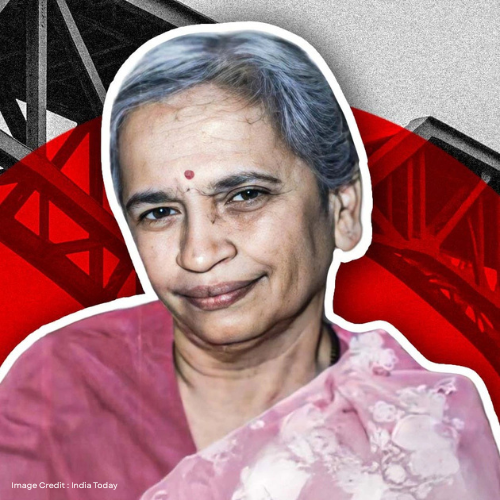
Within the history of Indian engineering, Shakuntala A. Bhagat is a pioneering figure who defied gender stereotypes and made invaluable contributions to the country's infrastructural development. When most engineering schools were male, dominated, she surfaced as India's first female civil engineer, earning her degree in 1953. Her groundbreaking innovations in modular bridge systems and structural engineering radically redefined the bridge design and construction processes in India, especially in difficult Himalayan locations.
Her life story is not just about academic excellence but also about innovation, determination, and a commitment to nation-building. Through her research and engineering breakthroughs, Shakuntala Bhagat opened doors for future generations of women.
Early Life and Inspiration
Shakuntala Joshi Bhagat was born in Mumbai into a family that had strong ties to engineering and infrastructure development. Her father, Professor V. M. Ghatge was a respected bridge engineer and academic. Growing up in an environment filled with discussions about design, engineering drawings, and infrastructure planning sparked her interest in civil engineering from an early age.
During the early 20th century, it was uncommon for women in India to pursue careers in engineering. However, Shakuntala’s upbringing encouraged curiosity and intellectual growth. Her father’s influence and her exposure to technical discussions motivated her to pursue a field that very few women dared to enter at the time.
This early inspiration laid the foundation for a remarkable career that would later influence bridge construction techniques across India and beyond.
Education and Academic Achievements
In 1953, Shakuntala Bhagat graduated from the Veermata Jijabai Technological Institute (VJTI), Mumbai, becoming India’s first woman civil engineer. Her achievement was historic because engineering colleges in India at the time had very few female students, and civil engineering was considered especially demanding.
Determined to further expand her knowledge, she pursued higher studies abroad. In 1960, she completed a Master’s degree in Civil and Structural Engineering from the University of Pennsylvania in the United States. Studying abroad during that period was rare for Indian women, making her accomplishment even more significant.
After completing her education, she returned to India and joined Indian Institute of Technology (IIT) Bombay, where she served as:
- Assistant Professor of Civil Engineering
- Head of the Heavy Structures Laboratory
Her academic work focused on structural analysis, materials research, and bridge engineering, which later influenced her innovative engineering solutions.
Career and Engineering Innovations
Shakuntala Bhagat’s career is best known for its groundbreaking contributions to bridge superstructure design. Her work addressed a major challenge in India: constructing durable bridges in difficult terrains quickly and efficiently.
Quadricon Modular Bridge System
One of her most significant achievements was the development of the Quadricon Modular Bridge System, which she created along with her husband Anirudha S. Bhagat, a mechanical engineer.
The Quadricon bridge system introduced a revolutionary approach to bridge construction using:
- Prefabricated steel components
- Standardised interchangeable parts
- A modular structural design
- Adaptability for different widths and load requirements
This system allowed bridges to be constructed faster and more efficiently compared to traditional methods. The modular design meant components could be transported easily and assembled on-site, making it ideal for remote or mountainous regions.
Transforming Bridge Construction in the Himalayas
The Quadricon system proved especially useful in the Himalayan region, where harsh terrain and difficult logistics often delayed infrastructure projects.
- 1972: The first Quadricon bridge was constructed in Spiti, Himachal Pradesh.
- Within four months, two additional bridges were built in the region.
- By 1978, a total of 69 bridges had been constructed across northern India.
These bridges stretched from Kashmir to Arunachal Pradesh, connecting remote regions and improving transportation networks. The success of the technology demonstrated that modular engineering could solve complex geographical challenges.
The innovation eventually gained international recognition, and Quadricon bridges were later used in countries such as the United States, Germany, and the United Kingdom.
Other Major Contributions
Beyond the Quadricon system, Shakuntala Bhagat made several important contributions to civil engineering.
Design and Construction Projects
- Designed and built over 200 Quadricon steel bridges worldwide
- Conducted advanced research on concrete technology
- Collaborated with the Cement and Concrete Association of London
- Served as a member of the Indian Road Congress
Unishear Connector Innovation (1968)
Another significant innovation by Shakuntala and Anirudha Bhagat was the Unishear Connector, introduced in 1968. This device improved the jointing of steel bridge components and solved problems associated with traditional methods such as riveting and welding.
The innovation was widely recognised and, in 1972, received the Highest Award from the Invention Promotion Board.
Founding Quadricon
Shakuntala Bhagat and her husband co-founded the company Quadricon, which specialised in modular bridge construction.
The company was built on a vision of creating affordable, adaptable bridge solutions for challenging terrains. The couple often invested their own resources to support research and development, demonstrating their dedication to engineering innovation and public infrastructure.
Their entrepreneurial effort ensured that their bridge technology could be implemented across India and internationally.
Awards and Recognition
Throughout her career, Shakuntala Bhagat received several awards and honours for her contributions to engineering.
Some of her major recognitions include:
- Invention Promotion Board’s Highest Award (1972) for the Unishear Connector
- Woman of the Year Award (1993)
- Recognition from various engineering institutions for pioneering contributions to bridge engineering
These awards reflected the importance of her work in advancing infrastructure and engineering innovation.
Legacy and Impact
Shakuntala Bhagat passed away in 2012 at the age of 79, but her influence on engineering and infrastructure development continues.
Her legacy includes:
- Being India’s first woman civil engineer
- Creating India’s first patented modular bridge design system
- Designing over 200 bridges worldwide
- Constructing 69 bridges across the Himalayan region
- Inspiring generations of women to pursue careers in engineering
At a time when engineering remained largely inaccessible to women, Shakuntala Bhagat broke barriers with determination, innovation, and resilience. Her journey stands as a powerful reminder of how education, courage, and vision can challenge long-standing gender norms and open new paths for women in technical fields. On International Women’s Day, her legacy becomes even more meaningful, celebrating not only her contributions to engineering but also the doors she helped open for future generations of women engineers. She is remembered as a pioneer who built not just bridges across landscapes, but also bridges of opportunity for women aspiring to shape the world through engineering.







.png)