
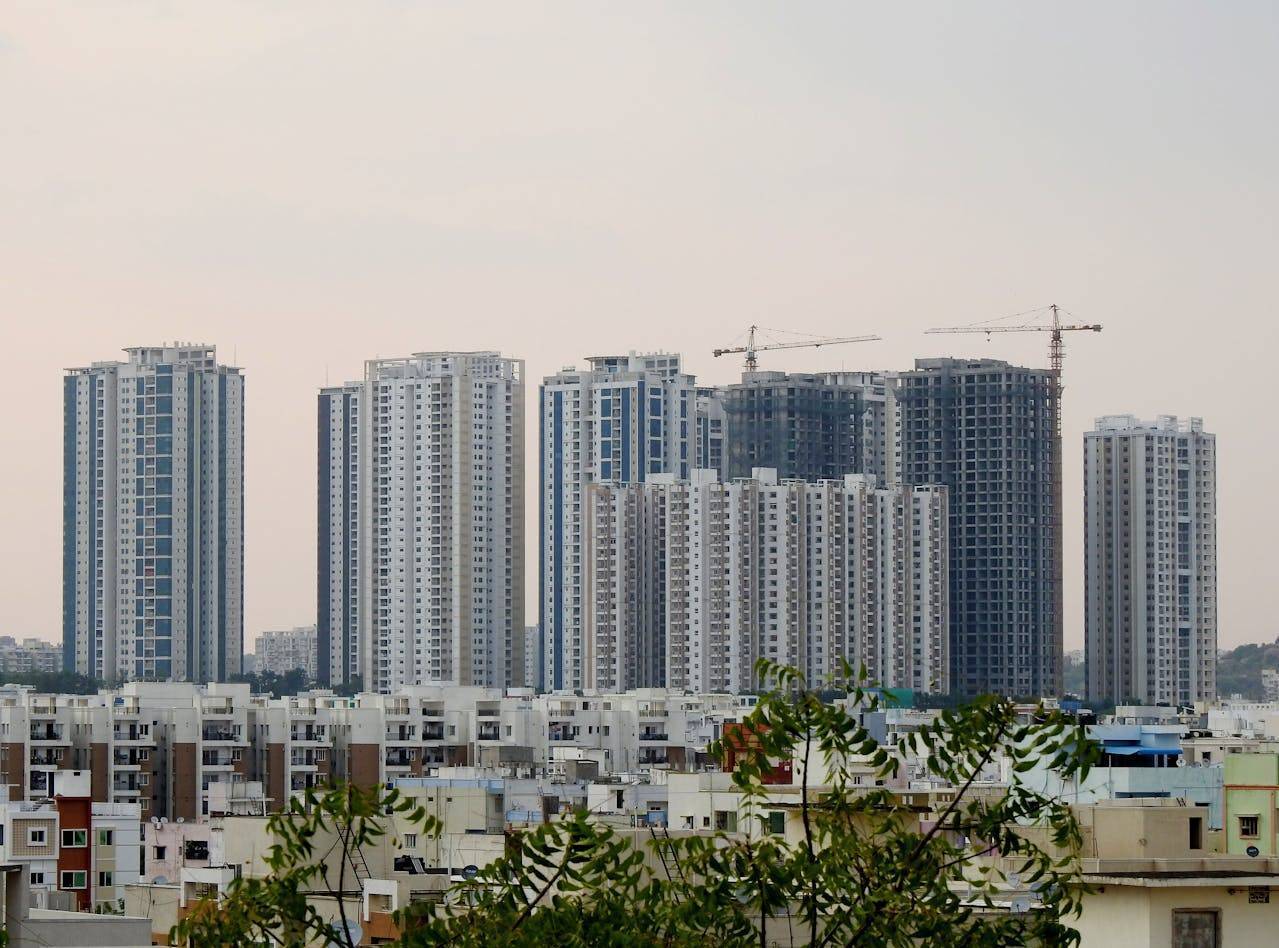
The Telangana government has made changes to the Telangana Building Rules, 2012 to allow for more flexible development, faster approvals and increasing real estate activity in the state. The changes under GO 95 issued by the Municipal Administration and Urban Development (MA&UD) department are primarily with regard to broadening the scope of Transferable Development Rights (TDR), rationalising building parameters and encouraging high-rise construction.
It is anticipated that these steps will support developers not only in Hyderabad but in other rapidly expanding urban centres as well by facilitating efficient project proposals and easing financial requirements.
One of the major changes in the amendment is the new definition of tall building. According to the revised regulation, a building having height 21 metres or more will be considered a high-rise only. However, the following non-functional parts of the boundary will be excluded such as chimney, cooling towers, lift machine rooms and water tanks. This clearer definition puts to rest the unending dispute in height computations and is expected to increase the transparency and efficiency of the approval process.
The government, besides that, has through the increased adoption of TDR considerably upgraded the capability of making it a more adaptable instrument in the hands of developers. At present, besides granting extra built-up area, TDR can also be employed for attaining regulatory relaxations and to offset the costs of development. It is anticipated that this step would entail better land utilization and allow for a more efficient planning of projects in the future.
Key provisions include:
- Buildings between 18m and 21m on plots ranging from 750 sq m to 2,000 sq m can be constructed using TDR, subject to compliance with parking and other norms
- Setback relaxations are now permitted through TDR for both high-rise and non-high-rise buildings, with high-rises allowed up to 10% relaxation while maintaining a minimum seven-metre setback
- In cases where master plan roads are altered or downsized, developers can either pay development charges or provide equivalent TDR instead of cash
Another big change is the staged submission of TDRs. Developers will need to hand over only 50% of the TDRs at the time of building permission, and the rest has to be completed before the OC is issued. This is a move to help developers financially at the start of the project and will help with the cash flow during the building time. On the other hand, the new rules also permit extra floors on bigger plots above 2,000 sq m based on the width of the adjacent road. This matches the urban density with the available infrastructure, so it is a balanced approach to increasing height.
- Up to 3 additional floors on 40-ft roads
- Up to 4 additional floors on 60-ft roads
- Up to 5 additional floors on 80-ft roads
The government has set specific TDR loading standards for high-rise buildings, where TDR loading is done proportionately to the contributed infrastructure. For example, a building with 10 to 20 floors must absorb 3% TDR for the area above the 10th floor, whereas those with more than 20 floors must load 5% TDR for the area beyond the 20th floor.
These measures are designed to balance the city's vertical extensions with the capacity of urban infrastructure. Besides, industry stakeholders, especially the Confederation of Real Estate Developers Associations of India (CREDAI) Hyderabad, have welcomed the reforms and described the initiative as a landmark in enhancing the ease of doing business. Developers have also welcomed the regulations' transparency and the possibility of phased TDR payments and broadening TDR usage.

Mr. Lakshmi Narayana G, Designated Partner, GHR Lakshmi Urbanblocks Infra LLP, said, “What is heartening to see is that the new orders were issued after examining representations that were received from various stakeholders, with the objective of rationalising the utilisation of TDR. Among many other advantages, this new TDR move certainly contributes to an optimal-capacity road network that is aimed at preventing traffic congestions in the city. For a proof of concept of how this new move could benefit, one does not have to look beyond the Neopolis layout in Hyderabad, as it is built around a "spine" consisting of 148-foot wide (8-lane) and 118-foot wide (6-lane) arterial roads, pedestrian-friendly infrastructure, cycle tracks, and tree-lined zones to ensure smooth movement. This infrastructure in Neopolis is aimed at handling the heavy traffic expected from high-rise residential and commercial developments, including 60+ floor towers."
The changes demonstrate Telangana's desire to establish a regulatory environment that caters more to developers and a growth-oriented one. Through facilitating compliance, offering more flexibility, and lessening financial burdens, the state is setting itself up as a prime place for real estate investments. With urbanization speeding up and a rise in the demand for well-developed properties, these changes are anticipated to be instrumental in determining the next growth cycle of the real estate industry in Telangana.







.png)