

For most of India's real estate history, the "homebuyer" was implicitly male including the name on the sale deed, the loan applicant, the decision-maker a broker or salesperson pitched to.
Four independent data sets released in 2026 say that assumption is now out of date: a national homebuyer sentiment survey, a consumer research firm's tracking study, registration data from a global property consultancy and multi-year investment-preference research all point in the same direction.
Women have gone from a footnote in Indian real estate to a buyer segment developers can no longer build around, or market to, as an afterthought.
Line up the four sources and the story is consistent even though each measures something slightly different; survey composition, national transaction share, city-level registrations and lending data.
Here's each source's headline number, at a glance:
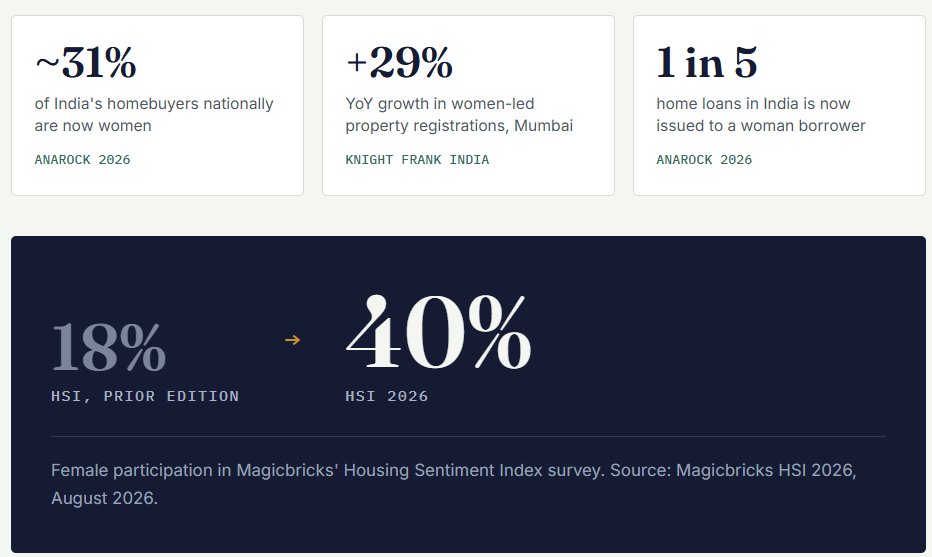
None of these figures are interchangeable, and none should be added together as they describe different populations (survey respondents, tracked national transactions, one city's registration data).
The reports and the numbers are the clearest evidence that this is a structural shift, not a single platform's anomaly.
2. The Transaction Data: Anarock and Knight Frank Confirm the Trend
Sentiment surveys can run ahead of reality. Registration data can't — it's a record of money that actually changed hands.
That's why the Knight Frank number above matters:
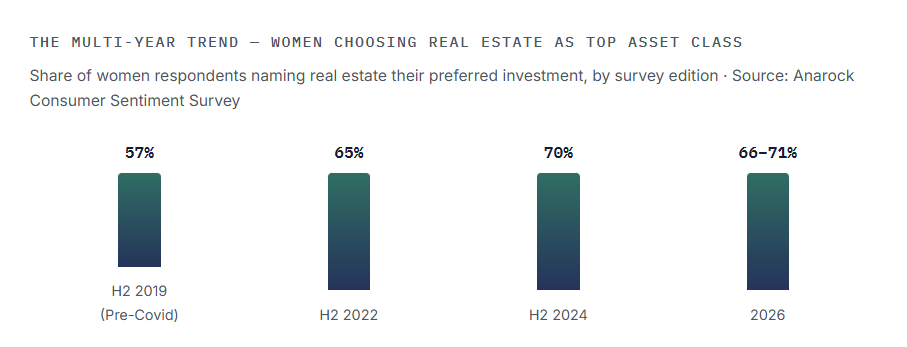
Reeza Sebastian Karimpanal, Chief Revenue Officer – Residential at Embassy Developments, has pointed to industry data showing close to a third of women buyers now purchase specifically for investment rather than end-use — a shift from the older pattern of real estate as a family-decided, end-use-only purchase.
Knight Frank's Reshmi Panicker has framed the same trend as structural rather than cyclical, tying it to rising workforce participation, greater financial independence, and targeted incentives such as Maharashtra's stamp duty concession for women buyers.
03. What Women Are Actually Buying
The Anarock data also breaks down budget and intent, and the picture is more premium than the "affordable housing for women" narrative that dominated a decade ago.
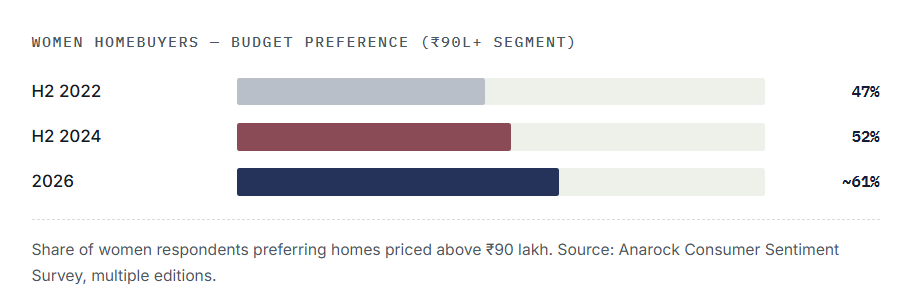
Within that premium band, most demand clusters between ₹90 lakh and ₹1.5 crore, with a smaller but growing segment exploring ₹1.5–2.5 crore properties.
On intent, the split leans toward living in the home rather than flipping it:
Roughly 69% of women buyers purchase for end-use, against 31% buying primarily as an investment.
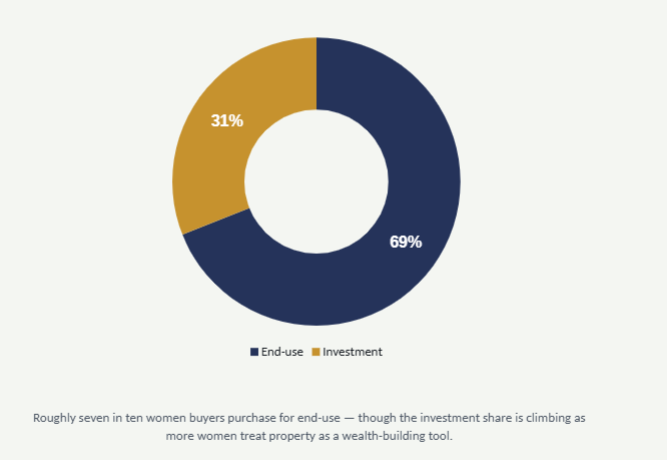
Though that investment share has been climbing as more women treat property as a wealth-building instrument rather than a family milestone alone.
ASSET-CLASS SHIFT
Women's preference for equities has fallen sharply; from over 20% in H2 2022 to just 2% in H2 2024, per Anarock; while gold has held a modest, stable ~12% share.
Real estate has absorbed almost all of the difference.
04. The Policy Tailwind: Stamp Duty and Home Loan Concessions
None of this is happening in a policy vacuum.
Most states now build a direct financial incentive into registering property in a woman's name, and lenders layer a second incentive on top through the interest rate.
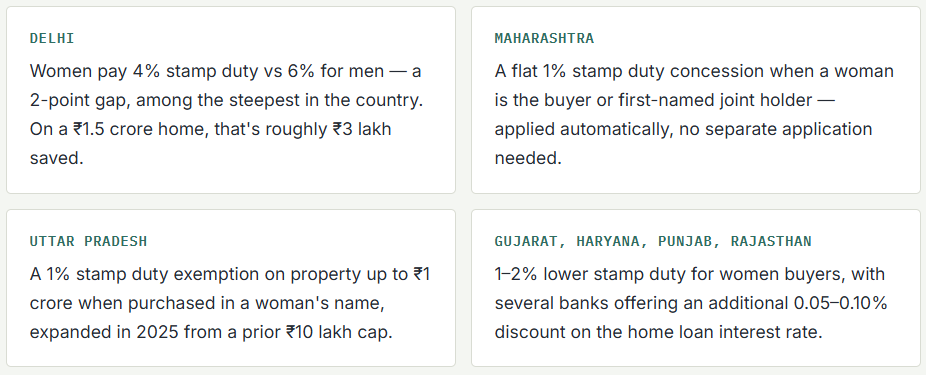
Layer on the Pradhan Mantri Awas Yojana (PMAY) interest subsidy, up to ₹2.67 lakh, available only when a woman is owner or co-owner in eligible income categories and a near-universal 0.05% lower home loan interest rate most major lenders extend to women borrowers, and the combined saving on a mid-sized purchase can run into several lakh rupees.
Bankers and brokers alike note the same failure point, though: many families still register property in the husband's name out of habit, or add a male co-owner unnecessarily, and lose the concession without realising it.
05. Why Now - The Five Forces Behind the Shift
1. INCOME
Rising female workforce participation and dual-income households have handed more women direct control over a down payment and EMI decision, not a supporting role in someone else's.
2. POLICY
State stamp duty concessions and PMAY's woman-ownership requirement put a real rupee figure behind registering property in a woman's name, turning a values-based choice into a financial one.
3. ASSET MIX
Volatile equities and modest fixed-deposit returns through 2025–26 have pushed real estate ahead of gold and stocks as women's preferred store of value.
4. DIGITAL ACCESS
Listings platforms, virtual tours and online loan pre-approval have lowered the friction of researching and shortlisting a home independently, without a broker or family intermediary as the default first step.
5. LIFE STAGE
A younger, more career-established cohort of women is reaching homebuying age with more savings and more deliberate timing — overlapping directly with the Gen Z and millennial wave the HSI 2026 also flags as the market's most confident buyers.
Stop treating women buyers as a niche audience segment.
At roughly a third of the national buyer base and 40% of active platform intent, this is approaching parity, not a micro-segment worth a single campaign line or a Women's Day promotion.
Lead with safety, documentation clarity and independent ownership.
In messaging aimed at first-time women buyers, with close to seven in ten buying for end-use rather than investment, locality, safety and lifestyle content will land harder than a pure ROI pitch while still making the concession math (stamp duty, PMAY, interest rate) explicit, since awareness of these benefits remains inconsistent.
Design sales journeys that don't assume a male co-buyer.
Loan pre-approval flows, site-visit scheduling and legal documentation built around a "primary earner + spouse" default under-serve the growing share of women buying and applying independently.
Layer the generational read on top of the gender read.
With Gen Z posting the highest sentiment of any age group this cycle, a meaningful share of new women buyers are likely to be young, first-time, digitally-sourced leads which should shape ad platform choice, content format, and loan-partner tie-ups alike.