

In the real estate world, things are not as simple as they may seem. The price you agree upon paying is just one aspect of the equation. What is not visible is the two most important rates—Circle Rate and Market Rate, associated with the transaction, which have significant financial and legal implications on the entire process.
Most people, especially first-time buyers, only concentrate on the market rate agreed upon in the deal with the seller. However, the circle rate is often overlooked, which may attract unwanted attention in the form of higher stamp duty, registration fees, and even income tax authorities.
It is therefore important to know the interdependence of the circle rate and the market rate in the real estate world, not just from a compliance point of view but as a smart move in the world of real estate.
What is Circle Rate?
The minimum price for which property is sold in a particular area is known as Circle Rate. It is also referred to as Guideline Value or Ready Reckoner Rate. It is decided by state governments. It varies according to factors such as location, land use, etc.
It is a minimum value for calculation of stamp duty and other charges. It is a legal fact that no property can be sold below the Circle Rate, irrespective of mutual agreement between buyer and seller to purchase or sell a property for a lower value.
The major intention behind Circle Rates is to stop property undervaluation and to generate proper tax revenue for the government from property deals.
But Circle Rates are not entirely in sync with real property values. It is revised periodically and not constantly. It is likely to be out of sync in areas that are developing very fast.
What is Market Rate?
Market rate is the actual rate at which a property is sold or bought. It is different from the circle rate in the sense that it is not fixed by any government authority. It is the outcome of a negotiation between the buyer and the seller of the property.
Market rate is the actual reflection of the practical situation. It takes into account the actual situation of the market, the advantages of the property's location, and the quality of the property. It is a very dynamic rate and can change very frequently. It is observed that the rate of the property is much higher in the market than the circle rate.
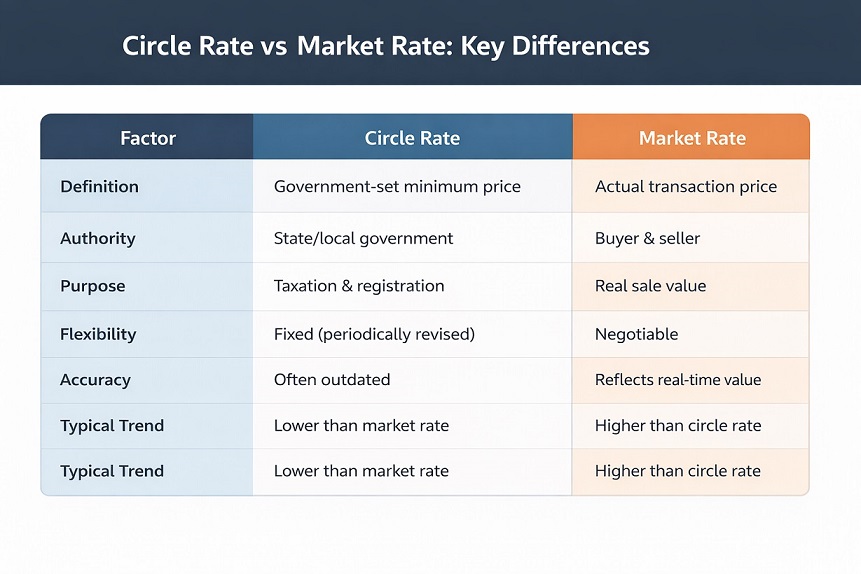
Key Differences Between Circle Rate and Market Rate
While both terms relate to property valuation, their roles and implications are very different. Circle rate is a regulatory benchmark, while market rate reflects actual economic value.
- Circle rate is set by the government; market rate is decided by buyers and sellers
- Circle rate is used for taxation; market rate determines the actual transaction
- Circle rate is revised periodically; market rate changes frequently
- Circle rate ensures compliance; market rate indicates investment potential
Understanding these differences helps buyers evaluate not just the price of a property, but also its overall financial impact.
Why There is a Gap Between the Two?
In any city, there exists a difference between the circle rates and the market rates. There are various reasons behind the presence of such a difference.
The first reason behind the difference between the circle rates and the market rates is the revision of the rates. The circle rates are revised from time to time, whereas the market rates are subject to frequent changes due to the increase or decrease of demand.
The second reason behind the difference between the two rates is the conservative approach of the authorities. The circle rates are generally set at lower rates to ensure the smooth flow of transactions.
The location of the property also plays a vital role in the difference between the circle rates and the market rates. In areas like the premium segment, the rates are higher than the circle rates.
Financial Impact on Buyers
For property buyers, the difference between circle rate and market rate has direct financial implications. It affects not only the purchase price but also additional costs and funding requirements.
Stamp duty and registration charges are calculated on the higher of the circle rate or the transaction value. This means that if the market price is higher than the circle rate, buyers must pay charges based on the higher amount. Conversely, if the market price is lower, the circle rate still becomes the basis for calculation.
This can significantly increase the overall cost of buying a property, especially in areas where the gap between the two rates is large.
Home loan eligibility is another important aspect. Financial institutions may consider the registered value or conduct their own valuation, which may not always match the market price. As a result, buyers may need to arrange a higher down payment to cover the difference between the loan amount and the actual purchase price.
Tax Implications
Another important aspect where the circle rate is crucial is in terms of taxation. Transactions that take place below the circle rate may raise suspicions of attempts to lower the value of the property.
For buyers, if they buy the property below the circle rate, they may have to pay more tax as the difference may be considered deemed income under the tax laws. Similarly, for the sellers, it may affect their capital gain tax.
These factors make it imperative that both parties ensure that the transaction is in accordance with the law.
Example
Imagine a real estate with a circle rate at 6,000 per sq. ft and a market rate at 8,500 per sq. ft. The difference will be pretty big for a 1,000 sq. ft apartment. The circle value of the property will be 60 lakhs and the market value will be 85 lakhs.
If the deal is done at the market rate, stamp duty and registration charges will be based on 85 lakhs. At the same time, the bank loan may not be enough to fully pay for this amount, depending on its valuation criteria. So the buyer will have to gather additional funds, which will raise the overall financial stress. These situations emphasize the need to take both rates into account when making financial plans.
Common Mistakes Buyers Should Avoid
Most buyers underestimate the significance of the circle rate. They make decisions based on the market price alone.
- Ignoring circle rate while calculating the total cost
- Assuming the loan sanction will be as per the market price
- Trying to bring down the transaction value to save tax
- Ignoring the difference between the circle rate and the market rate
Smart Strategies for Buyers
A knowledgeable buyer will always look for balance in both regulatory and market aspects while making decisions. Checking circle rates through government websites and comparing them with market rates in the area can be beneficial for buyers.
Additional costs such as stamp duty, registration costs, and loan deficit should be factored in while planning to buy a property. Buying in areas where the circle rate and market rate are close to each other can be beneficial for buyers as it will cause less stress for them in the long run.
The most important thing to remember is to be transparent in all dealings and avoid practices such as undervaluation, which can put buyers in trouble.
When Circle Rate is Higher Than Market Rate?
Although less common, there are situations where circle rates exceed market rates. This usually occurs in slow or declining markets where property demand has weakened.
In such cases, buyers are required to pay stamp duty based on the higher circle rate, even if the actual purchase price is lower. This increases the cost of acquisition and can discourage transactions. Sellers, on the other hand, may find it difficult to close deals, leading to reduced market activity.
Conclusion
Circle rate and market rate are two important aspects of real estate transactions. The circle rate is important for regulatory compliance and paying taxes, whereas the market rate is important for the economic value of the property. For buyers of real estate properties, it is important to understand the relation between the circle rate and the market rate. The relation between the two rates is important to understand the economic value of the property. The relationship is important to avoid legal and tax issues.
In today's transparent and regulated real estate market, the key to successful real estate investment is to make informed decisions. The informed decisions can be made after analyzing both the circle rate and the market rate.




.png)