

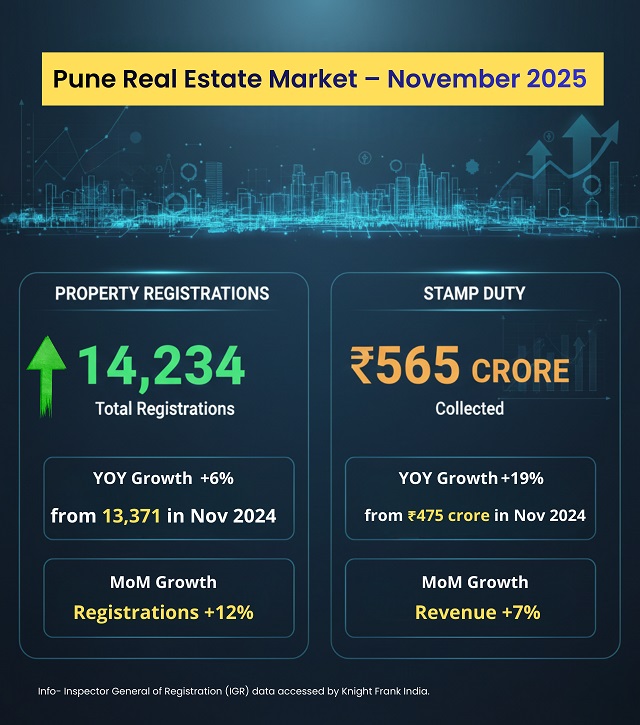
The residential real estate market in Pune has been very active with over 14,000 property registrations recorded in November 2025. The area generated more than Rs. 565 crore in stamp duty revenue, as per the data of the Inspector General of Registration (IGR) accessed by Knight Frank India.
The city recorded 14,234 registrations in the last month compared to 13,371 units in November 2024, thus registering a year-on-year growth of 6%. The collections from the stamp duty were also increased by 19% from Rs. 475 crores to Rs. 565 crores during the same time. Comparing month-on-month numbers also suggested an increase as the registrations were elevated by 12% and the revenue had a 7% increment, which was an indication of achieving level buyer interest even if the season is not at its peak.
From January to November 2025, Pune has seen the registration of 1,73,578 property transactions, which is more than the 172,677 units recorded during the same period in 2024.
Pune's housing market has been undoubtedly on the rise throughout 2025. The number of registrations in November exceeded 14,200, with collections from stamp duty going beyond Rs. 560 crores, thus giving a clear indication of the strength of end-user demand, stated Shishir Baijal, the Chairman and Managing Director of Knight Frank India.
Mid-Segment Homes Drive Market Activity
By analyzing the ticket sizes, one can infer that homes with a price of up to Rs. 1 crore were the most popular and accounted for 85% of the registrations. Properties that were above Rs. 1 crore made up the 15% remainder, while transactions exceeding Rs. 5 crore were less than 1% of the total number of operations. This is a clear indication of the segments of mid- and affordable housing that have gained initial traction, while the segment of luxury has remained stable in terms of interest.
As for the unit sizes, the 500-800 sq ft range was still the biggest one at 46%, the ones over 800 sq ft were 29%. Moreover, the smaller units of less than 500 sq ft have changed downward slightly from 25% to 24%, at the same time, those with the size of 800-1,000 sq ft have changed upward slightly from 13% to 14%. The proportion of units that are 1,000–2,000 sq ft has been decreased slightly from 13% to 12%, while the percentage of those that are ultra-large and above 2,000 sq ft has remained at 3%.
Central Pune, West Pune, and North, South, and East Pune
Central Pune that is made up of areas under Haveli taluka, Pune Municipal Corporation (PMC), and Pimpri Chinchwad Municipal Corporation (PCMC) was the most significant contributor with 66% of the registrations in November. West Pune the areas of Mawal, Mulshi, and Velhe, which has been the second-largest area in terms of contributions to registrations, accounted for 15% of the registrations, while North, South, and East Pune combined accounted for the remaining 18% of the activity.
The market is still very strong and balanced, backed by a demand that is widely spread over micro-markets and price segments, Mr. Baijal further added.
Drivers of Sustained Demand
The experts in the real estate field explain Pune's excellent property performance as a result of committed urban migration, a booming IT and industrial sector, and a surge in investor confidence in residential projects. The developers are continually producing more and more mid-sized apartments and affordable housing to satisfy the requirement of end-users and first-time buyers.
Girish Kamble, CEO – West, Tribeca Developers , said, “At Tribeca, our experience in Pune has taught us that the city’s demand for high-quality housing continues to evolve in tandem with its growing urban infrastructure and thriving corporate ecosystem. We witnessed this firsthand when we launched the final tower of our luxury project, The Ark, selling 40% of the inventory within just a few weeks. Pune’s real estate market has shown remarkable resilience, with average housing prices reaching an all-time high, reflecting a double-digit growth. Over the past five years, the city has consistently demonstrated a 40% price appreciation and a robust absorption of over 85,000 homes annually. This performance firmly establishes Pune as a preferred destination for discerning homebuyers seeking both value and quality.”
Changes in city planning such as new metro lines, better road connectivity, and more commercial areas are essentially the reasons that people are getting attracted to micro-markets like West and North Pune. In addition, lifestyle amenities such as good schools, hospitals, shopping centers, and parks are the dominating factors that decide the purchaser's inclination.
The attribute of the festive season, which was earlier in the year, has been pointed out by Knight Frank India, as one of the most significant reasons for the spike in the activity.
The market analysts are of the opinion that Pune's real estate activities will be more or less of the same character in the first quarter of 2026. With hardly any inventory in the prime micro-markets and constant end-user demand, the registration volumes and stamp duty collections will most probably continue to grow.
Pune is still managing to attract buyers in spite of seasonal fluctuations. These buyers are looking for residential properties that are reasonably priced and strategically located, remarked Mr. Baijal. One can say that 2025 is turning out to be one of the strongest years in the recent past in terms of both transaction volumes and revenue for the city, he added.






.png)