
The residential real estate market in Mumbai continued to grow during the first half of 2026, with more than 80,000 property transactions being recorded, indicating consistent demand from end-users and stable buyer confidence in the financial capital of India. Based on market study, the city recorded 80,221 real estate transactions in the first half of 2026, witnessing a continued upward trend on an annual basis and establishing itself firmly among the most resilient housing markets in the country.
Based on the registration data analysed by Knight Frank India,, the city falling under the jurisdiction of the Brihanmumbai Municipal Corporation posted its strongest first-half showing since 2013. The figures include primary sales and secondary market transactions which point to a wide range buyer participation rather than the dominance of one buyer category.
Stamp Duty Revenue at ₹6,968 Crore
On the revenue front, Mumbai was able to provide the Maharashtra state government with a sum close to 6,968 crore via stamp duty collections which indicated a slight but still steady increase over last year. This mix of rising quantities coupled with continuous level revenue lead to a conclusion that not only has the transaction activity increased but typical deal sizes have largely stayed equal, with higher involvement from housing segments of mid-income level.
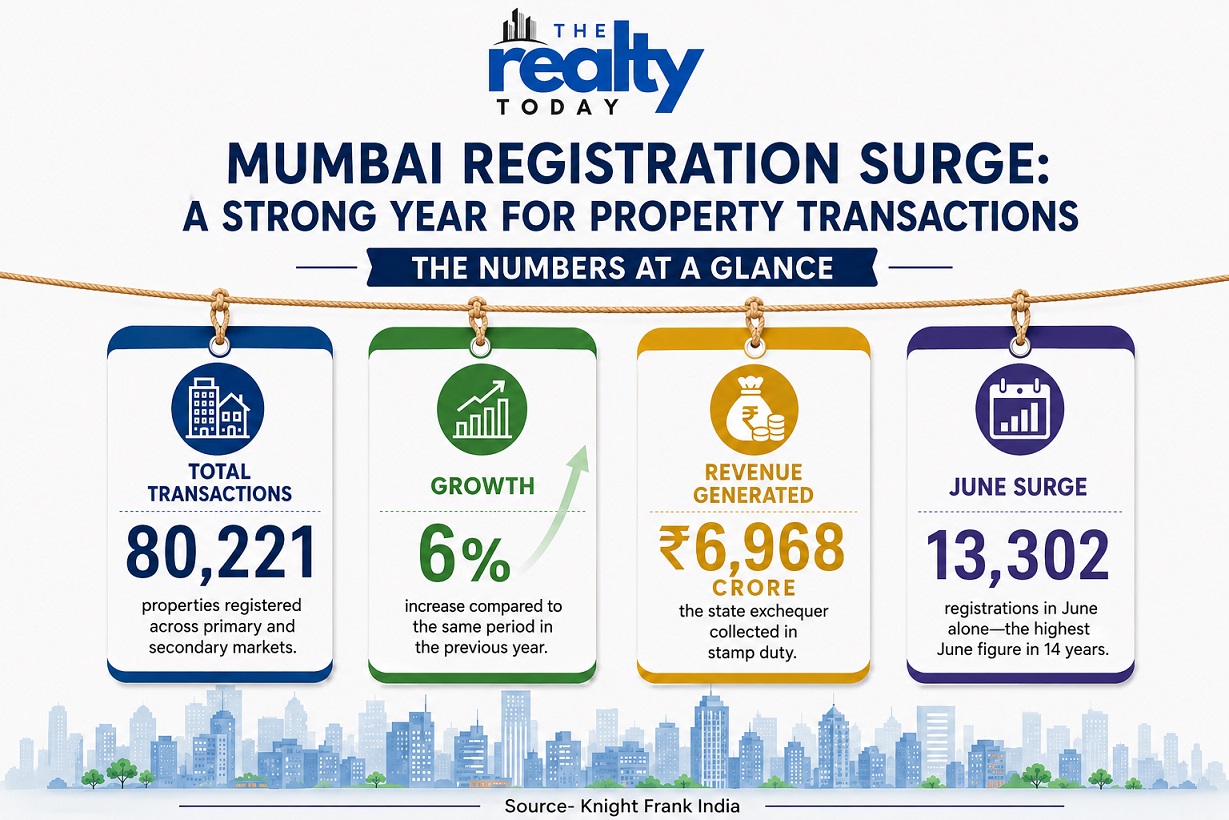
What really struck me about the first half of 2026 was how June performed. This month is about to be the best June for property registrations in the last 14 years at least, if not even longer. Just this one month tends to account for around 13,302 transactions, which means a year-on-year hike of almost 15%. Stamp duty revenues for June, which would mirror this activity level, are expected to surpass 1,000 crore, showcasing that there is still a lot of strength in the housing market even when performance is already high.
End-User Demand Drives Growth
To understand this continual upward trend, the first thing that comes to mind is the combination of fundamental changes and temporary market conditions. For one thing, a great end-user demand has been the main driving force, and there have been hardly any buying activities for speculation as was the case in phases of the market earlier. Buyers, it seems, are more concerned about enduring value, location safety and the credibility of the project rather than quick making money through price rise.
Rise of Redevelopment Projects
The market is also getting influenced by another quite significant factor which is the increased liking of redevelopment schemes in old localities. Developers and researchers say that buyers are becoming more inclined to change their homes in the familiar micro-markets rather than moving to outer or newly developing zones. It is because redevelopment in South Mumbai and connected central suburbs not only gives one access to modern facilities but also preserves one's link to well-established infrastructure. This is a big factor that has caused this pattern compared to other areas.

Shishir Baijal, Chairman and Managing Director of Knight Frank India, has noted, the residential market in Mumbai has kept its strong momentum, and in fact, June 2026 witnessed the highest number of property registrations for the month in the last 14 years. The market should have been sustaining homebuyer confidence, and the resilience of end-user demand is demonstrated by this performance even though it is a high base from last year. The strength of the market is also evident in the registrations for the first half of 2026, which continued to increase over an already strong first half of 2025.
Experts highlighted that the real estate market is witnessing a clear shift toward redevelopment-led growth, as homebuyers prioritise established locations with better connectivity and social infrastructure.
Transaction Mix Shifting
Although registration figures have gone up, stamp duty increase has been quite limited actually. This points to a (somewhat) subtle change of the composition of the transactions with a bigger portion of the share of the mid-market housing dealing than the high-value luxury transactions. Diversification (partly) is widely seen as a good indicator of the market's long-term stability as it mitigates the risk of relying solely on a single segment on prices.
The Mumbai residential market is anticipated to keep up its progress without losing its pace. Builders are getting on with their plan of carrying out redevelopment projects, at the same time, demand is largely supported by the end-users who are looking for long-term residential solutions. The pricing is expected to witness little change and this will be mainly due to the level of sales, which has been very consistent so far, and also Really there are ongoing infrastructure developments in the major micro-markets.