
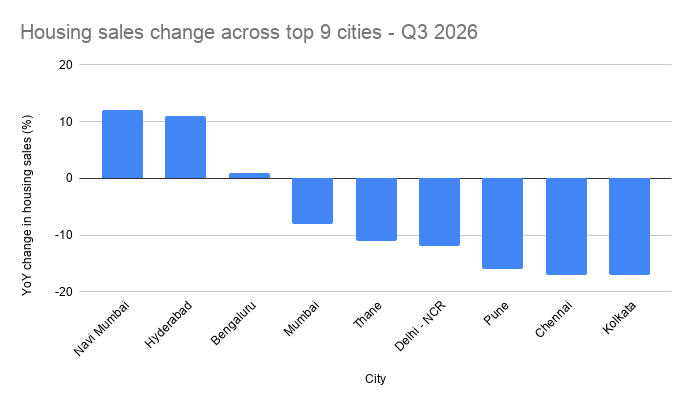
Housing sales across nine major Indian cities fell 6% year-on-year to 1,03,170 units during the July-September quarter, as demand remained subdued and developers brought fewer new homes to the market. Sales were also down 4% from the previous quarter, according to the latest residential market data.
New housing supply stood at 98,165 units during the quarter, compared with 1,00,330 units in the same period last year. On a sequential basis, however, new supply fell 15% from 1,15,010 units in the April-June quarter, after housing sales across the top nine cities had grown 19%. This meant that the number of homes sold during the quarter was higher than fresh additions to the market by nearly 5,000 units.
Sales fall to 1.03 lakh units in Q3
The drop in sales was spread out across most of the major housing markets, but the drop was more severe in some cities than others. Pune, Chennai and Kolkata saw some of the biggest declines on a year-on-year basis, while Mumbai and Thane also saw lower sales in the last three months.
Pune saw sales of 17,860 units, down 16% from 21,190 units a year ago. Chennai and Kolkata both recorded a 17% drop, with sales of 4,680 units and 3,860 units, respectively. Delhi-NCR recorded a 12% decline to 8,090 units.
Mumbai's sales were down 8% to 9,830 units, while Thane recorded an 11% decline to 16,230 units. The figures point to a softer quarter for several established residential markets compared with the same period last year.
Developers pull back on fresh launches
The sharper decline in new supply compared with sales is one of the key features of the quarter. New launches fell 15% from the previous quarter, indicating that developers were more selective about bringing additional inventory into the market.
The reduction was particularly visible in Thane, where new supply declined 28% sequentially. Chennai recorded a 22% fall, while launches in Delhi-NCR declined 19%. Pune also saw a reduction in new supply during the quarter.
The trend indicates that developers are tracking sales and existing inventory more closely before initiating new projects. The July-September period is also typically slow for residential activity with sales picking up during the festive months towards the end of the year due to the monsoon.
Housing sales rise in Hyderabad and Navi Mumbai
Not all markets saw a decline. Navi Mumbai had the highest growth among the nine cities with rising housing sales by 12% to 9,810 units from 8,730 units in the year-ago quarter.
Hyderabad came close with an 11% rise, with sales of 15,470 units compared with 13,890 units a year earlier. Bengaluru remained largely stable, with sales increasing 1% to 17,340 units.
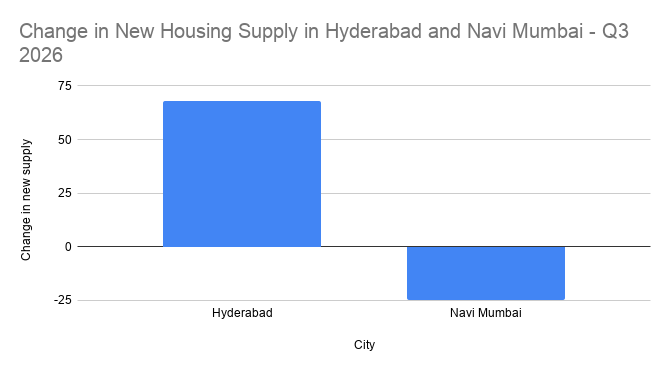
Hyderabad also stood out on the supply side. New launches in the city rose 68% year-on-year even as sales increased 11%, making it one of the markets where fresh inventory expanded considerably during the quarter. In contrast, Navi Mumbai saw new supply decline 25% year-on-year.
Housing market enters a more measured phase
The latest figures show a market that is still recording more than one lakh housing sales in a quarter across the nine tracked cities, but at a slower pace than a year earlier. At the same time, developers have reduced the pace of fresh additions in several markets.
The contrasting performance across cities also shows that the slowdown is not uniform. While Pune, Chennai, Kolkata and Mumbai recorded declines, Hyderabad and Navi Mumbai continued to see growth, with Bengaluru holding broadly steady.
With the festive season typically bringing stronger homebuying activity, the next quarter will provide a clearer indication of whether the moderation in sales is temporary or marks a longer period of more measured growth in the major residential markets.