

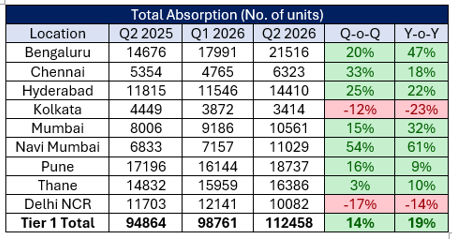
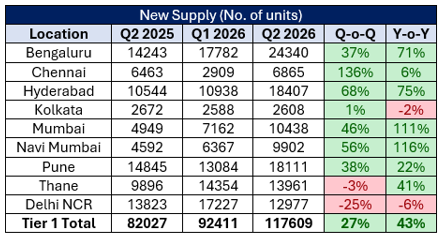
Unaffected by the geopolitical uncertainties in the Middle East, housing sales in India’s top 9 cities rose 19% YoY to 1,12,458 units in Q2 2026 on the back of multi-quarter rise in housing supply at 1,17,609 units, up 43% YoY, according to a report by NSE-listed real estate data analytics firm PropEquity.
On Q-o-Q basis, sales rose 14% while supply rose by 27% in Q2 2026.
The southern markets outperformed other markets with Bengaluru witnessing 47% growth at 21,516 units, Hyderabad 22% growth at 14,410 units and Chennai 18% rise at 6323 units.
The western markets, too, saw strong housing sales with Navi Mumbai recording 61% growth at 11,029 units, followed by Mumbai 32% at 10,561 units, Thane 10% at 16,386 units and Pune 9% at 18,737 units.
Kolkata with 23% decline at 3414 units and Delhi-NCR with 14% decline at 10,082 units lagged in housing sales in Q2 2026.

Mr. Samir Jasuja, Founder and CEO, PropEquity said, “Indian housing market has remained resilient despite the geopolitical uncertainties in the Middle East. Southern markets continue to lead growth, while Mumbai and Navi Mumbai have also seen strong demand. Although some regions such as Thane and Delhi-NCR have witnessed relatively softer activity, overall market sentiment remains positive.”
“An important trend has been the rise in new supply after several quarters of constrained launches leading to stronger absorption levels across key markets. This indicates that demand remains healthy and the ongoing conflict has had minimal impact on the real estate sector.”
On the supply front, Navi Mumbai topped with 116% YoY growth at 9902 units followed by Mumbai with 111% growth at 10,438 units, Hyderabad with 75% growth at 18,407 units and Bengaluru with 71% growth at 24,340 units. Markets like Chennai, Pune and Thane saw growth in supply between 6%-41%.
Hyderabad emerged as the second highest housing supply market after Bengaluru displacing Pune, Thane and Delhi-NCR.
Delhi-NCR saw 6% decline in housing supply at 12977 units while Kolkata saw 2% decline at 2608 units.
Jasuja further added, “We are also witnessing greater interest in the Indian real estate market from investors who were previously evaluating opportunities in the Middle East due to India's economic stability, infrastructure growth and encouraging long-term real estate fundamentals.”

Mr. Umesh Gowda H A, Chairman and Founder of Sanjeevini Group, said, “India’s housing market has demonstrated remarkable resilience despite the geopolitical tensions in the Middle East. Strong economic fundamentals, sustained policy support and healthy domestic demand have helped the sector remain largely insulated from external uncertainties. Bengaluru, in particular, continues to stand out as one of the country’s strongest residential markets, driven by robust office leasing activity, steady job creation and relatively attractive pricing compared to other major metros. These factors have supported sustained momentum in both housing demand and new project launches, reinforcing the city’s position as a preferred destination for homebuyers and investors alike.”

Mr. Lalit Parihar, Managing Director, Aaiji Group, a Dholera-based real estate firm, said, “India’s housing market continues to demonstrate strong growth despite the Middle East conflict. The sharp increase in supply has expanded choices for homebuyers, while strong absorption levels indicate that underlying demand remains healthy across major markets. The reworking of supply pipelines by developers especially in Southern and Western India to suit the affordability of homebuyers have helped sales growth. Additionally, India’s stable economic outlook, improving infrastructure and growing investor confidence have enabled the housing market to maintain its growth trajectory reaffirming real estate as a preferred asset class for both end-users and investors.”