
Key Takeaways on Anti-Corrosion Coatings in Construction
- Corrosion is a major threat to infrastructure, causing deterioration in reinforced concrete structures, steel bridges, industrial plants, marine structures, and parking facilities.
- Anti-corrosion coatings act as protective barriers, preventing moisture, oxygen, chlorides, and aggressive chemicals from reaching metal surfaces and initiating corrosion reactions.
- Multiple coating products are used in construction, including epoxy, polyurethane, zinc-rich primers, cementitious coatings, bituminous coatings, acrylic coatings, fusion bonded epoxy (FBE), and polyurea systems.
- Epoxy and polyurethane coatings are among the most widely used, offering strong adhesion, chemical resistance, UV protection, and long-term durability for steel and concrete structures.
- Proper surface preparation, application conditions, and regular maintenance are critical for ensuring the long-term performance of anti-corrosion coating systems.
- India’s anti-corrosion coatings market is expanding rapidly, driven by infrastructure growth, industrial development, and increasing demand for durable, high-performance protective materials.
Corrosion is considered a major factor that leads to the deterioration and incurring of high expenses on constructions and infrastructures globally. Through corrosion, reinforced concrete buildings, steel bridges, industrial plants, marine structures, or parking facilities, have all become significantly structurally weakened, faced safety risks, and required very costly repairs.
Normally, in concrete structures with steel reinforcements, the corrosion is limited to the steel reinforcement that is embedded in concrete. On the other hand, when dealing with steel composite structures, the whole structural member is at risk. To tackle this problem, there are still a lot of anti-corrosion coatings that serve as protective systems. These coatings are physical and chemical barriers, which prevent the components of the environment like moisture, oxygen, chlorides, and other harmful agents from coming into contact with metal surfaces.
Understanding Corrosion in Construction
What is Corrosion?
Corrosion is a chemical reaction of metal with its surrounding. For example, when iron gets in contact with oxygen and water, it undergoes corrosion and produces iron oxide, commonly known as rust. The very process of rusting iron weakens its structure.
Corrosion in Reinforced Concrete
Steel reinforcement inside concrete is generally protected from the agents of corrosion. The low pH of concrete can be significantly affected by carbonation or chlorides. When steel rusts, it swells and thus exerts pressure on the concrete causing it to break.
Why Anti,- Corrosion Coatings are a Vital Part of Construction?
- Anti- corrosion coatings significantly help in preventing the structures from:
- Moisture and oxygenChloride penetrationChemical exposure
- Life extension of the structureReduction of maintenance costs
Types of Anti-Corrosion Coatings
1. Epoxy Coatings
In the construction industry, one of the most popular anti- corrosion systems used is epoxy coatings. They are made of epoxy resins and curing agents which when mixed chemically react to form a hard, dense, and durable layer.
Epoxy coatings give excellent adhesion on surfaces of steel and concrete. They make a highly impermeable barrier that prevents moisture, oxygen, and aggressive chemicals from entering. Due to their strong bonding properties, structural steel, reinforcement bars, pipelines, storage tanks, and industrial floors are typically the substrates onto which they are applied.
Among the benefits of epoxy coatings is their chemical resistance. In industrial environments where there is exposure to oils, fuels, solvents, and chemicals, they can still perform effectively. But, epoxies have low UV resistance and can deteriorate or turn yellow if they are exposed to sunlight directly. This is the reason they are usually covered with a polyurethane layer when used for outdoor purposes.
2. Polyurethane Coatings
Polyurethane coatings are very elastic coatings with extremely high performance. These coatings can be used for the direct protection of the substrates or applied on epoxy primers. These coatings produce very tough films that are resistant to abrasion and can effectively withstand the impact of the environment.
These coatings have good UV stability and are therefore very useful for the protection of outdoor steel constructions, bridges, and building facades. These coatings also retain their color and gloss for a long time and are therefore useful in architectural coatings.
Polyurethane coatings have better flexibility and weather resistance compared to epoxy coatings. However, these coatings have to be applied in the correct manner by experienced workers. Surface preparation is also very important to achieve good adhesion and lasting performance.
3. Zinc Rich Coatings
Zinc rich coatings are used to protect the steel surface from corrosion using cathodic protection. Zinc, rich coatings are made from a mixture of metallic zinc dust and an epoxy or inorganic binder material.
When zinc, rich coatings are applied to steel surfaces, the zinc in the coatings acts as a sacrificial anode. This means that instead of the steel surface corroding, the zinc corrodes first. Thus, zinc, rich coatings protect steel surfaces from corrosion using cathodic protection.
Zinc, rich coatings are used to protect structural steel surfaces, bridges, offshore platforms, and marine surfaces. Normally, they are applied in a system that includes a primer coat, an epoxy intermediate coat, and a polyurethane topcoat.
4.Cementitious Anti- Corrosion Coatings
Cementitious anti-corrosion coatings are mainly intended for use in repairing reinforced concrete and other similar systems. The coating is done on the exposed parts of the reinforcement bars before patch repairs.
They have corrosion inhibitors in them, and polymer modifications, that make a protective alkaline layer around steel. They not only cut down the corrosion of the steel by restoring alkalinity, but also by forming a barrier.
Cementitious anti- corrosion coatings are part of the materials used for rehabilitation projects of spalled concrete, balconies, parking structures, and marine infrastructure. Although they are quite effective in repair applications, they are generally not used to coat exposed steel structures.
5. BituminousnCorrosion Coatings
Bituminous coatings are forms of protective systems based on asphalt that are used for water proofing and corrosion protection. They form thick, black protective layers that prevent moisture ingress. These coatings are typically used for underground pipelines, foundations, retaining walls, and buried steel structures. Their main benefit is that they resist water very well and are very economical.
Bituminous coatings do not resist UV rays very well and can be brittle after a while. They are generally utilized inside the ground or in concealed applications rather than being used as exposed structural elements.
6. Acrylic Anti- Corrosion Coatings
Acrylic coatings are protective systems based on water or solvent, and they provide moderate corrosion protection. They create flexible films and are frequently applied to light industrial or architectural steel. These COATINGS are simple to use, very kind to the environment (which particularly applies to water, based ones), and provide good UV resistance. Fast drying and good appearance are usually reasons to choose them for maintenance work.
Acrylic coatings typically provide lesser chemical and abrasion resistance than epoxy or polyurethane ones. They are meant for moderate wear rather than harsh industrial situations.
7. Epoxy- Coated Reinforcement (Fusion Bonded Epoxy FBE)
Fusion bonded epoxy (FBE) coatings are protective coatings applied at the factory to reinforcing steel bars (rebar). The coating is applied electrostatically and heat, cured to form a uniform protective layer.
This type of coating is typically used in bridges, marine structures, highways, and parking decks where chloride exposure is high. FBE is a great way to make the structure last longer by preventing reinforcement from coming into contact with corrosive materials. The film needs to be unbroken in order for it to be effective. If the coating gets damaged when transporting or installing it, the protection will be lowered so strict quality control must be observed.
8. Polyurea Corroision Coatings
Polyurea coatings are quick, drying, top, of, the, line elastomeric formulations that are mainly used to protect against water and rust. The continuous layer they form is chemically resistant and can stand up to wear and tear.
The major advantage of these coatings is that they retain a good degree of flexibility and hence, can be applied to surfaces with any kind of shapes. Examples of facilities where these paints can be found include: wastewater treatment plants, containment areas, tanks, and industrial floors. Due to their nature, polyurea systems needs a specialized spraying apparatus and a trained staff to apply them. However, their price is justified by a much longer lifespan even under very harsh conditions.
Key Factors in Selecting Anti-Corrosion Coatings
Selection of the appropriate coating material is influenced by the following key factors:
Environmental Exposure
Coastal and marine environments demand the use of high-performance coatings such as zinc-rich primer with epoxy and polyurethane topcoat systems. For industrial environments exposed to chemical attacks, chemical resistance is a key factor.
Surface Condition
Good surface condition is essential for the coating material. This is achieved through cleaning, blasting, or grinding. Surface condition plays a significant role in determining the lifespan of the coating material.
Durability Requirements
When the structure is required for a longer period, the initial cost of the coating material is not a significant factor.
Application Conditions
Installation conditions such as temperature and humidity levels affect the coating material. Installation conditions vary with each coating material; hence, the appropriate conditions must be followed during installation.
Maintenance and Lifecycle Considerations
Even coatings with high performance need to be inspected periodically. This is because they are subject to damage, such as scratches, UV rays, and environmental conditions.
The routine maintenance of coatings includes:
- Visual inspections
- Repair of damaged areas
- Recoating
- Monitoring of corrosion-prone areas
A good coating system can extend the life of a structure by several decades.
Market Potential
According to an IMARC report, the India anti-corrosion coatings market size was estimated to be around USD 1.14 Billion in 2024. Looking ahead, IMARC Group anticipates the market to hit USD 2.14 Billion by 2033, reaching a compound annual growth rate (CAGR) of 4.37% over 2025, 2033.
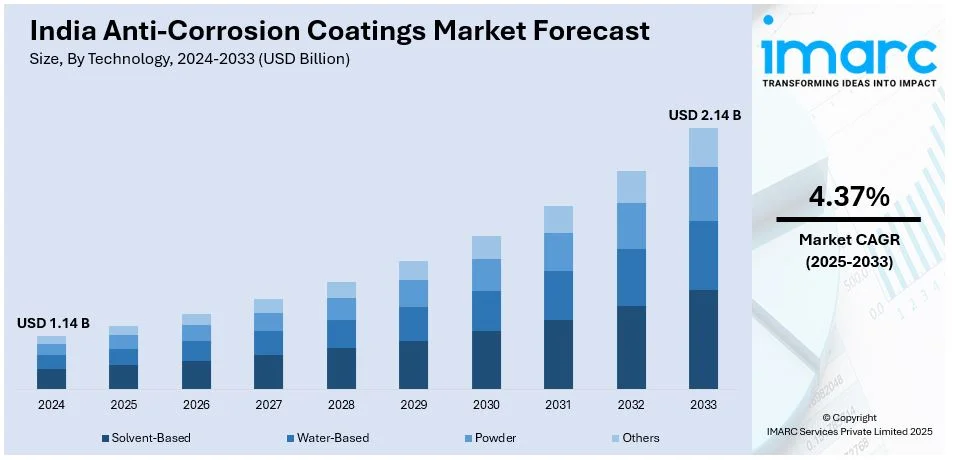
The market is growing as a result of the increased industrial output, the construction of more facilities, and the requirement for long, lasting materials. Moreover, the rising usage in the automotive, marine, oil & gas, and building industries are among the factors contributing to the up, take of anti, corrosion coatings while the advancement in technology and the implementation of strict environmental regulations are features that promote the transition to production of environmentally friendly and high, performance coatings.
Rising Demand for High-Performance Coatings in Infrastructure and Industrial Applications
The India anti-corrosion coatings market is witnessing strong growth due to infrastructure expansion, industrial development, and the need for durable protective coatings. For instance, as per industry reports, India’s infrastructure development gained momentum in 2023-24 with an allocation of ₹10 lakh crore, supported by public and private sector investments shaping the country’s growing infrastructure network. With large-scale infrastructure projects in railways, highways, bridges, and power plants, corrosion-resistant coatings are in high demand to lengthen the lifespan of metal structures subject to extreme environments and weather conditions.
Furthermore, leading manufacturers are emphasizing new-age coatings with self-healing capabilities, increased durability, and greater efficiency, providing enhanced protection for critical infrastructure and industrial assets. In addition, as there is an increasing demand for long-term, low-cost solutions, the India anti-corruption coatings market will see sizeable growth in the next coming years.
Top Anti-Corrosion Coating Manufacturers in India
India’s industrial, marine, and infrastructure sectors rely heavily on high-performance anti-corrosion coatings to enhance durability, safety, and lifecycle performance of assets. Leading manufacturers provide advanced epoxy, polyurethane, zinc-rich, and polymer-based systems designed to withstand harsh environments.
Key Anti-Corrosion Coating Manufacturers in India
1. Demech Chemical Products Pvt. Ltd. (Pune)- Known for its Koroguard® series, the company offers polymer-based, UV-resistant, high-performance anti-corrosive coatings widely used in infrastructure and heavy industries.
2. Stanvac Chemicals India Ltd. (New Delhi)- Provides 1K DTM Hybrid Acrylic and 2K surface-tolerant epoxy coatings, ideal for pipelines, plant structures, and industrial steel protection.
3. Arcoy Industries (I) Pvt. Ltd. (Ahmedabad)- Specializes in industrial anti-corrosive paints, protective linings, and acid-resistant coating systems for chemical and process industries.
4. Kroma Paints Private Limited- Manufactures epoxy zinc phosphate primers and long-lasting protective coatings for metal structures and industrial applications.
5. Jyoti Innovision Pvt. Ltd. (Ahmedabad)- Offers a broad portfolio of anti-corrosive and protective coating systems catering to infrastructure and industrial sectors.
6. Mcon Rasayan India Ltd.- Produces specialized anti-corrosive coating systems and construction chemical solutions.
7. Surfa Coats Paints- Known for industrial-grade, heat-resistant, epoxy-based anti-corrosive coatings.
8. Ugam Chemicals (Pune)- Manufacturer of specialized corrosion-resistant coating products for industrial applications.
9. Xetex Industries Private Limited (Mumbai)- Provides a range of industrial anti-corrosive and protective coating solutions.
10. ResinIndia Tek Pvt Ltd (Pune)- Focuses on industrial epoxy coating systems designed for corrosion protection and structural durability.
Conclusion
Anti-corrosion coatings play a significant role in protecting steel and reinforced concrete structures from corrosion and other deterioration. Typical anti- corrosion coatings include epoxy and polyurethane systems. Other examples are zinc, rich primers, cementitious repair coatings, and advanced polyurea technologies. Surface preparation, proper product choice, skilled application and periodic maintenance are vital keys in lasting the coating systems. Aging infrastructures coupled with deteriorating environmental conditions, advanced anti, corrosion coating technologies will undoubtedly become more important and prevalent.
Images- structuraltechnologies.com, vivablast.com