
Key Highlights: Budget 2026 Real Estate Wishlist – NAREDCO
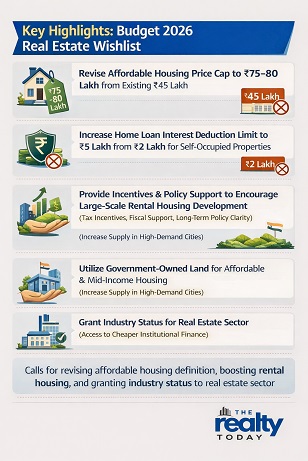
- NAREDCO has urged the government to revise the affordable housing price cap to ₹75–80 lakh from the existing ₹45 lakh, citing rising land, construction, and compliance costs in urban markets.
- The association has proposed increasing the home loan interest deduction limit to ₹5 lakh from ₹2 lakh for self-occupied properties to improve affordability and boost demand.
- With rental yields at just 1–3%, NAREDCO has sought targeted tax incentives, fiscal support, and long-term policy clarity to make large-scale rental housing financially viable.
- NAREDCO recommended active utilisation of government-owned land for affordable and mid-income housing to increase supply in high-demand cities without burdening private developers.
- Reiterating a long-standing demand, the body has called for industry status for real estate to enable access to cheaper institutional finance, supporting a sector projected to reach $1 trillion by 2030.
Before the Union Budget 2026, the real estate industry body the National Real Estate Development Council (NAREDCO) has requested the government to do a full, scale reset of housing policies, with an emphasis on housing affordability, rental housing, and the recognition of the sector.
Central to its Budget 2026 wishlist is a request to greatly change the definition of affordable housing, along with requests for increased tax relief and other incentives that would boost rental housing development. The association also suggested that the affordable housing price limit be raised to 7580 lakh from the existing 45 lakh.
The association explained that since land, construction, and compliance costs have been increasing, especially in urban and suburban markets, the current limit has become obsolete and does not reflect the market situation anymore.
“We need to ensure Housing For All. Housing should get equal importance like any other infrastructure sector,” said NAREDCO Chairman Niranjan Hiranandani, speaking at an industry event in the national capital. He acknowledged that while the Centre has introduced several measures to stabilise and support the real estate sector in recent years, further intervention is essential to sustain momentum in the affordable and mid-income housing segments.
Mr. Hiranandani further proposed that the government should actively utilize its own land banks for the creation of affordable and mid, income housing in the cities where demand is highest. This, he explained, would be a cost, effective way of increasing housing supply without overburdening private developers.
Reiterating the request, NAREDCO President Parveen Jain said that broadening the definition of affordable housing would bring immediate fiscal and consumer benefits. “The limit for deduction of interest on home loans should be increased to ₹5 lakh in respect of the self-occupied property from ₹2 lakh currently,” Jain said. He added, “Homes up to ₹80 lakh should be considered as affordable housing. The change in definition would help as the GST on affordable homes is just one per cent.”
Along with ownership housing, NAREDCO has requested the government to actively back rental housing by giving targeted incentives to developers. Jain brought out that presently, the rental yields in the housing sector vary from 1 to 3 per cent, which is why real estate players consider such projects commercially unattractive in most cases.
“Rental yields in the housing segment remain low at just 1–3 per cent,” Jain noted, explaining that without tax relief or policy support, large-scale rental housing remains financially unviable. He suggested that tax incentives, fiscal support, and long-term policy clarity could encourage developers to invest in purpose-built rental housing, which is increasingly critical in urban India due to workforce mobility and changing household preferences.
According to Mr. Jain, rental yields in the housing segment are currently quite low “Rental yields in the housing segment remain low at just 1–3 per cent,” Jain said. .He further elaborated that large, scale rental housing, in absence of them, will not be financially viable. He proposed that developers should be induced through tax incentives, fiscal support, and long term policy clarity to invest in purpose- built rental housing which becomes a necessity in urban India due to workforce mobility and changing household preferences.
Another plea that has been made a number of times over the years has been restated by the association today, the giving of industry status to the real estate sector. Jain said that if a developer were to be accorded such recognition, he could get institutional finance at cheaper rates, especially for components like land, and materials necessary in construction.
“Considering the sector's contribution to India's GDP and employment creation, it is high time that the government provides industry status to the real estate sector,” Mr. Jain said. He pointed out that real estate is projected to grow into a $1 trillion industry by 2030, underlining its strategic importance to India’s economic expansion.
With anticipation mounting for Budget 2026, NAREDCO's submissions capture the wider mood of the industry, they want structural changes instead of temporary stimulus. Since housing affordability is getting more difficult and rental housing remains largely undeveloped, the stakeholders think that the next Budget is a crucial moment for the government to realign housing policy with the new urban and economic scenario of India.