
Ahmedabad Monitors 140 Construction Sites to Curb Air Pollution Ahead of 2030 CWG- Key Highlights
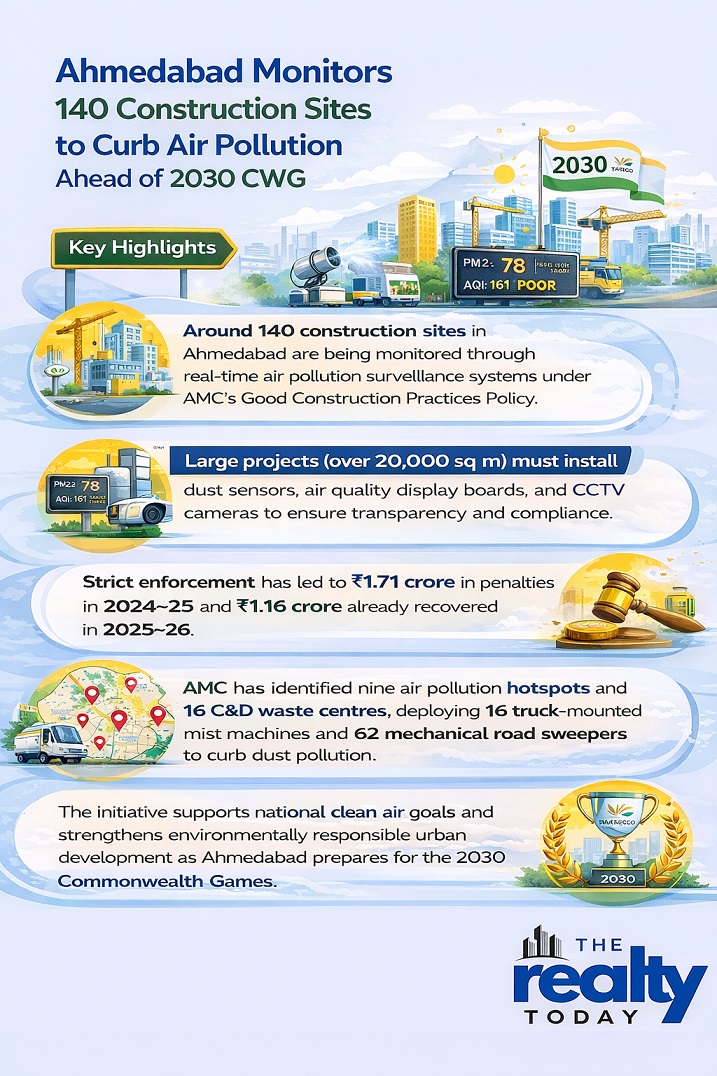
- Around 140 construction sites in Ahmedabad are being monitored through real-time air pollution surveillance systems under AMC’s Good Construction Practices Policy.
- Large projects (over 20,000 sq m) must install dust sensors, air quality display boards, and CCTV cameras to ensure transparency and compliance.
- Strict enforcement has led to ₹1.71 crore in penalties in 2024–25 and ₹1.16 crore already recovered in 2025–26.
- AMC has identified nine air pollution hotspots and 16 C&D waste centres, deploying 16 truck-mounted mist machines and 62 mechanical road sweepers to curb dust pollution.
- The initiative supports national clean air goals and strengthens environmentally responsible urban development as Ahmedabad prepares for the 2030 Commonwealth Games.
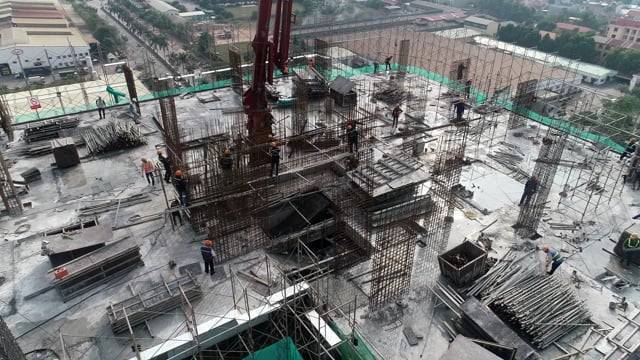
With the preparations for the 2030 Commonwealth Games in full swing, the Ahmedabad Municipal Corporation (AMC) has increased its efforts to ensure better air quality. The AMC has identified one of the major sources of air pollution as construction activities and is working towards controlling the pollution caused by this source.
To achieve better compliance with regulations regarding pollution emissions and dust control, the administration is installing realtime monitoring devices at all construction sites that will measure air quality and help in reducing the levels of pollution effectively. Currently about 140 construction sites spread across the city are being regularly checked for air pollution through real time air pollution monitoring systems; such systems can also be used by citizens who want to perform similar activities in their respective areas.
Even under the Good Construction Practices Policy, the City: Good Construction Practices Policy (Page 1 of 12) which is an integral part of the overall Sustainability Framework that provides a regulatory structure and a systemic approach for achieving higher living standards,
Environment and quality of life through sustained development of the built environment, and thus supports lifecycle performance improvement of the key infrastructural components of the city that are addressed within the framework: the road network, the housing stock and the facilities for health and education.
The overall purpose of the GCP Policy is to ensure that the construction activity, especially large scale developments, are undertaken at the standards of GCP so as to minimise the negative impacts during the construction stage and in the post construction phase. There are three major components in
Key requirements for large construction sites include:
- Installation of dust sensors to monitor particulate matter levels
- Air quality display boards to publicly show pollution readings
- CCTV cameras for continuous compliance monitoring
Officials further revealed that AMC teams frequently review the information obtained from these systems and carry out necessary actions against sites that are found violating the norms, especially where there is poor dust suppression and unsafe handling of the construction material.
The punitive measures have culminated in quite a hefty cash forfeitures. MPC has so far (202425) recovered a total of 1.71 crore in fines, while the amount of 1.16 crore has already been collected in 202526 till date. It was pointed out by civic officials that hefty fines are targeted to produce a powerful deterrent against the violation of rules.
Besides construction sites, the civic body has also taken a scientific approach to identifying pollution sources throughout the city. On the basis of these studies, AMC has identified nine air pollution hotspots and officially announced them. These are Pirana, Rakhial, Raikhad, Bopal, Vatva, SP Stadium, Chandkheda, and Maninagar. Along with this, AMC has declared 16 construction and demolition (C&D) waste collection centres.
In order to reduce pollution in these areas, AMC has installed 16 truck mounted mist machines. These machines were purchased with the help of a grant from the National Clean Air Programme (NCAP) and the 15th Finance Commission. At the Pirana dumpsite and nearby areas, six of these machines are working nonstop. The rest of the units are used on air pollution, prone roads in the city.
Besides construction sites, the civic body has also taken a scientific approach to identifying pollution sources throughout the city. On the basis of these studies, AMC has identified nine air pollution hotspots and officially announced them. These are Pirana, Rakhial, Raikhad, Bopal, Vatva, SP Stadium, Chandkheda, and Maninagar. Along with this, AMC has declared 16 construction and demolition (C&D) waste collection centres.





.png)