

Key Highlights: How PropTech Is Transforming Commercial Real Estate?
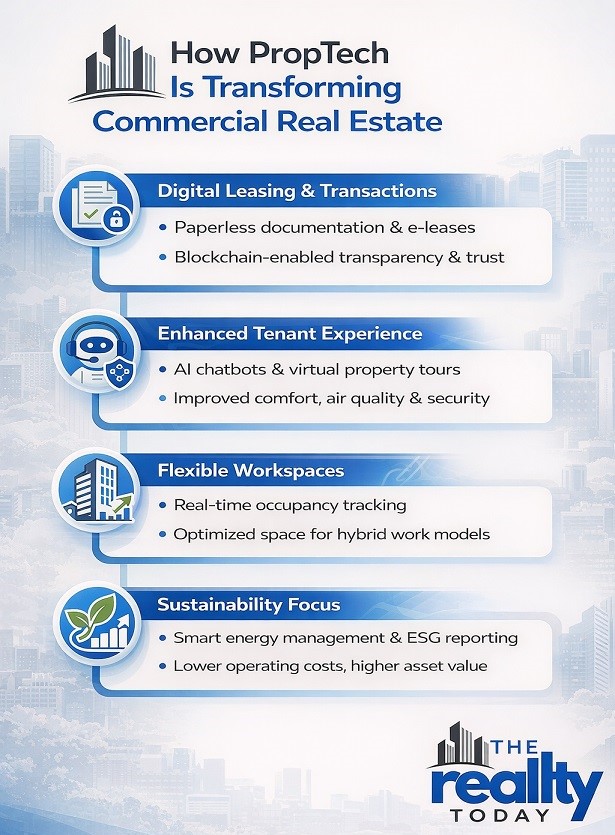
- Shift from Traditional to Data-Driven CRE: PropTech is transforming commercial real estate into a smart, responsive, and customer-centric sector, replacing manual, paper-based processes with digital, data-led decision-making.
- Smarter Marketing & Tenant Engagement: Virtual tours, AI chatbots, predictive analytics, and digital leasing platforms are accelerating leasing cycles, improving transparency, and enhancing tenant experience.
- Rise of Smart Buildings: IoT, automation, and AI enable energy efficiency, predictive maintenance, better security, and improved occupant comfort, reducing operating costs and asset downtime.
- Operational Efficiency & Transparency: Automation, digital documentation, e-leases, and blockchain are streamlining transactions, lowering errors, increasing trust, and improving portfolio-level efficiency.
- Strong Market Growth & Data Impact: India’s PropTech market is growing at a 19.4% CAGR, with data-driven strategies improving occupancy by up to 12%, reducing vacancies by 15–20%, and cutting operating costs by 10–15%, making PropTech central to the future of CRE.
Commercial real estate is an industry that of late has been labeled a traditional, asset, driven sector. The transactions in the industry often heavily depended upon manual procedures, paper documentation, and very close relationships given the long history of interaction among parties. That model indeed was stable but it also restricted the ability to be fast, efficient, and adaptable. Now a new energyProperty Technology, or PropTechis causing a revolution in every corner of a commercial real estate ranging from development and marketing down to operations and tenant experience.
PropTech is more than just the digitization of the processes. It is a strategic transformation, which, at a top level, converts commercial real estate into a data, driven, smart, and prompt sector. New buildings are no longer mere structures; they represent living ecosystems that have constant interaction with occupants, managers, and investors. Technology provides the way for stakeholders to be well, informed, carry out operations efficiently, and, through a property management approach that is focused on the experience, deliver the idea of facilities.
Understanding PropTech and Its Importance
PropTech refers to broad spectrum of technology that has the potential to enhance the development, marketing, management, and occupation of commercial properties. The amalgamation of technology in the commercial real estate industry has been slow, but the following factors have contributed to its rapid evolution in recent years:
- The need for seamless and personalized experiences
- The need for efficiency and sustainability
- The evolution of technology
- The need for smart infrastructure
These are the reasons why the commercial real estate sector is currently undergoing a transition from traditional ways of doing business to a smarter and more technology-driven approach. Companies are now beginning to treat their tenants and occupants as customers, and this is having a direct impact on building design and operations.
Digital Marketing and Tenant Engagement
The PropTech sector has completely changed the way property marketing and leasing are conducted. The traditional marketing process of distributing brochures, visiting the site, and inquiring has slowly been replaced by new and innovative experiences. This means that property managers can now reach more people and accomplish more.
The key tools and strategies used include:
- Virtual tours and 3D visualization: These enable potential clients to view properties from a distance, right down to even before the properties are constructed. Such devices help broaden the understanding of the property layout, features and space allocation by providing a very close, to, reality glimpse of the property.
- Online platforms with user, friendly interfaces: These platforms offer potential tenants facilities to find and compare properties which map the ones fitting their preferences and needs, hence resulting in greater transparency and less hassle.
- Predictive analytics: These take advantage of the past and present real estate data to optimize pricing, marketing, and investment decisions, thus equipping the managers with the ability to predict the market changes instead of merely reacting to them.
- AI, based chatbots and other digital customer service solutions: These tools are capable of providing instant answers to questions, facilitating communication, and making sure that potential tenants have easy access to the information they need.
Using the above, listed tools and methods, the commercial real estate staff will be able to invite tenants to a considerably greater extent and make the lease process more efficient.
Smart Buildings and Operational Efficiency
The main reason for the rise of the smart building phenomenon is PropTech. It is only through the integration of sensors, Internet of Things technology, automation, and digital control solutions that buildings are able to self, monitor, self, control, and self optimize their operations in real time.
Smart buildings provide several benefits to the operations as well as the occupants:
1. Energy efficiency and a cleaner environment: By day or night, automated systems are able to change lighting, heating, and air conditioning instantly when people come or go and also according to the weather outside. These systems not only save energy but also promote a cleaner environment.
2. Predictive Maintenance: The operating status of the equipment is monitored on a constant basis by the use of sensors; therefore, the maintenance team can identify and fix problems before they become expensive repairs.
3. Improved Occupant Comfort: Through constant monitoring and control of the quality of indoor air, temperature, and humidity, it is possible to effect a great improvement in the indoor environment, making it healthier and more comfortable.
4. Improved Security: AI, assisted surveillance systems, cloud-based access control, mobile credentials, and the ability to monitor from anywhere can greatly improve the security level of the occupants and prevent property owners from being threatened.
5. System integration: An integrated system allows the property managers to have an up, to- date, comprehensive picture of the operations of the building thus enabling them to take a very proactive approach to their management activities and also be able to prevent the occurrence of problem situations.
Operational Efficiency and Automation
Economic trends, rising costs, and changing requirements from tenants make operational efficiency a requirement. PropTech technology allows for the automation of different property management tasks, ranging from administrative tasks to service delivery.
The benefits of operational automation include:
- Reduction of manual work such as maintenance requests, communication with vendors, and security deposits
- Increased efficiency by allowing employees to focus on strategic planning rather than manual work
- Data centralization for informed decision-making
- Communication with tenants, vendors, and investors
Automation of different property management tasks allows property management teams to deliver enhanced services while keeping operational costs under control.
Digital Transactions and Transparency
PropTech is changing the face of commercial real estate transactions as well. The conventional way was heavily dependent on paper, complicated, and slow, involving many intermediaries. However, with the adoption of digital technologies, transactions have become quicker, more transparent, and genuine.
The main benefits are:
- Electronic documentation: Secure systems eliminate errors and issues that are typical of paper, based transactions
- Automated systems: Lease transactions, approvals, and renewals can now be done online, saving time and reducing errors
- Blockchain tech: Innovative technologies enhance trust and transparency in property rights, financial transactions, and contractual obligations
Compensating for Changing Work and Occupancy Patterns
The present work setting is very flexible and hybrid in nature as compared to the past. PropTech is helping commercial properties to adjust their space according to the changing requirements of their tenants by providing them with data insights on the usage of the space and occupancy patterns.
Key advantages include:
- Real-time occupancy analysis: Assists property managers in understanding space usage by tenants, optimizing space usage
- Flexible workspace management: Assists in shared and hybrid workspace without wasting space that is underutilized
- Data-driven space planning: Assists commercial properties in adapting to evolving demand and maximizing space usage
Sustainability and Responsible Development
Sustainability has been one of the major trends to affect decision making in commercial real estate. PropTech supports green operations by making sure energy consumption data and environmental impact data are both accurate and up to date.
Energy resource management becomes more efficient, and environmental practices become more sustainable.Long-term operational improvements are realized through improved decision-making.Meeting the growing demand of tenants and investors for ethically managed businesses becomes easier.Operational sustainability in the commercial real estate industry makes the industry more robust and attractive to future-looking stakeholders.
Data-Driven Insights in Commercial Real Estate
In commercial real estate, data is the key to unlocking better occupancy, optimized pricing, and higher returns. As per Anum Proptech, analysis of leasing trends, tenant demand, and market absorption shows that data-led strategies can reduce vacancy periods by 15–20% and improve occupancy rates by up to 12% across office, retail, and industrial properties. Real-time monitoring of footfall, lease renewals, and rental benchmarking allows asset managers to align offerings with market demand, avoid overpricing, and maximize revenue per square foot. Investors using historical performance data and predictive models can also reduce risk exposure and make informed decisions on portfolio expansion or divestment.
Centralized and consistent data further strengthens decision-making at a portfolio level. Firms leveraging integrated data platforms report 20–25% faster leasing cycles and a 30% improvement in operational efficiency. Tracking energy consumption, maintenance, and tenant behavior not only lowers operating costs by 10–15% annually but also enhances sustainability reporting for stakeholders. In a sector where lease durations and capital intensity magnify risk, these insights turn raw data into actionable strategies, helping developers, investors, and property managers stay ahead of market shifts while delivering measurable financial impact.
Market Potential
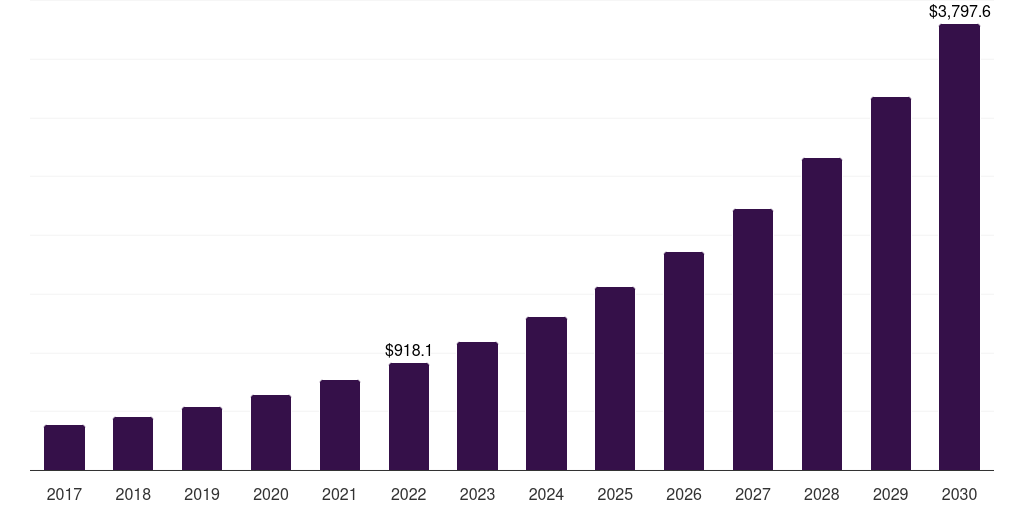
As per, Grandview Research, India PropTech market is on a rapid growth trajectory, with revenues reaching USD 918.1 million in 2022 and projected to hit USD 3,797.6 million by 2030, reflecting a CAGR of 19.4% between 2023 and 2030. Residential properties accounted for the largest share in 2022 at 55.4%, while the Commercial and Industrial segment is emerging as the fastest-growing category, driven by rising demand for office spaces, retail outlets, and warehouses. This growth is fueled by increased digital adoption across property management, leasing, and investment decision-making, with software solutions, analytics, and automated processes becoming integral to real estate operations.
Data-driven insights are reshaping how investors, property managers, and developers operate. With over 1.2 million market statistics and detailed company profiles available, stakeholders can leverage real-time analytics to optimize occupancy, forecast demand, and enhance financial performance. India’s PropTech sector is now recognized as the fastest-growing market in Asia Pacific, offering a strategic opportunity for both domestic and international players. By integrating advanced technologies such as AI, Big Data, and blockchain, industry participants can improve operational efficiency, reduce transaction costs, and gain a competitive edge in the evolving digital-first real estate landscape.
The Future of Commercial Real Estate
The commercial real estate sector is being reshaped by Property Technology into a wiser, more adaptable and customer oriented industry. PropTech comes as a bridge between the physical and digital worlds, and through this, it transforms buildings into smart ecosystems that not only enhance tenant experience and operational efficiency but also increase the value of the asset over time.
Totally relying on PropTech is not anymore an option, extension only decision. Commercial real estate industry success will increasingly be based on the ability to leverage technology, make data- driven decisions and offer spaces that are versatile, green, and centered on experience.At the changing environment, PropTech is not only changing the way things are done it is really the future of commercial real estate.





.png)