

Purchasing of a property stands among the topmost big financial moves a majority of the society takes. From a residential apartment to a villa, commercial office, plot, and even industrial land, the whole deal is laden with a series of legal papers, financial agreements, and technical drawings. The consequences of a single missing endorsement, an inaccurate ownership statement, or a latent legal problem can be anything from a monetary loss to project delays or even a protracted legal fight.
Besides being a buzzword in the industry, Artificial Intelligence (AI) is a game-changer in real estate through automation of document examination, detection of errors, and removal of repetitive human jobs. Property developers, prospective buyers, banks, legal firms, and financial institutions are all turning to AI-based software to carry out due diligence quickly and efficiently, manage documents better, and reduce risks.
The question though is an all-important one: Is it the AI alone that decides whether you can sign those documents after the verification of the property? An outright "yes" and "no" are not the right answer, though in some circumstances the latter is even more valid.
AI may contribute quite a bit to the review of documents but at the end it still will depend upon lawyers, land surveyors, government agencies, and technical inspections.
The Significance of Property Document Verification
When it comes to property deals, there are several parties involved such as developers, owners, banks, lawyers, government officials, and buyers. Every property has legal background, approvals, and ownership history.
Potential problems are:
- Disputed ownership
- Falsified or fake documents
- Approval issues
- Unauthorized construction
- Encumbrances
- Outstanding taxes
- Mortgaged property
- Disputes over property boundaries
- Violations of zoning laws
Traditionally, lawyers check all documents manually, which takes a lot of time and is vulnerable to human errors, particularly when dealing with large volumes of paperwork.
AI can automate many aspects of this process.
AI's Approach to Property Documentation
Contemporary AI consists of systems using a combination of the following technology:
- Optical Character Recognition (OCR)
- Natural Language Processing (NLP)
- Machine Learning
- Pattern Recognition
- Document Intelligence
Rather than just reading the text, AI analyzes information, compares information between documents, finds discrepancies, and draws attention to missing information.
AI can compare the owner's name mentioned in the:
- Sale deed
- Title deed
- Property tax receipt
- Encumbrance certificate
- Loan documents
In case there is inconsistency in naming, whether it's due to spelling differences or initials, AI marks it for verification.
Documents AI Can Analyze
There are certain documents where AI would prove most effective on account of being well-defined and structured, like:
- Sales Deed
- Agreement to Sale
- Title Deed
- Mother Deed
- Encumbrance Certificate
- Property Tax Slips
- Plan Approval
- Occupancy Certificate
- Completion Certificate
- RERA Registration Documents
- Khata Certificate
- Mutation Certificate
- Lease Agreement
- Mortgage Documents
- Bank Loans
- Identity Documents
- POA
- NOCs from Authorities
- The more the number of documents, the better the use of AI becomes.
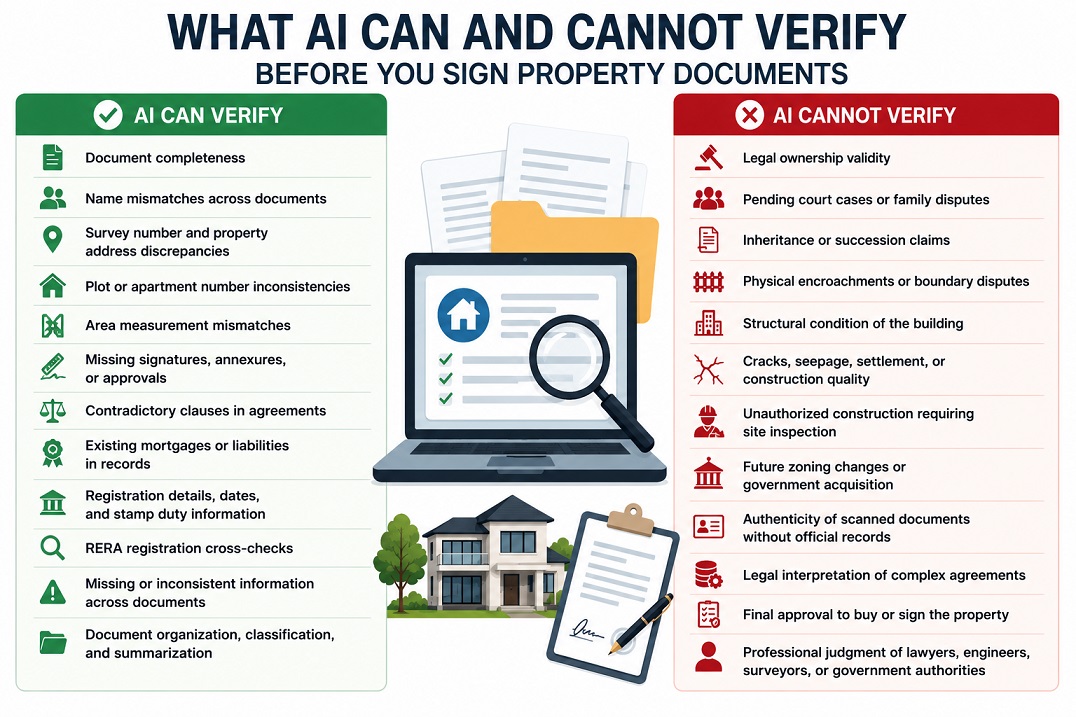
What all can be detected using AI?
One of the biggest advantages of AI is that it is capable of processing large volumes of data within a very short period of time. This technology allows detecting those issues that otherwise would remain undetected in a manual review.
Following issues can be detected using AI:
- Lack of documents in paperwork
- Variations in name of the owner
- Discrepancies in survey number/property address
- Discrepancies in apartment/plot number
- Mismatch in the area mentioned in the documents
- Contradictory clauses in the agreement
- Lack of annexure/schedule
- Lapse in approval/certificate
- Existing mortgage or liability
- Lack of signature
- Unusual document formatting that may indicate possible tampering
AI can also extract important details such as registration numbers, plot size, built-up area, carpet area, transaction dates, and stamp duty information, making document review significantly faster.
What AI Cannot Verify?
The Things That AI Can Never Verify
Despite all the progress that has been made, there are still some things that AI cannot prove on its own regarding whether a property can be purchased legally.
AI cannot verify:
- Whether it is legally owned
- Pending lawsuits or family disputes
- Any claims about inheritance or succession
- Encroachments on the boundaries of the property
- Condition of the building
- Faults in the structure or any constructions built without authorization
- Future zoning laws or government acquisition
- The authenticity of scanned documents without an official database
Moreover, there are other factors like the presence of cracks, water seepage, settlement, poor quality of construction, or any other safety-related issue that need to be assessed by qualified engineers.
AI in Banking, RERA Verification, and Real Estate Development
AI has a growing presence within all parts of the real estate industry. For example, a lot of banks use AI to simplify the early steps in the processing of home loans. AI systems are employed to scan mortgage documents, extract information about the borrower, find missing documentation, cross-check data across documents, and flag differences for expert legal review.
This streamlining allows for the exclusion of human resources from simple tasks, and faster processing of the loan, thus allowing legally trained staff to concentrate their efforts on the intricacies of the legal matter. In the same way, real estate developers are training AI to help sort the digital archives, track compliance documentation, oversee approvals and file paperwork across various projects.
Automating low-value tasks involved in reviewing documentation would also provide real estate developers with efficiencies of scale benefits and minimize administrative overhead. AI can assist the buyer in RERA verification by retrieving information such as RERA registration number, cross checking project information through other supporting documents, matching project names and flagging any discrepancies for manual checking.
Still, AI cannot ascertain the accuracy of the data uploaded or ensure its completeness for the regulator's record. But these are merely guide dogs for the moment and, for the foreseeable future banks developers and financial institutions have, and will continue to rely upon the knowledge and expertise of experienced lawyers, valuers, technical specialists and government records before they loan on property, certify the title or undertake multi-million pound transactions.
Why Human Expertise Still Matters?
Purchasing a house through paperwork alone is not enough. A real estate attorney's assistance is vital for understanding the various legal requirements and responsibilities of a contract, for checking the validity of title ownership, for discovering other legal liabilities that a buyer might face and for making recommendations on those points.
A building is inspected for its structural condition by technical consultants and property boundaries and measurements are ascertained by surveyors. The necessary validations, registrations, and approvals for property compliance are the responsibility of government officials.
It is these professional assessments that require a level of context and experience that AI hasn't been trained to recognize yet. Inconsistencies might be highlighted by AI but it is a person's job to decide if such inconsistencies are legal issues or can be fixed by supplying more documentation.
Leveraging the Advantages of AI
AI needs to be thought of as a formidable assistant in decision making rather than a substitute for professional opinion. It is very helpful when it comes to the preliminary phases of due diligence for property, like categorizing documents, noticing incomplete records, condensing long agreements, and raising alerts about irregularities for further investigation. This helps reduce the amount of work that would otherwise have been done mechanically and frees up lawyers' time to work on the aspects of the matter that are difficult and require their judgment.
Before signing off any property agreement document, it is essential for a buyer to:
- Engage or refer to a licensed real estate attorney for the confirmation of property ownership.
- Contact appropriate governmental bodies for the approvals.
- Examine the chain of ownership and records showing burdens (liens).
- In person inspection of the property.
- Identification and verification of land boundaries (if any).
- Checking that property taxes and required statutory dues have been paid.
- Litigation or legal proceedings pending check.
- No matter how sophisticated an AI gets in such areas, these procedures continue to be important.
Broader Conrext; AI Adoption in India's Corporate Real Estate Surges from 5% to 91% in Three Years
India's corporate real estate sector is witnessing a significant digital transformation, with artificial intelligence (AI) rapidly becoming an integral part of business operations. According to a recent FICCI-KPMG report, AI adoption among corporate real estate organisations has increased from less than 5% in 2023 to 91% in 2025, reflecting the sector's growing focus on technology-driven decision-making and operational efficiency.
The report projects India's real estate market to expand from $650 billion in 2025 to $5.8 trillion by 2047, underlining the sector's importance in the country's economic development. Real estate currently contributes 7.3% to India's GDP and continues to play a major role in employment generation, urban development, and capital formation.
The sector is also expected to witness substantial physical expansion over the coming decade. The report estimates that India will add nearly $906 billion worth of new housing stock by 2034, while an additional 41 million sq. ft. of retail space is expected to become operational by 2028. Industry experts attribute this growth to favourable government policies, increasing institutional investments, and the expansion of digital infrastructure, all of which are accelerating the adoption of AI across the property sector.
Global consultancy McKinsey & Company estimates that AI has the potential to unlock up to $550 billion in value across the real estate value chain. However, the firm notes that achieving these benefits will require organisations to redesign workflows, strengthen human decision-making, and develop new operating models rather than relying solely on technology deployment.
Another industry assessment by JLL indicates that while the proportion of companies running AI pilots has increased from 5% to 92% over the past three years, many organisations remain in the early stages of implementation. Several companies are yet to establish structured AI strategies, creating a gap between technology leaders and businesses still evaluating adoption.
The Road Ahead
With more governments switching over to digitizing land records and approval processes, the role of AI in property transactions will be significant.
By integrating with digital land registries, geographic information systems (GIS), blockchain records, and e-governance platforms, ownership history, approvals, and transaction records can be verified more rapidly and reliably. Legal text will also be much easier for a layman to understand through the use of generative AI. A law firm could have dozens of draft agreements, while a generative AI tool could not only point out differences between them but also generate a report highlighting these discrepancies as per a due diligence checklist.
Conclusion
Artificial Intelligence is helping transform property document review. Due diligence becomes faster, more organized, and efficient. AI can extract information, compare multiple records, flag discrepancies, detect omissions, and bring to attention legal risks that warrant further investigation through human legal intervention and expertise.
In fact, the manual effort is dramatically cut down and the speed of document review increases a lot for buyers, developers, banks and legal professionals. Even so, an AI cannot verify legality of ownership, check authenticity of government records, discover every outstanding legal issue, carry out physical inspection of a property or supersede lawyers/surveyors/engineers. Human judgment is indispensable because legal interpretation, technical evaluation, and regulatory checks still fall under the umbrella of human expertise.
The best option is the combination of AI and professional due diligence. By being used responsibly, AI becomes an extremely handy assistant that not only boosts accuracy and efficiency but also lets professionals deliver the technical and legal assurances required before signing one of the most important agreements in life.