

The way we build things is really changing. Digital tech, especially AI, is moving from office plans right onto job sites. This is a big deal for tracking how jobs are going and making sure things are built well. Before, we just did manual checks and wrote stuff down on paper. Now, AI makes it all about real numbers, real-time updates, and even guessing what might happen next.
The AI system that monitors progress and quality is transforming the way everyone involved in a construction project—builders, owners, and consultants—views what’s actually happening on a building site. By integrating computer vision and machine learning techniques with drone cameras and BIM, AI provides an accurate and comprehensive perspective of construction projects in a way that’s safe, cost-effective, and scalable. It’s no longer just about speed; it’s also about managing cost, time, and people’s safety while creating quality products for long life performance.
Old Ways of Checking Progress and Quality
Building projects are always tricky. Lots of different workers, changing site conditions, and tight deadlines. What we used to do for checking progress was pretty basic:
- Site walks by engineers
- Taking pictures now and then
- Reports in Excel
- Rough guesses on how much was done
- Paper checklists for quality
These old ways had problems. They took a lot of time, people made mistakes, and the info was often days or weeks behind what was actually happening. We often found quality problems too late, when fixing them cost a lot and messed things up. If what was reported didn't match reality, it could cause fights, delayed payments, and everyone losing trust.
On big building jobs and in real estate, these issues get huge. As projects get bigger and profits get smaller, the industry is really looking to AI to automate and standardize how things are checked.
What's AI-Driven Progress Monitoring?
AI-based progress monitoring involves the use of technologies like machine learning and computer vision to monitor construction activities and measure actual progress on projects compared to schedules and designs. The approach involves the use of automated collection and analysis of construction site data to present objective results in real time, as opposed to human-generated reports.
Starting from data collection at a construction site, which uses drone technology, cameras, smartphone cameras, as well as 360-degree cameras, this process involves taking pictures from various angles on a routine basis to have a complete visual feed of what is happening on site.
Further, AI algorithms process this visual information. Based on this AI, the system learns, step by step, how to recognize and extract information about various construction features like columns, walls, slabs, pipes, electrical conduits, as well as finishing work, thereby increasing its efficiency in recognizing these features with each site information exposure.
The results of the analyzed information are then verified through comparison with Building Information Models (BIM), drawings, and project schedules. The outcome of this process enables the system to calculate work quantities and assess the differences in the project timelines.
Finally, this platform provides real-time progress updates, emphasizing accomplishments, progress, and also those projects that are pending and lagging behind. In addition, compared to human reporting systems, AI technology is more dynamic and impartial and offers a very effective and unbiased observer role for developments on a site.
Tech That Makes AI Monitoring Possible
1. Computer Vision
This allows computers to understand what they are seeing in pictures and videos. In construction, it is employed to identify what construction components are in a picture, what stage they are at, and whether they are good. Intelligent AI can identify whether something is completed, partially done, or done wrong.
2. Machine Learning
It enhances the level of intelligence through the learning processes that occur from the project information of the past. Through the use of deep learning technology, the technology is able to handle challenging light conditions as well as messy environments that may be present on the site of the construction project.
3.Drones
Drones allow us to have a clearer image from above, which is very helpful in large constructions like roads, bridges, and factories. AI will be able to use information gathered by drones on how much soil has been dug, how a large structure has been built, or whether objects are placed in a way that doesn’t conform to their original designs.
4. Integration with BIM
Where AI gets much stronger is when it works with BIM. By lining up site pictures with 3D models, AI can automatically check if what's built matches the design, find missing pieces, and catch order mistakes.
5. Smart Sensors
These gadgets give other information such as concrete temperature, vibration, and humidity, and how much equipment is being used. AI connects this information with what it sees visually to check the quality and how things are performing.
AI for Checking Quality
Traditionally, checking quality in construction meant checklists, inspections, and relying on people's experience. AI adds a way to prevent problems before they happen.
- Spotting Flaws Automatically- AI can find visible problems like cracks, uneven surfaces, or things not lined up right. By looking at pictures from different stages, AI can find stuff that people might miss during normal checks.
- Checking Against Specifications- AI systems can validate whether construction meets the right sizes, allowances, and materials. For instance, AI can verify if rebar is spaced correctly, whether forms are lined up, and whether slab thickness is right compared to approved drawings.
- Quality Checks at Key Points- AI allows for automatic quality checks at important steps—before pouring concrete, after the building frame is done, or before handing over the project. This means mistakes are caught early, reducing re-work and future problems.
- Data-Backed Quality Audits- Unlike manual checks, AI-made quality records have timestamps and location info, and they're fair. This creates a clear record that's valuable for certifications, client reviews, and solving disagreements.
Advantages of AI Monitoring
- Everyone involved gets to see what's happening on the project without having to go to the site. This is super helpful for owners, lenders, and managers looking after many projects.
- AI spots delays early by comparing what's actually happening to the plan. Project teams can fix things before small delays become big problems for the whole project.
- Finding quality issues early really cuts down on the cost of re-work. Some studies say re-work can be 5–10% of total project costs—AI helps reduce this waste.
- AI takes the guesswork out of progress reports. How much of a project is done is based on what AI sees and numbers, not just guesses, which builds trust among everyone.
- By reducing how often people need to do dangerous manual checks, AI makes sites safer. Some systems can even spot unsafe actions and if safety rules aren't being followed.
Where AI is Being Used in Construction?
- Homes and Tall Buildings- AI tracks progress floor by floor, quality of finishes, outside work, and coordinating plumbing and electrical. Developers use AI dashboards to watch many buildings at once.
- Big Infrastructure Projects- For roads, subways, and bridges, AI checks how much dirt has been moved, progress on big structures, and if things are lined up correctly. Drones with AI are especially good for long, linear projects.
- Factory and Power Projects- AI helps with quality control for complex stuff like pipes, steel parts, and equipment foundations, where everything needs to be super precise.
- Government Projects- Government groups use AI to make things more open, cut down on delays, and make sure money is spent right on public projects.
Global Market Potential of AI in Construction
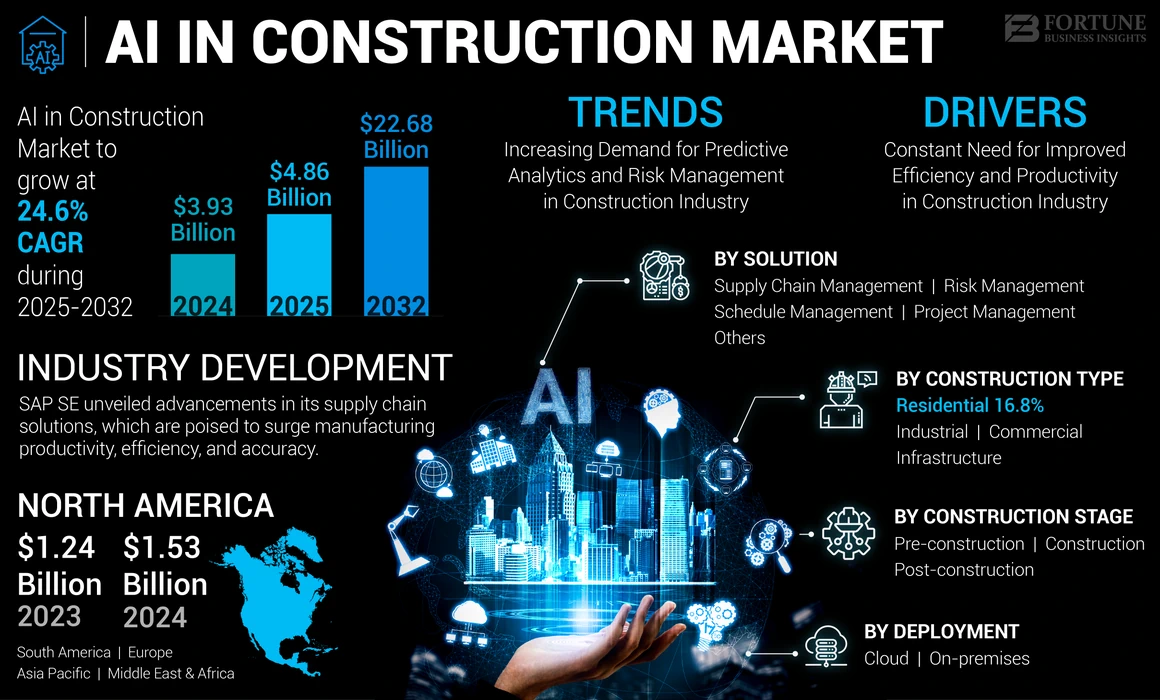
The application of AI in construction, especially in automated progress monitoring and quality control, is primed for an explosive market growth, fueled by accelerating data generation, widespread adoption of digital technologies, and growing pressure to improve project efficiency. Numerous industry research reports have painted the AI, in, construction global market as already being of multi, billion, dollar size, with a rapid growth trajectory over the next ten years. A report by Fortune Business Insights suggests that the market was worth close to USD 3.9 billion in 2024 and is expected to be nearly USD 22.7 billion in 2032, implying a CAGR of about 24.6%.
While the overall market remains the focus of various studies, one looking at the progress of monitoring only has made an estimate of the segment of AI, driven construction progress monitoring to be around USD 1.5 billion in 2024 and reaching USD 7.7 billion by 2033 with a CAGR of more than 20%, according to Dataintelo. These forecasts are further supported by The Business Research Company which projects the next 5 years to see the market of Artificial Intelligence in Construction growing from a modest USD 1.8 billion in 2024 to more than USD 7 billion in 2029 at a CAGR of over 30%. As a result, these figures reflect the positive and on, going trend of AI technology adoption in the construction industry, one which is enabled by more data becoming available and an increasing demand for automated and intelligence, driven project controls.
McKinsey & Company has estimated that large construction projects produce visual, sensor, and operational data that run into terabytes every year. However, only about 30% of this data is used for decision, making in a systematic way, which leaves a huge opening for AI platforms that can turn unprocessed site data into actionable intelligence. These numbers, when combined, highlight the immense commercial and operational potential of AI, powered automated progress monitoring and quality control, which is rapidly becoming one of the major segments in the global construction technology ecosystem.
India Market Potential of AI in Construction
The use of AI in construction in India, especially for automated progress monitoring and quality control, is set to grow significantly as the overall AI market unfolds. A BCG, NASSCOM report states that the AI market in India will grow between 25% and 35% per year, reaching a value between USD 17 billion and 22 billion by 2027. The main driver behind this growth is digitisation of various sectors like infrastructure and real estate. Future Market Insights says the Indian AI in construction market will grow at a 25.4% CAGR until 2035. This growth rate reflects increasing demand for smart project monitoring, automated site analytics, and AI, powered quality assurance tools that are customizable for local projects.
360 Research Reports, in another industry forecast, recognises India as one of the quickest markets for construction AI solutions with an approximate 18.3% CAGR. This growth is predominantly due to the modernization of highway corridors, expansion of industrial real estate, and the increasing use of BIM, integrated AI systems. The data infrastructure that supports this expansion is becoming stronger as well. India's data center capacity is forecasted to increase nearly five times to approximately 8 GW by 2030, supported by an investment of around USD 30 billion. This will enhance local data processing abilities, which are very crucial for real, time AI analytics. This information is shared by The Economic Times Hindi.
The India construction sector is evidently creating massive amounts of data for its projects just from these trends observed collectively. Besides, it is building the required infrastructure as well as the market size for AI solutions to provide ongoing progress monitoring and automated quality control on a large scale.
Adoption Challenges of AI in Construction
- Good Data Is Key: AI needs really good, consistent data to work well. Bad pictures can make it less effective.
- Getting People on Board: Site teams might not like new tech because they're not used to it, or they worry about being watched too closely.
- Making It All Work Together: Integrating AI systems with existing tools and software used for a current project, business software, and BIM.
- Start-Up Costs: Although it may be costly in the long run, start-up costs for hardware, software, and training may be a hindrance for smaller builders.
However, as technology becomes better and as more people involve themselves in this technology, such problems are slowly fading away.
The Future of AI in Construction
In the future, AI for monitoring construction will not just report what happened but will also guess what might go wrong and suggest how to fix it.
Some things we expect to see:
- AI guessing future delays and quality problems.
- Drones doing inspections all by themselves.
- AI making daily site reports.
- Connecting with digital copies of buildings to help with their whole lifespan.
- Automating rule checks and paperwork.
As construction becomes more like manufacturing and standardizes, AI will become a main part of how projects are delivered, not just an extra tool.
AI for automatic progress and quality checks is a big change in how construction projects are managed. By replacing old, manual ways with continuous, fair, and data-driven systems, AI makes everything clearer, more efficient, and better quality throughout the project. For an industry that's often had problems with delays, going over budget, and inconsistent quality, AI offers a real way to make things more predictable and perform better. As more people use it in homes, infrastructure, and factories, AI monitoring will increasingly show us what it means to build efficiently, safely, and truly well today.





.png)