

SWAMIH Fund: Key Highlights
- Govt-backed SWAMIH Fund completed 61,000+ homes in stalled projects till Dec 15, 2025
- Relief to 4 lakh homebuyers; over 1 lakh homes to be delivered in total
- Entire corpus fully committed by Dec 5, 2025
- Portfolio spans 145 projects across 30 cities
- 110 projects completed, including 7,000+ EWS & Rehab units
- ₹37,400 crore capital unlocked across 127 projects
- About 50% investor funds repaid; ₹3,500 crore returned to Centre
- SWAMIH Fund-2 (₹15,000 crore) announced to build 1 lakh more homes
The Special Window for Affordable & Mid-Income Housing investment [SWAMIH] fund, promoted by the government, had managed to finish more than 61,000 units in stranded housing projects till December 15, 2025, according to an official statement released by the finance ministry.
Launched to inject last-mile funding within distressed housing projects, the SWAMIH Fund has turned out to be the largest residential sector-specific stress resolution platform for the country of India. The SWAMIH Fund will provide relief to over four lakh homebuyers who got affected by delayed projects by ultimately delivering over one lakh homes.
According to the ministry, SWAMIH fully committed its entire investible corpus ahead of schedule on December 5, 2025, reflecting strong deal execution and disciplined capital deployment. The fund’s portfolio spans over 145 projects across 30 cities, underlining its nationwide footprint in resolving stalled housing developments.
Out of the total completed housing stock, around 61,000 households have been completed in 110 projects, with more than 7,000 in the EWS and Rehabilitation categories. These completed apartments have enabled thousands of families to possess their homes, which has been a long-standing hope for them.
The ministry highlighted that SWAMIH has been managed with robust governance standards, active asset management, and strict oversight mechanisms. This approach has resulted in 55 full exits and 44 partial exits, demonstrating the fund’s ability to balance social impact with financial prudence.
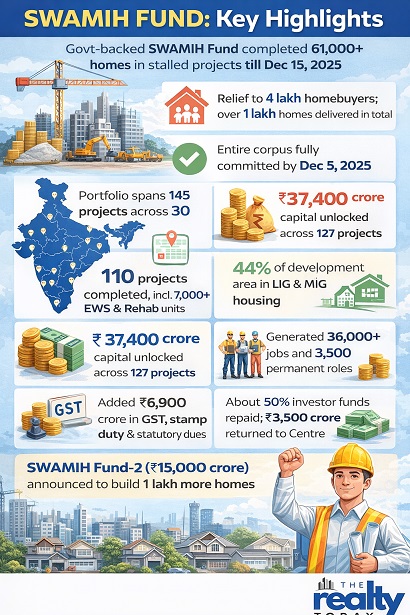
In terms of economic impact, the fund has unlocked ₹37,400 crore of capital across 127 projects, covering more than 90 million square feet of development area. Notably, 44% of this area comprises Low Income Group (LIG) and Middle Income Group (MIG) housing, reinforcing the fund’s focus on affordable and mid-income segments.
The re-launch of the suspended projects has also helped to create a lot of employment opportunities. The employment generated through the fund is over 36,000 skilled and unskilled workers, besides 3,500 on a permanent employment level. The re-launch of the projects has facilitated the requirement of over 20 lakh tonnes of cement and 5.5 lakh metric tonnes of steel.
In financial terms, SWAMIH's activities have added about ₹6,900 crore to GST as well as to stamp duties and other statutory dues to the Central as well as the state governments. The SWAMIH funds have also repaid approximately 50% of the withdrawn funds to its investors, including a repayment of ₹3,500 crore to the Central Government out of a total of ₹7,000 crore withdrawn.
Union Finance Minister, Nirmala Sitharaman, under the Union Budget 2025-26, announced the formulation of SWAMIH Fund-2, which is a blended finance facility worth ₹15,000 crores involving the government, banks, and private capital, and this new facility is aimed at facilitating the speedy construction of another one lakh housing units.
Managed by SBI Ventures Limited, a subsidiary of the State Bank of India, the SWAMIH Investment Fund continues to play a critical role in resolving India’s housing stress by supporting RERA-registered, brownfield residential projects affected by legal, financial, or operational challenges.





.png)