

In a bid that will eventually minimize conflicts between home buyers and developers, the Karnataka Real Estate Regulatory Authority (K-RERA) is all set to make it mandatory for developers to include parking space details in the allotment letter and the agreement for sale. The new law will try to address the most frustrating problem that apartment owners face, the allocation of parking space.
The move finally comes as a relief to flat buyers in Bengaluru and other cities in Karnataka, following complaints over the years about uncertainty, last-minute changes, as well as a discrepancy between the parking space provided and the one promised. According to K-RERA officials, the move will make buyers aware of what they are getting in addition to the apartment.
What the New Rule Proposes?
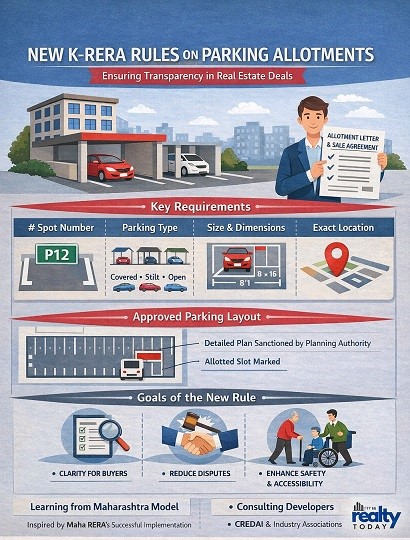
Under the new guidelines, it becomes mandatory for the developers to provide all details regarding the available parking space while issuing letters for allotments and sale agreements. This includes:
- The specific parking spot number
- Parking type (covered, open, stilt, or basement)
- Size and dimensions of the car park
- Precise location within the project premises
Additionally, developers must annex an approved parking layout plan to the agreement for sale. This plan must be sanctioned by the competent planning authority and clearly mark the allotted parking slot corresponding to each apartment.
According to sources within the regulator, the objective is to eliminate ambiguity and prevent misleading representations that often surface only at the time of possession.
Dealing With Long-Standing Complaints
Parking disputes have proved to be one of the regular complaints received by K-RERA. Many flat buyers have accused the seller of misrepresenting the parking space while booking the property, whereas the actual parking space allocated to them at the time of possession is either smaller in size, poorly located, or of a different variety altogether.
In a number of instances, buyers have alleged that no written information has been given to them concerning the dimensions or position of the parking facility so that buyers have limited recourse available to them. A lack of clarity has led buyers on a number of occasions to settle for a substandard parking facility so as not to stay stuck on a point for a long time.
Buyers of homes have welcomed this decision taken by the regulatory body because it was long overdue. Additionally, for most customers, parking spaces are beyond just being an accessory; rather, they play a fundamental role in their usability.
Accessibility, Safety and Usability Issues
In addition to the ownership disputes, accessibility and safety have been major issues that warrant regulatory action. For instance, property owners with family members who are senior citizens or persons with disabilities have complained of serious inconveniences brought on by poorly planned or distantly located parking spots.
Many a residential project does not have slots nearest to the lifts, or ramps, or even smooth surfaces for their day-to-day movement. Such is the reason buyers argue that these features could be largely avoided had the parking layout been clearly disclosed to them before booking the premise.
Safety and usability issues have also been highlighted. Some spaces virtually unusable by standard vehicles are those made by the squeezing of parking slots between pillars, narrow turning radii, and insufficient door clearance. Many buyers have claimed that they were aware of these problems only after taking possession when changes were no longer possible.
Learning from Maharashtra's Model
K-RERA takes inspiration from Maharashtra Real Estate Regulatory Authority (Maha RERA), which introduced a similar provision in 2024. Ever since then, there has been a reduction in litigations pertaining to parking rights/allotments in Maharashtra.
By adopting the same framework, Karnataka intends to keep itself in sync with the best practices in regulating the real estate sector while instilling confidence in consumers in the organized market.
Builders’ Perspective and Industry Consultation
Although the general public has received this development quite enthusiastically, there have been concerns from the developers. This is because some developers feel the designs for parking spaces might need to be changed during the course of the construction process.
In light of such concerns, K-RERA has been holding discussions with industry associations such as the Confederation of Real Estate Developers' Associations of India (CREDAI), as well as industry professionals in the major real estate companies in Bengaluru. This is because K-RERA has stated that it is taking cognizance of such inputs while drafting the final guidelines.
However, K-RERA officials maintain that transparency cannot be compromised and that buyers have a right to know exactly what is being sold to them.
Once informed, the new rule will bring more discipline in project documentation and cut post-possession conflicts. The legal experts said that clearly defined parking disclosures will strengthen the enforceability of sale agreements and limit scope for interpretation.
For homebuyers, the legislation reflects a move to better decision-making and equitable dealing. To the developers, it portends a greater degree of careful planning and documentation.
As the scale and complexity of Karnataka's real estate market grow, so does the need for such regulatory interventions that could assure sustainable and buyer-centric development. The final notification is expected to come any time now from K-RERA, and once implemented, it may set a new yardstick for transparency in residential real estate transactions across the state.
Image source- rera.karnataka.gov.in






.png)