

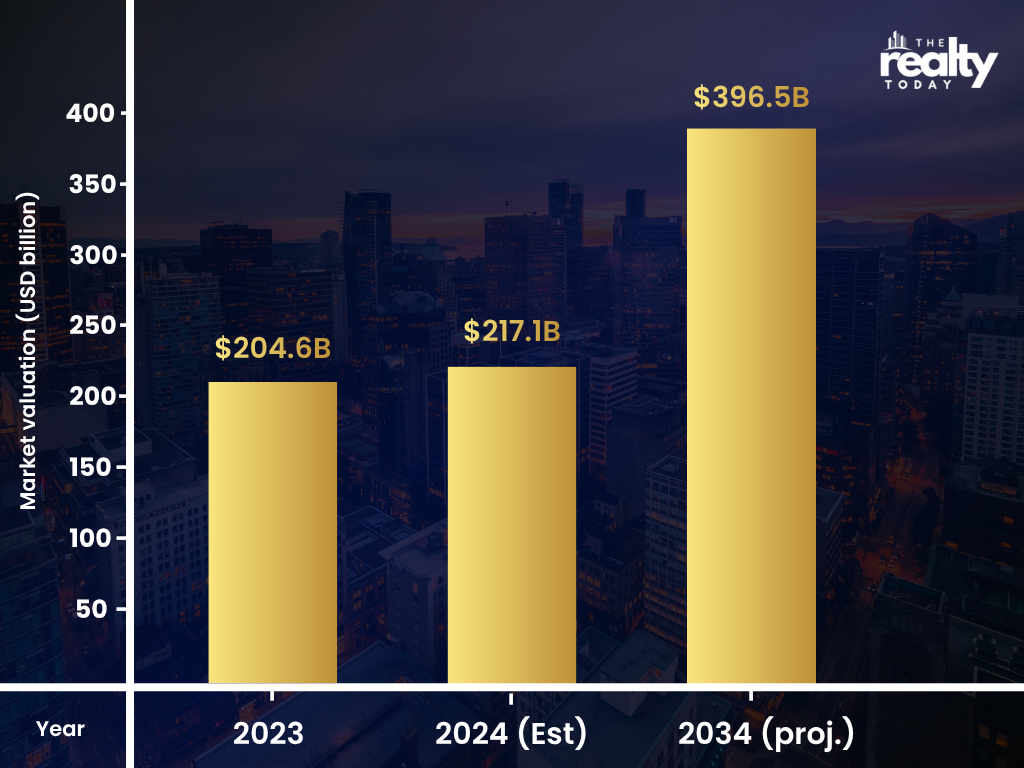
The United Kingdom's real estate sector is standing at the threshold of a massive transformation. According to a comprehensive market analysis reported by OpenPR, the UK real estate market is projected to reach a staggering value of USD 396.5 billion by 2034. This growth represents a steady climb from its 2023 valuation of USD 204.6 billion, progressing at a Compound Annual Growth Rate (CAGR) of 6.1% over the next decade.
This shift is not merely about rising property prices; it reflects deeper structural changes in how people live, work, and invest in the UK post-pandemic.
Key Market Projections
The growth trajectory of the UK property market is underpinned by robust demand across residential, commercial, and industrial segments. The following table illustrates the expected market expansion:
Primary Drivers of Growth
Several macroeconomic and localized factors are converging to drive this nearly USD 200 billion increase in market value.
1. Continued Residential Shortage
As per the analysis, the fundamental imbalance between housing supply and demand remains the strongest driver of value. The UK has consistently fallen short of its annual housing targets, leading to sustained upward pressure on both rental yields and capital values. Residential real estate continues to be the largest contributor to the overall market size.
2. The Rise of "Build-to-Rent" (BtR)
The report highlights a significant pivot toward professionalized rental markets. With high interest rates making homeownership challenging for first-time buyers, institutional investors are pouring capital into Build-to-Rent schemes. This shift toward long-term rental models provides stable, inflation-hedged returns for global investors.
3. Commercial Evolution: Life Sciences and Logistics
While traditional high-street retail faces headwinds, specialized commercial sectors are booming. The UK's "Golden Triangle" (London, Oxford, and Cambridge) is seeing unprecedented demand for life sciences laboratories. Additionally, the continued growth of e-commerce has turned industrial warehouses and logistics hubs into some of the most valuable assets in the real estate portfolio.
Market Segmentation and Regional Dynamics
The UK market is no longer just "London-centric." While London remains a global hub for luxury residential and Tier-1 office spaces, secondary cities are becoming growth engines.
London & South East: Remains the liquidity capital, attracting the bulk of foreign direct investment (FDI).
The Northern Powerhouse (Manchester, Leeds, Liverpool): These regions are seeing faster percentage growth in rental prices compared to the capital, driven by urban regeneration and lower entry costs for investors.
The Midlands: Cities like Birmingham are benefiting from major infrastructure projects (like HS2 connectivity), which are unlocking new residential and commercial corridors.
Technological Transformation: PropTech
A major theme in the 2034 forecast is the total integration of technology. PropTech is no longer a niche sector; it is the backbone of the market.
Data-Driven Valuation: AI is being used to predict property hotspots with higher accuracy.
Digital Transactions: Blockchain and smart contracts are reducing the time required for conveyancing, making the market more liquid.
Smart Buildings: Developers are increasingly focusing on "Internet of Things" (IoT) enabled buildings that offer better energy management and tenant experiences.
Sustainability and the "Green Premium"
Environmental, Social, and Governance (ESG) standards are moving from "nice-to-have" to "mandatory." The report suggests that by 2034, a significant portion of market value will be tied to energy efficiency ratings.
Retrofitting: A massive secondary market is emerging for retrofitting older UK housing stock to meet Net Zero targets.
Regulatory Pressure: Stricter EPC (Energy Performance Certificate) requirements for rental properties are forcing landlords to upgrade, which in turn increases the capital value of compliant assets.
Investment Outlook
For institutional and private investors, the UK remains a "Safe Haven" market. Despite Brexit-related adjustments and short-term interest rate volatility, the legal transparency of the UK property system and its status as a global financial center ensure a steady flow of capital.
Risk Factors to Monitor:
Interest Rate Fluctuations: Sustained high rates could dampen transaction volumes in the short term.
Planning Reform: The speed of growth is heavily dependent on the government's ability to reform planning laws to allow for faster development.
Labor Shortages: Increasing costs of construction materials and specialized labor could squeeze developer margins.
Conclusion
The projected growth to USD 396.5 billion by 2034 paints a picture of a resilient and evolving UK real estate market. While the challenges of affordability and supply persist, the diversification into specialized sectors—such as Build-to-Rent, Logistics, and Data Centers—offers a wide array of opportunities for stakeholders. As the market nearly doubles in value over the next decade, the focus will increasingly shift toward sustainability, technology, and regional urban renewal.