

Uttar Pradesh's real estate sector closed 2025 with its strongest year yet, as capital investment in registered projects rose 53.5% to ₹68,328 crore, according to data released by the Uttar Pradesh Real Estate Regulatory Authority (UP RERA). This is a sharp climb from ₹44,526 crore recorded in 2024, and marks the second consecutive year of accelerating growth after investment stood at ₹28,411 crore in 2023.
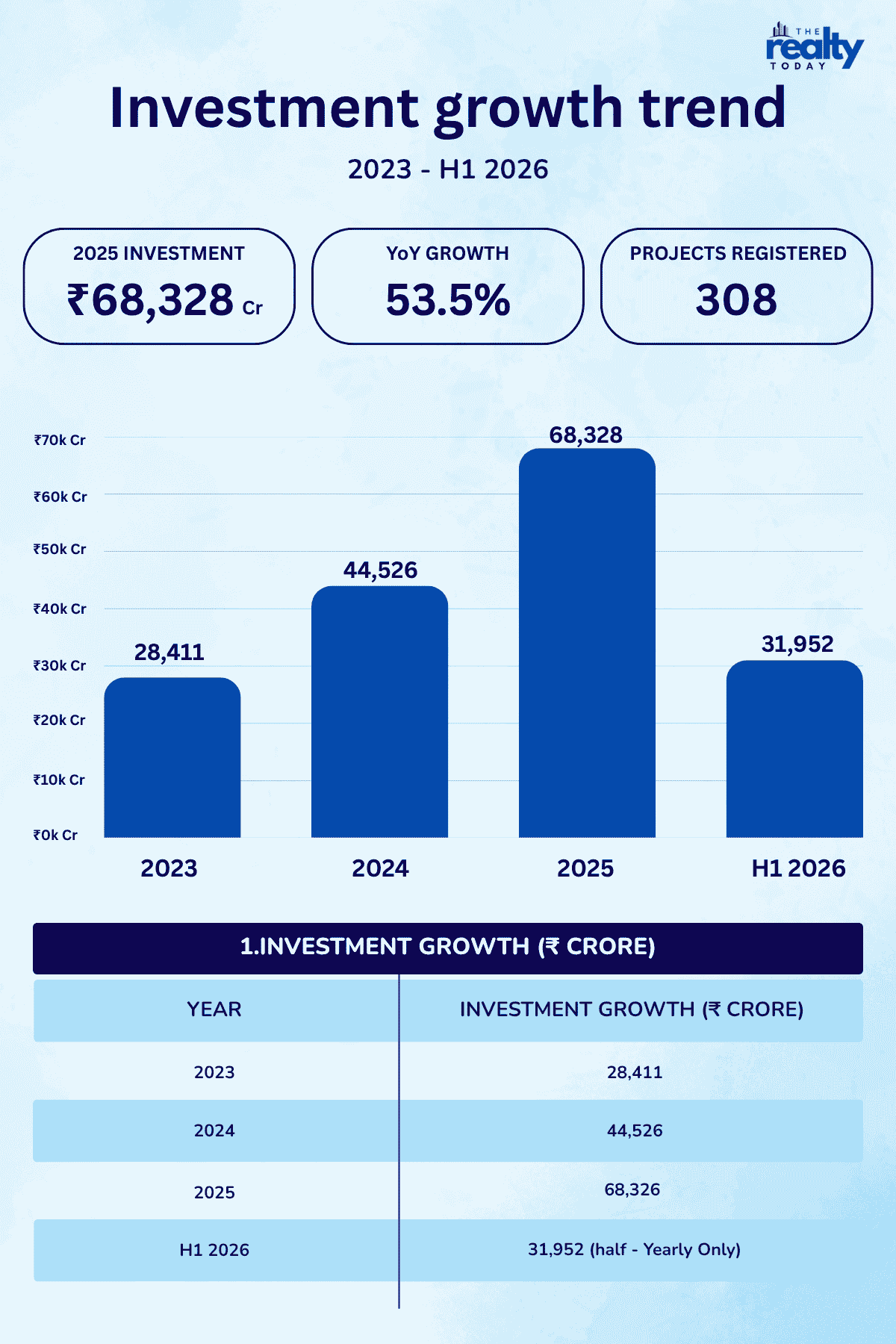
Industry voices attribute the surge to a combination of policy reform and faster regulatory clearances. UP RERA Chairman Sanjay Bhoosreddy said the steady rise in project registrations, housing units and investments reflected growing confidence among homebuyers and investors in the state's real estate ecosystem.
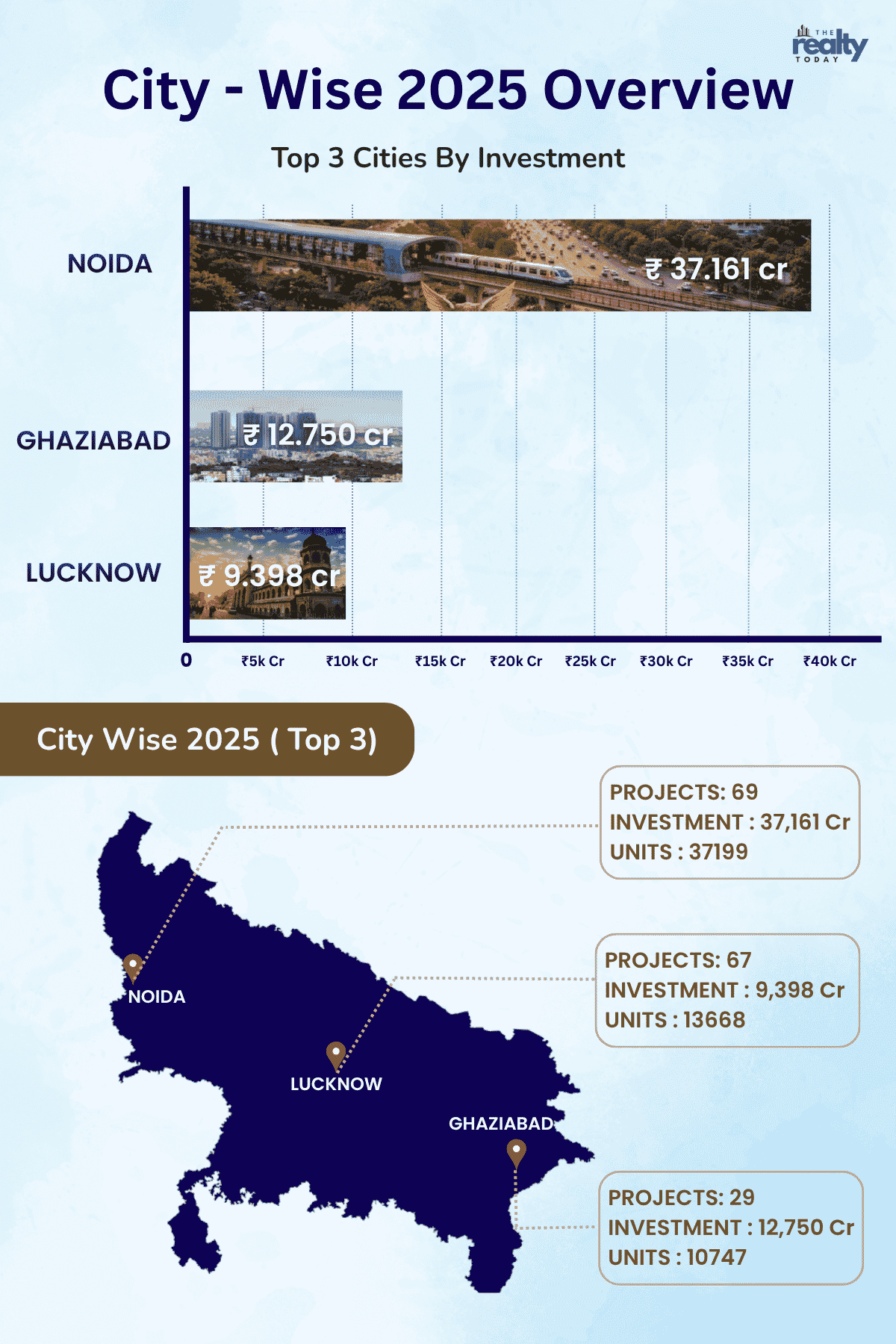
Noida remained the single largest contributor to the state's real estate economy in 2025, accounting for 69 project registrations, ₹37,161 crore in investment, and 37,199 approved residential and commercial units — a scale that alone represents more than half the state's total investment for the year.
Ghaziabad followed with 29 projects and ₹12,750 crore in investment across 10,747 units, while Lucknow registered 67 projects worth ₹9,398 crore across 13,668 units — placing the state capital second in project count, just two behind Noida, even though its investment value trails the NCR belt considerably.
Pilgrimage and heritage cities have become a distinct growth pocket within the state's property market. Mathura recorded 23 project registrations in 2025, the highest among non-metro religious destinations, followed by Varanasi with nine, Prayagraj with seven, and Ayodhya with five.
Government officials have pointed to large-scale redevelopment activity and rising tourist footfall in these cities as key drivers, with pilgrimage-linked real estate increasingly seen as a growth category distinct from the state's traditional NCR-driven housing demand. Bareilly and Agra also featured among the notable non-NCR contributors, registering 15 and 14 projects respectively.

Developers and officials cite three broad factors behind the jump:
1. Revised township policy: Changes to the state's township policy have been widely cited as a key catalyst, making large-format township development more viable and attractive for private developers.
2. Faster regulatory clearances: Industry representatives note that quicker project approvals have meaningfully shortened the time between land acquisition and RERA registration, directly improving investment velocity.
3. Infrastructure push: Ongoing expressway networks, mass rapid transit expansion, and smart-city projects across the state continue to support demand in both established and emerging real estate corridors.
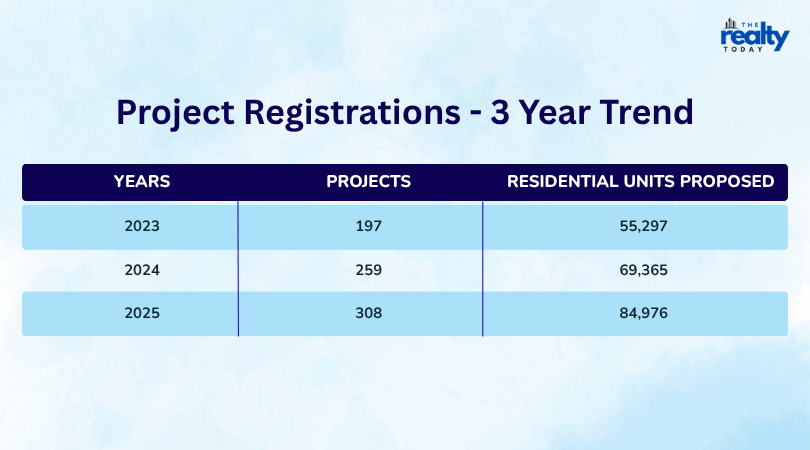
Together, these factors have allowed Uttar Pradesh's growth in housing supply to run ahead of the broader national trend, which industry estimates placed in the 8–12% range for 2025 — well below UP's 22.5% rise in proposed units.
Momentum Has Carried Into 2026
The growth has not been a one-year spike. UP RERA's half-yearly report for January–June 2026 shows the momentum continuing: 143 new projects were registered in H1 2026, up from 134 in the same period of 2025, proposing 46,049 residential units against 35,082 units a year earlier; a jump of over 31%. Capital investment for the first half of 2026 stood at close to ₹31,952 crore.
The Bigger Picture
The 2025 numbers align with the Uttar Pradesh government's broader ambition of positioning the state as a $1 trillion economy, with real estate identified as one of the key growth levers. The state has previously set a target of attracting ₹7.3 lakh crore in real estate investment over five years, alongside plans to construct over 64 lakh housing units across income categories in urban areas to meet projected urbanisation, as the state's urban population is expected to rise sharply by 2027.
For homebuyers, the data offers a reassurance point: a rising base of RERA-registered projects, combined with regulatory measures such as UP RERA's recent cap on flat transfer charges for legal heirs, signals a market that is expanding activity while also tightening consumer protection.
For developers and investors, the takeaway is more strategic — Uttar Pradesh's growth story is no longer a Noida-and-Ghaziabad story alone. Lucknow's rise as a non-NCR anchor, and the emergence of Mathura, Varanasi, Prayagraj and Ayodhya as active registration markets, point to a state-wide broadening of real estate activity that developers evaluating their next project location will want to factor in.
(Source: Uttar Pradesh Real Estate Regulatory Authority, 2025 and H1 2026 data)