
Global Capability Centres (GCCs) in India continue to scale new heights, having evolved from back-office operational centres into strategic hubs for high-value functions like artificial intelligence, engineering, analytics, research & development and digital excellence. India’s dominance in the global GCC marketplace is driven by a deep STEM (Science Technology Engineering & Mathematics) talent pool, competitive real estate & manpower costs, and availability of high-quality office supply.
Since 2021, GCCs have leased approximately 118 million sq ft of Grade A office space across the top seven cities of the country, accounting for 37% of overall demand as per latest Colliers’ report, "GCCs in India: Global leadership through scale, competitiveness, talent & innovation". In H1 2026, GCCs have leased 16.6 million sq ft, which translates to a notable 46% share in overall Grade A office space uptake. In fact, continuing the upward growth trajectory, GCCs are expected to remain the cornerstone of office space demand, with annual GCC leasing projected at around 35-40 million sq ft for the next two years, reinforcing India’s status as a leading global innovation hub.

“India has firmly established itself at the epicenter of GCC-led innovation, combining talent superiority, cost arbitrage & technological prowess with policy push & a supportive business environment. As multinational corporations continue to scale up their operations in India, office space demand is expected to continue to be fueled by large-scale capability centres at the forefront of AI-driven innovation. Going forward, over the next two years, GCCs are expected to drive 45-50% of India's office space demand, taking up around 35-40 million sq ft of Grade A space annually. This is expected to create multiple opportunities for developers and investors alike, simultaneously strengthening the country's position in the global commercial real estate market,” says Arpit Mehrotra, Managing Director, Office Services, Colliers India.
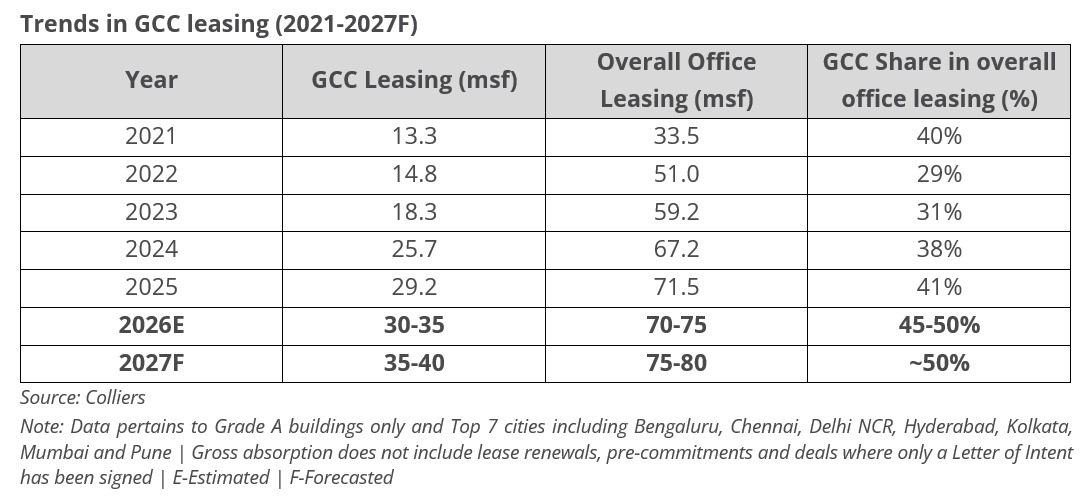
Note: Data pertains to Grade A buildings only and Top 7 cities including Bengaluru, Chennai, Delhi NCR, Hyderabad, Kolkata, Mumbai and Pune | Gross absorption does not include lease renewals, pre-commitments and deals where only a Letter of Intent has been signed | E-Estimated | F-Forecasted
Diversifying beyond Technology sector, BFSI and Engineering & Manufacturing firms together drive more than one-third of GCC demand
In recent years, GCC demand for Grade A office space has extended beyond the Technology sector, highlighting India's expanding role in high-value business operations and innovation-driven functions. While the Technology sector remains the largest contributor to GCC leasing, accounting for 39% of the cumulative demand since 2021, other sectors are also gaining momentum. BFSI sector has emerged as a key contributor to GCC demand, accounting for 22% of overall demand. In fact, the sector has emerged as a key driver of GCC footprint expansion, with leasing volumes increasing nearly three-fold between 2021 and 2025. Meanwhile, Engineering & Manufacturing firms have accounted for 16% of the GCC leasing activity since 2021. Their space absorption has grown by more than 2.5X over the same period, highlighting the emergence of specialized capability clusters that are driving deep domain expertise and innovation.

“As India’s office market continues to scale new heights, GCCs remain at the forefront of its growth story. While the Technology sector is likely to remain dominant and account for 40-50% of the GCC leasing in 2026, other demand sectors are expected to witness significant traction in coming years. BFSI and Engineering & Manufacturing GCCs are poised to cumulatively drive over one-third of annual office space demand in the next few years. Interestingly, GCCs across demand sectors are likely to increasingly adopt flex spaces within their real estate portfolios by prioritizing agility, speed-to-market, workforce flexibility and cost rationalisation,” says Vimal Nadar, National Director & Head of Research, Colliers India.
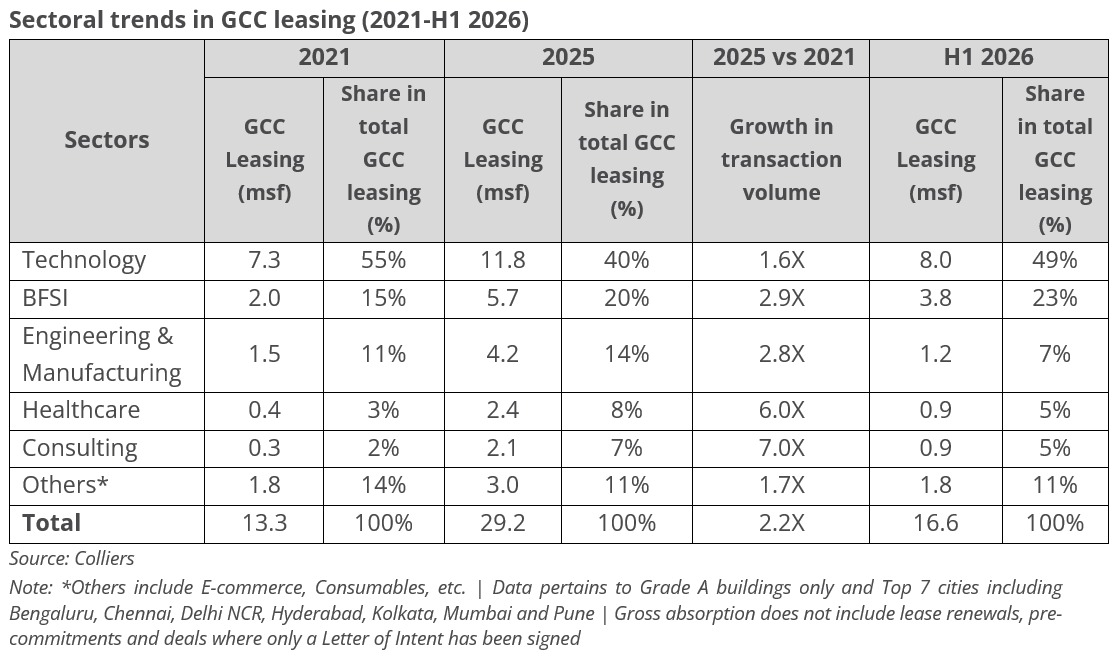 Note: *Others include E-commerce, Consumables, etc. | Data pertains to Grade A buildings only and Top 7 cities including Bengaluru, Chennai, Delhi NCR, Hyderabad, Kolkata, Mumbai and Pune | Gross absorption does not include lease renewals, pre-commitments and deals where only a Letter of Intent has been signed
Bengaluru and Hyderabad drive over 60% of GCC space uptake in the last 4-5 years
Although Bengaluru and Hyderabad have collectively driven over 60% of the GCC leasing since 2021, the demand from capability centres in India is becoming broad based. Other Tier I cities continue to leverage competitive costs and specialized industry ecosystems to attract global firms. While Bengaluru & Hyderabad are likely to continue to be preferred by Technology GCCs, Mumbai & Pune will anchor BFSI operations. Similarly, Chennai is likely to increasingly attract GCCs from the Engineering & Manufacturing domain.
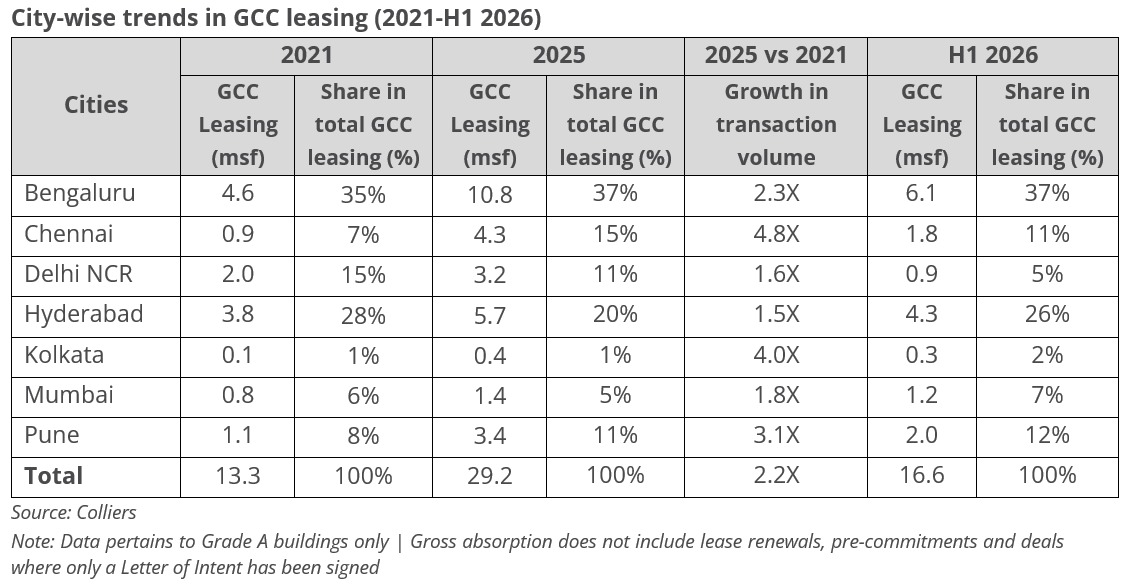
Note: Data pertains to Grade A buildings only | Gross absorption does not include lease renewals, pre-commitments and deals where only a Letter of Intent has been signed
Top 10 micro-markets capture over 70% of GCC demand during 2021-H1 2026
Mirroring broader trends in India’s office market, the GCC growth story remains concentrated in a few established business districts, with the top 10 micro markets driving more than 70% of India’s GCC space uptake since 2021. Southern cities dominate the GCC market, comprising nine of the top 10 micro-markets, supported by strong regional talent pool, infrastructure development, and cost competitiveness. In fact, Bengaluru’s Outer Ring Road (ORR) and Hyderabad’s Secondary Business District (SBD) are the most prominent GCC micro markets, together accounting for 37% of GCC leasing volumes since 2021. Other key GCC hubs include Whitefield, SBD 1 & North Bengaluru in Bengaluru, Off SBD in Hyderabad, OMR Zone 1, MPR & PTR in Chennai and Kharadi in Pune.
While all of these top 10 GCC micro markets are likely to continue to drive majority of the GCC demand, sub and near-dollar rentals can provide a boost to GCC space uptake in emerging markets such as Noida Expressway in Delhi NCR, Navi Mumbai in Mumbai, Hinjewadi in Pune etc.
Emerging models including AI-native & intelligent GCCs to drive next growth phase
Emerging trends such as the “Hub-plus-one” strategy which encompasses Tier II & III cities are likely to gain further traction in the coming years. Simultaneously, the rise of “Nano & mid-sized” GCCs and the growth of AI-powered capabilities are likely to define the next growth phase. Most importantly, as GCCs in India continue to drive innovation, knowledge-led operations and strategic business functions, they will remain pivotal in the ongoing maturity of India’s office market.