

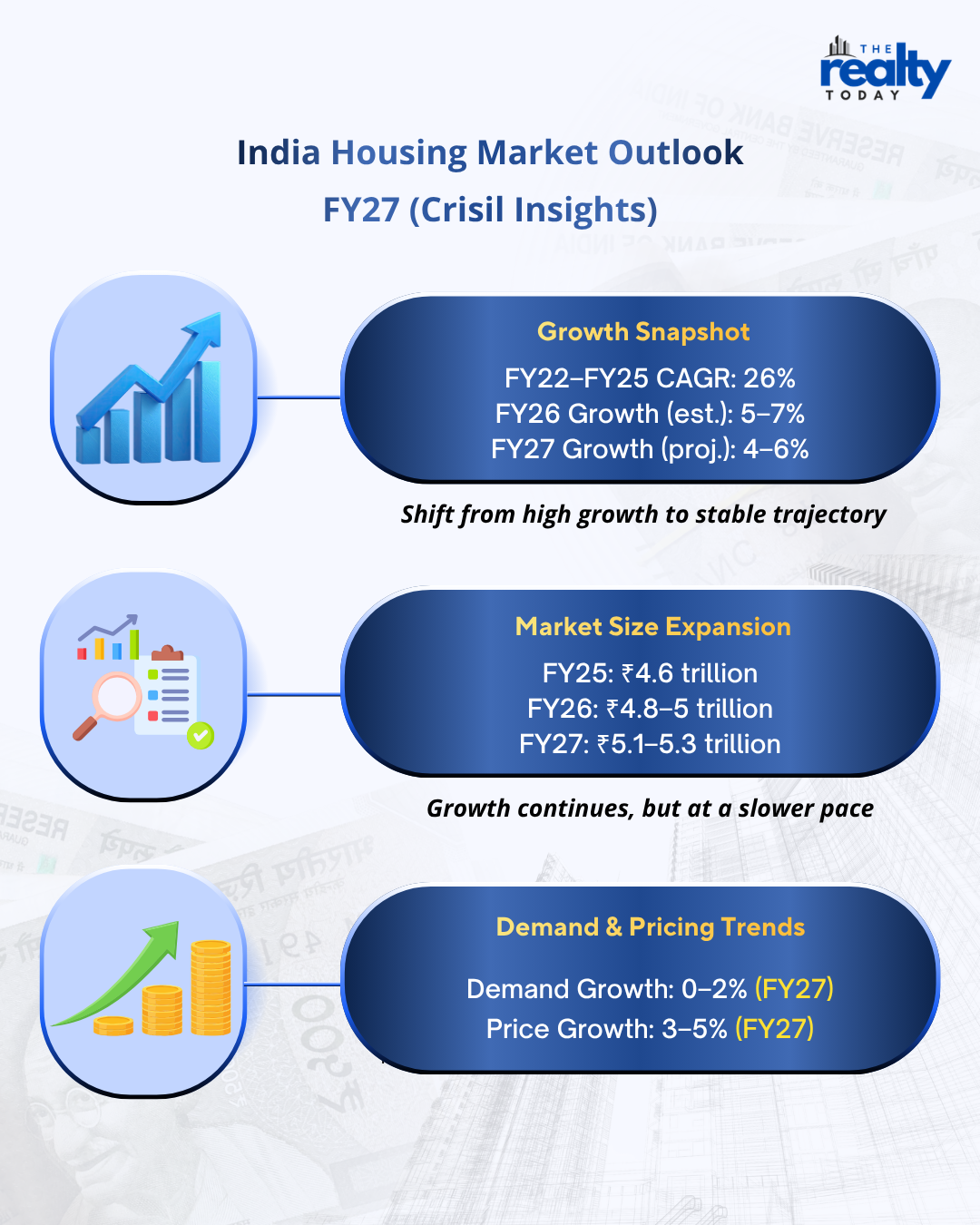
India's residential real estate sector is slowly moving towards a stable and sustainable growth phase in FY27 after a strong post-pandemic expansion. As per Crisil Ratings, growth in the value of housing sales is likely to ease a bit to 4-6% in FY27 from an estimated 5-7% in FY26. However, this moderation is more the result of a leveling off of demand and a deceleration in price rise rather than any fundamental market weakness.
The sector had undergone a phenomenal expansion from FY22 to FY25, achieving a compound annual growth rate (CAGR) of 26% in sales value. This upsurge was driven by releasing of demand, lower interest rates, and changes in consumer tastes favoring homeownership after the pandemic. Yet, when the market matures and base effects become stronger, the growth rate will simply slow down. Nevertheless, the market size is still growing steadily as the total housing sales value is projected to climb from approximately 4.6 trillion in FY25 to 5.15.3 trillion in FY27.
A major contributor for such a moderation has been a slower pace of growth in demand which according to estimates, will be at 0-2% range and still quite weak in FY27. The increase in property prices over the last few years has significantly impacted the affordability aspect and hence has made buyers more wary of their buying decisions.
On top of that, projects which were supposed to be launched earlier but got delayed due to approval-related problems in some cities, also played a part in affecting the supply timelines, however these problems are anticipated to reduce in the future. It has been highlighted in the report that, "the continuous rise in housing prices is going to result in a very low change in demand of about 0-2 per cent in FY27, " which clearly shows the correlation between affordability pressures and demand being less than vibrant.
- Demand growth: Expected at 0–2% in FY27
- Price appreciation: Likely to moderate to 3–5%
- Sales value: Projected to reach ₹5.1–5.3 trillion
Price growth moderation is another significant market trend. After a period of strong double-digit increases - approximately 11% CAGR from FY22 to FY25 - and a 7-9% growth estimated for FY26, the pace of price inflation will reduce further to 3-5% in FY27. This is due to both a base effect at a high level and a better balanced demand-supply scenario, where buyers are less willing to accept price increases.
However, the premium and luxury housing market segment remains one of the significant growth drivers despite the overall moderation. Its share in total launches has gone up drastically from about 12% in FY22 to almost 38-40% in FY27. This change in emphasis reflects the shifting preferences of buyers where more and more homebuyers are choosing larger homes, better amenities and higher standards of living. Moreover, this product category allows developers to achieve higher realizations and margins, so they continue to consider it an appealing focus area even when the pace of growth is slow.
On the supply side, there are signs that inventory levels may be slowly rising because new project launches are still coming up while demand growth is quite low. Inventory is forecasted to go up to 3.23.4 years in FY27 from less than three in the last two financial years, which means that supply could slightly exceed demand in the short run, thereby possibly building up unsold stock unless it's well-controlled.
From a financial perspective, the situation of developers looks quite stable and favorable. Solid collections, which are almost completely synchronized with the construction progress, have guaranteed sufficient cash flows, allowing developers to decrease their dependence on borrowing from outside sources. Collections are forecast to increase by 2224%, which will help a 1517% rise in cash flow from operations (CFO). This robust cash inflow is all along the line keeping credit metrics at a comfortable level, with the debt-to-CFO ratio expected to be between 1.11.3 times in FY27, which is a sign of careful financial management.
Some risks are still lurking. If demand weakens significantly and at the same time there are a lot of new projects being launched aggressively, it is quite possible that inventory levels rise quite sharply. Besides, the existing geopolitical tensions across the globe could be responsible for inflationary pressures which, in turn, may put further constraints on affordability and lead to a decline in the mood of prospective buyers.
India's residential real estate market is not dying out but rather changing and developing into a more balanced and mature phase of growth. Even though the rate of increase in the sale value and prices is slowing down, and the sector is still receiving the benefits from strong basics like demand for premium housing, steady cash flows, and developers' financial discipline is increasing. This trio of factors, among others, will continue driving a steady and sustainable growth in the FY27 period and even later when the market is settled in the vicinity of a normal growth path.




.png)