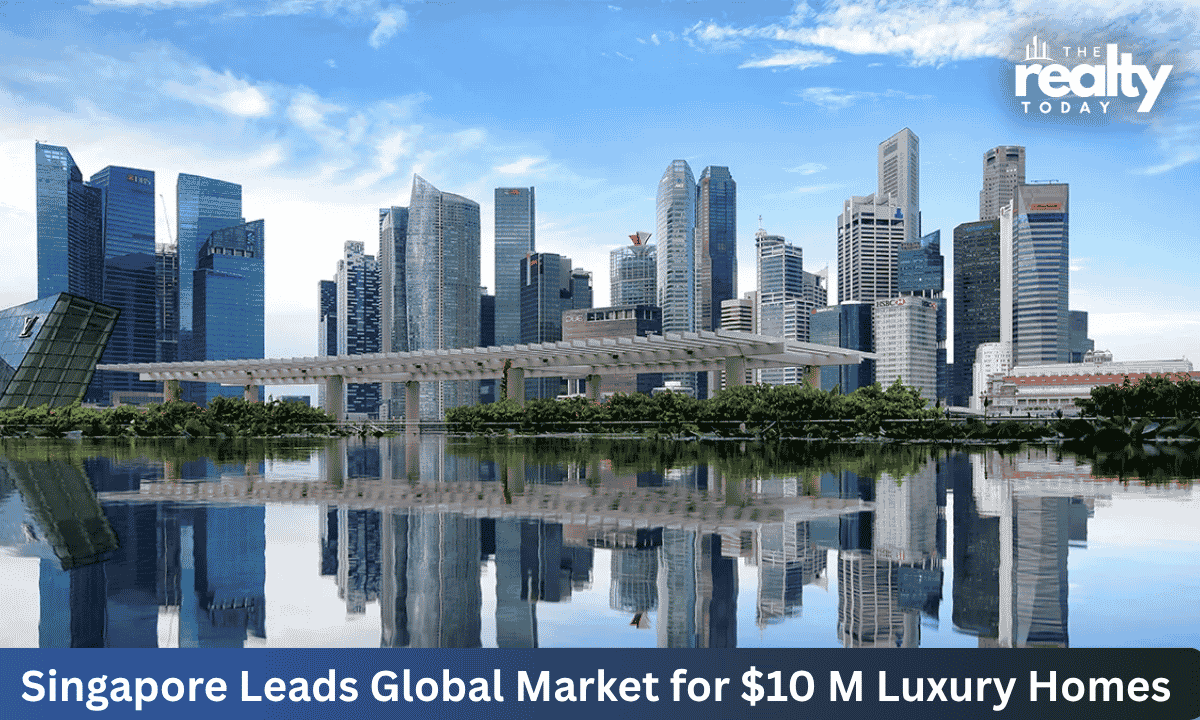
Forget the postcode envy of London or the skyline flex of Dubai. If you're shopping in the $10-million and up bracket, Singapore now has more to show you than anywhere else on the planet, one in every 20 homes for sale here crosses that line. No other city gets close.
That's a real finding, not hype. A UK property firm called Enness Global looked at 13 major cities and checked what share of homes for sale in each one cost $10 million or more, the price tag that marks a "trophy home" in the industry. Singapore came out on top, with 5.2% of its listings at that level. New York, the city most people would guess first, was a distant second at 1.2%. Dubai came next at 1.0%, then London at 0.8%. After that, the numbers drop off fast: cities like Paris, Berlin, Rome and Cape Town each have only about 0.1% of their homes priced that high.

Numbers like that don't happen by accident. Singapore has spent a decade quietly building the exact conditions ultra-rich buyers look for and 2026's data shows the strategy paying off harder than ever.
The real story is who's buying, not who's visiting
Here's the twist most coverage of Singapore real estate misses: this isn't a foreign-money story anymore. It's a homegrown one.
Singapore now hosts over 2,000 Single Family Offices carrying MAS tax incentives, up from roughly 400 in 2020. That's a fivefold jump in five years, and MAS just made it easier still, rolling out a streamlined licensing framework in June 2026 to cut the red tape around setting one up. These offices don't chase yield. They park generational wealth somewhere it won't get touched, and Singapore real estate, especially the trophy end, is where a lot of that money lands.

The buyer mix on the ground backs this up. Locals now make up 75.2% of Core Central Region condo sales. PR buyers have grown their share from 15.6% in 2022 to 18.8% today. Foreign individuals, meanwhile, have shrunk to just 3–5% of private residential deals in the first half of 2026 down from 8–12% before 2023. Singapore's trophy-home boom is being built by the people who already live there.
The 60% tax that changed everything
There's a reason foreigners aren't the ones driving this. Since April 2023, any non-citizen buying a home here pays a flat 60% Additional Buyer's Stamp Duty. There's no sliding scale and no break on a first home. Buy through a company or trust and it goes up to 65%. Only a few nationalities, like the US, Switzerland, Norway, Iceland and Liechtenstein, are exempt because of trade agreements. A Singapore citizen, on the other hand, pays nothing on a first home.

The tax is steep enough that even the industry group Propnex has asked the government to lower it to 30% for foreign buyers, but only for homes priced above $10 million in the Core Central Region. That's basically an admission that the tax hurts most exactly where Singapore wants to stay attractive to global buyers. Still, the big money hasn't slowed down. Real estate investment volumes hit S$15.4 billion in Q1 2026 alone, up 166.5% from a year earlier, largely because institutional deals, which drive most of that number, don't fall under ABSD at all.
Two neighbourhoods carrying the trophy-home crown
If you want to know where Singapore's $10-million-plus homes actually sit, it comes down to two very different categories.
Good Class Bungalows are the ceiling. Only about 2,800 exist, spread across 39 gazetted enclaves, and foreigners can't touch them because citizenship is a hard requirement. Prices averaged S$2,341 psf on land in Q2 2026. Entry costs S$15–20 million; the trophy addresses like Nassim Road, Cluny Hill, Ridout Road go for S$40–80 million and beyond. A Dalvey Estate bungalow recently listed at S$128 million; a Tanglin Hill GCB, still mid-construction, sold for a record S$6,197 psf. Zoom out 20 years and the segment has returned an average 437% — a number few other asset classes anywhere can match.
Core Central Region condos are where the volume lives. $10-million-plus deals rose from 14 units in Q4 2025 to 17 in Q1 2026, part of a broader luxury segment that hit a one-year transaction high the same quarter. Analysts are pricing in another 4–6% climb through 2026 as new launches push past S$3,200 psf.
Tie it together and you land on the same root cause every time: Singapore simply isn't making more land. No new GCB enclave has been gazetted in decades, and landed housing overall is capped near 73,000 units against almost 500,000 condos over the next 15 years. Scarcity does the heavy lifting; policy just decides who gets to buy into it.
Bottom line
Singapore isn't trying to out-glitz Dubai or out-prestige London anymore — the Enness numbers say it already has. A punishing 60% foreign tax hasn't shrunk the trophy-home pipeline; it's just handed the keys to the family offices, citizens and PRs Singapore spent years courting. For anyone tracking Singapore real estate news in 2026, that's the actual headline: the city-state didn't just join the ultra-luxury conversation — it's now setting the terms.