

The United Kingdom has retained its position as the world's most transparent real estate market, according to the 2026 Global Real Estate Transparency Index (GRETI) released by JLL and LaSalle Investment Management.
But the latest edition of the biennial report tells a much larger story than which country occupies the top spot.The 2026 GRETI highlights a widening divide between highly transparent and less transparent markets, while also pointing to a new wave of improvement driven by digitisation, government reforms, artificial intelligence, sustainability reporting and the growth of alternative real estate sectors.
The report assesses 88 countries and territories and 146 city markets, using 260 transparency factors. These markets are placed across five tiers, ranging from Highly Transparent to Opaque. More importantly, the findings show a clear relationship between transparency and the ability to attract global real estate capital.
The world's 13 Highly Transparent real estate markets
The United Kingdom continues to lead the global rankings. France takes the second position, followed by Australia.
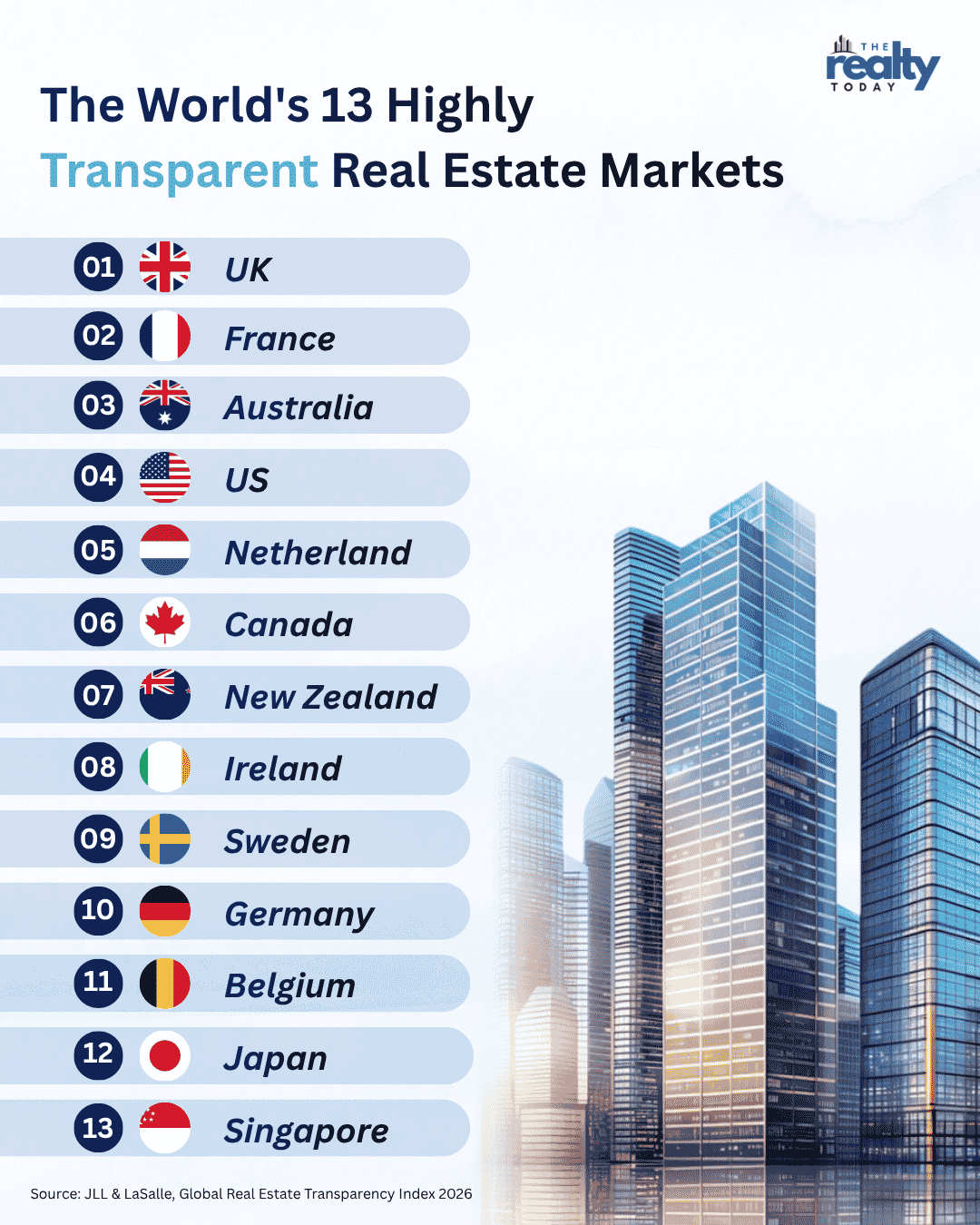
These markets benefit from deeper capital markets, stronger data availability, clearer regulatory systems and more established transaction processes.
Together, the 13 Highly Transparent markets now account for 56% of global income-producing real estate and more than 80% of direct real estate investment worldwide.
Transparency is directly shaping where capital flows
Transaction volumes in the world's Highly Transparent markets rose 64% over the past two years, 20 percentage points ahead of the rest of the world, drawing around $1.4 trillion in capital. As global uncertainty grows, investors are leaning harder on reliable data, clear regulations and confident transaction processes, making transparency less a marker of market maturity and more a prerequisite for institutional capital.
The progress isn't limited to established markets. Two-thirds of the markets in the index improved their transparency over the past two years, driven by digitised land registries, better property data access, and improved building-efficiency standards. Markets from Colombia and Kenya to Mexico and Qatar all recorded gains narrowing the gap with the world's leading markets.
Asia Pacific and the Middle East lead global transparency gains
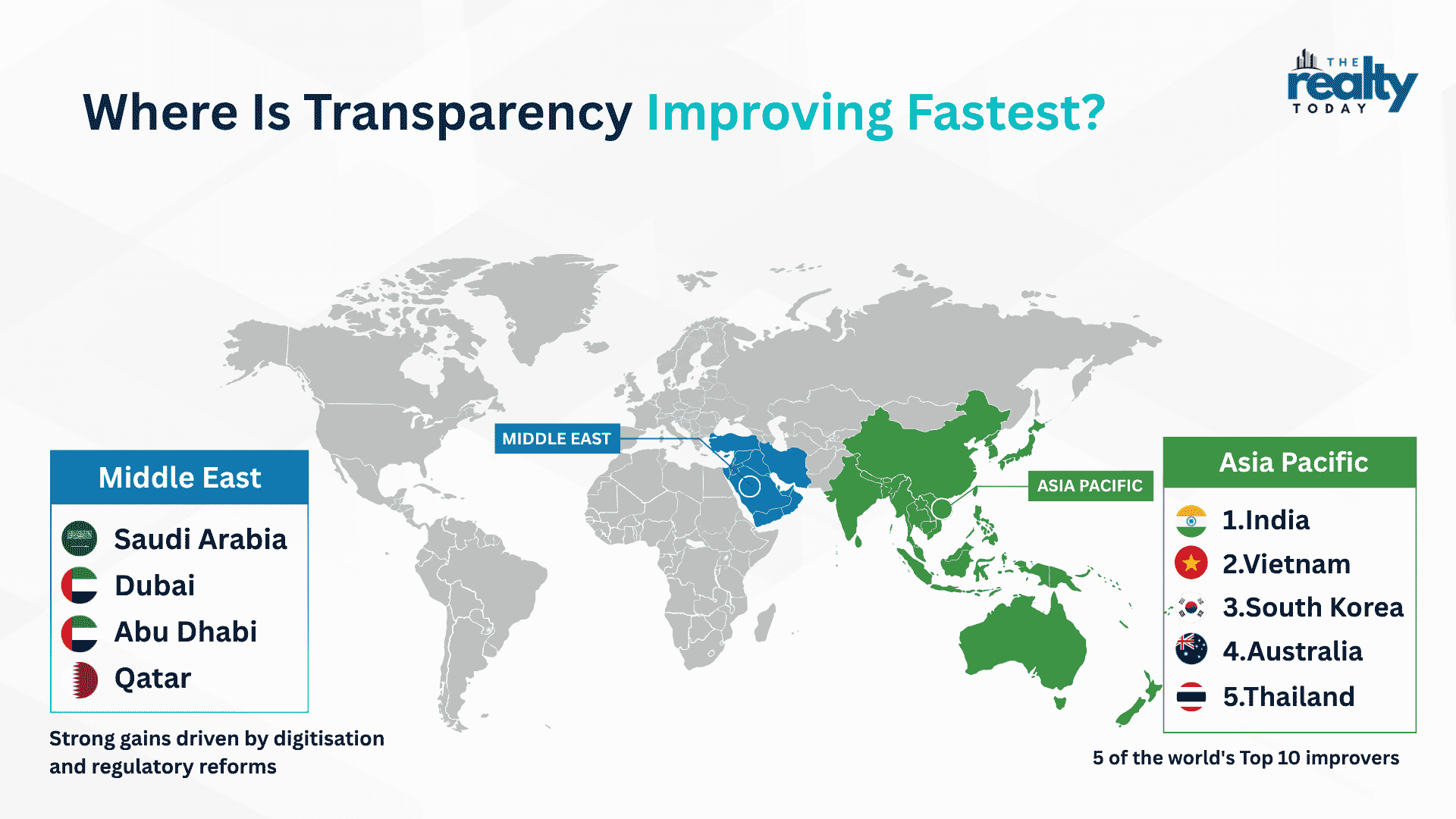
Asia Pacific was the standout region in the 2026 index, with five markets India, Vietnam, South Korea, Australia and Thailand making up half the world's top 10 improvers. India led the region's progress, helped by expanding digital infrastructure, better market data and a growing listed real estate sector; it first entered the Transparent tier in the 2024 GRETI, and its largest cities have since moved further into that category. Vietnam and South Korea also posted strong gains, while Australia improved further despite already ranking among the world's most transparent markets. Cross-border investment reflected this momentum, with India and Vietnam together drawing around US$12 billion in direct transaction volumes over the past two years.
The Middle East saw similar progress. Saudi Arabia, Dubai, Abu Dhabi and Qatar have all advanced over the past decade, driven largely by government-led digitisation, centralised property databases, stronger listed-company standards and, in Dubai's case, one of the world's more advanced systems for real-time public property data.
Together, the two regions show that transparency gains are increasingly coming from regulatory reform rather than market maturity alone.
Technology, energy and access are redefining transparency
AI is transforming how real estate is analysed, with over 90% of investors and occupiers now using AI tools for decision-making. But this raises the stakes on data quality, like, poor or fragmented data limits AI's usefulness, making standardisation and governance the next frontier of transparency.
Energy resilience is also moving to the centre of site selection and asset performance, as power costs and capacity become critical, especially for data centres and digital infrastructure. Building-performance and energy-tracking scores were among this year's biggest improvers.
Alternative sectors like data centres, manufacturing, and infrastructure now make up 20% of global transaction volumes, double their share a decade ago, demanding new kinds of market data beyond traditional assets.
Finally, regulatory changes could unlock over $800 billion in additional capital by 2030 through semi-liquid fund structures, widening access to individual investors. But this democratisation will require stronger transparency around valuations, performance and liquidity terms.
What GRETI measures
Published every two years by JLL and LaSalle, the Global Real Estate Transparency Index covers 88 countries, 146 cities and 260 factors from market data and regulation to sustainability and investment vehicle transparency. Markets fall into five tiers: Highly Transparent, Transparent, Semi-Transparent, Low Transparency and Opaque. Running since 1999, it's a key benchmark for global real estate investors.
The 2026 edition shows a clear trend: transparency now drives capital flows. Established markets still lead on scale and liquidity, but fast-improving markets like India, Vietnam, South Korea, Thailand and the Gulf states show that digitisation and reform can close the gap quickly. Transparency today goes beyond prices and transactions it covers land records, AI-ready data, energy access and sustainability disclosure. The markets that get this right fastest stand to capture the next wave of global investment.