

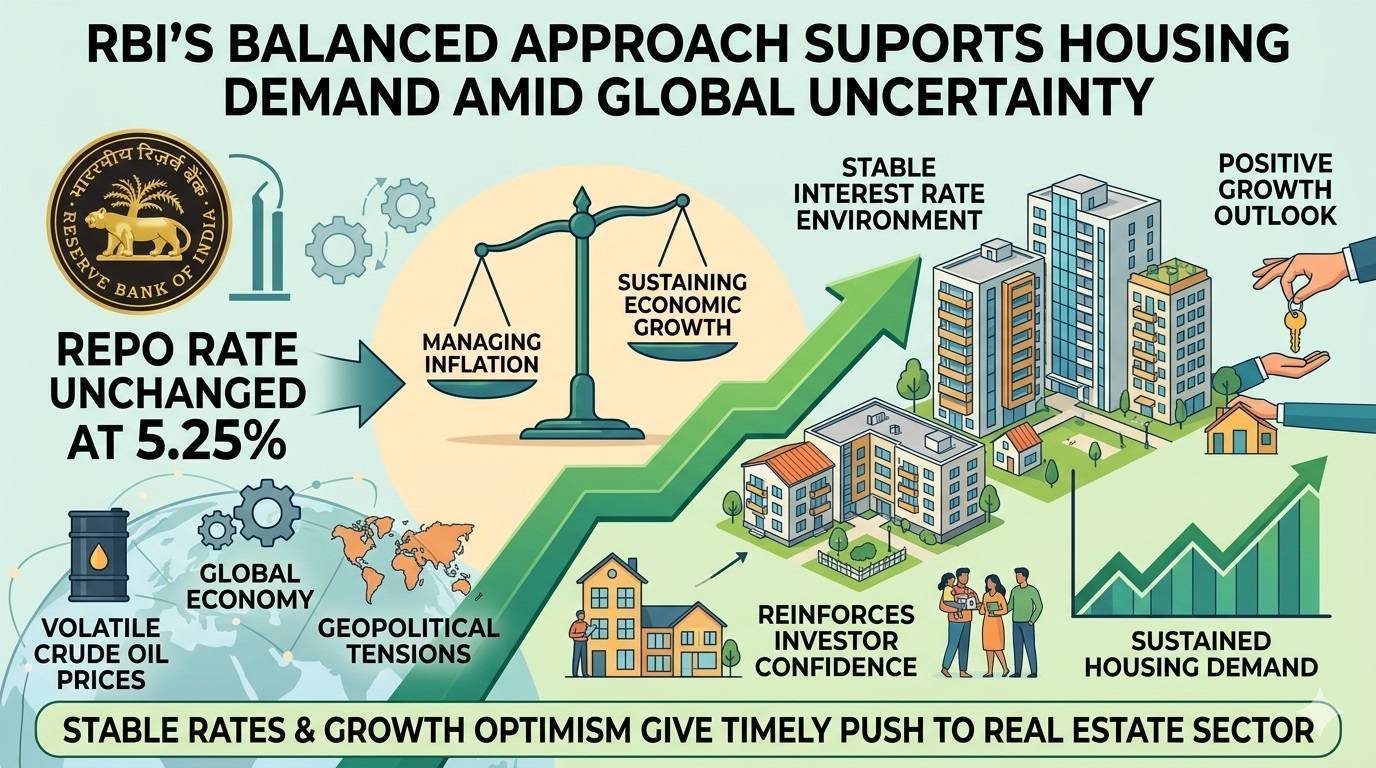
The Indian real estate sector is closely monitoring the Reserve Bank of India’s (RBI) upcoming monetary policy, with stakeholders largely expecting the repo rate to remain unchanged at 5.25%. A stable rate environment is critical, as it directly influences home loan affordability, project financing, and buyer sentiment. Developers and investors see stability as a signal of confidence, enabling predictable borrowing costs, supporting project pipelines, and sustaining demand across mid-income, affordable, and premium housing segments.
While domestic growth remains resilient, global uncertainties—ranging from crude oil price volatility to geopolitical tensions in West Asia—pose challenges for the sector. Experts highlight that a cautious, well-communicated policy stance can anchor investor confidence, encourage disciplined project execution, and ensure that both individual and institutional investments in real estate remain robust. Moreover, in an evolving investment landscape, alternative instruments such as real estate-focused AIFs may gain traction, providing liquidity and diversification in uncertain times.
Real Estate Expert Insights;
Mr. Umesh Gowda H A, Chairman and Founder of Sanjeevini Group

"The Reserve Bank of India is likely to keep interest rates unchanged while closely monitoring the impact of the ongoing conflict in West Asia. Housing demand remains resilient, and a stable rate environment should continue to support this momentum. However, the coming months will be critical. If the conflict persists, developers may adopt a cautious stance and focus on prioritising project execution and delivery."
Mr. E Lakshminarayana Reddy, Founder & CEO, EARA Group

“With the upcoming RBI monetary policy, the consensus expectation is that the central bank will maintain the repo rate at around 5.25%, adopting a cautious ‘wait-and-watch’ approach. While domestic inflation has remained largely within the comfort range, emerging global uncertainties—particularly rising crude oil prices and geopolitical tensions—pose upside risks. At the same time, India’s growth momentum remains resilient, giving the RBI room to pause and assess evolving conditions. The policy is likely to remain neutral, with any future action dependent on inflation trajectory and external factors. Stability in rates at this juncture would support both economic growth and financial market confidence.
Mr. Rajani Kant Mishra, Founder and Chairman, Amrawati Group

“The RBI is expected to maintain the repo rate, balancing controlled inflation with steady economic growth. A pause will provide stability to markets and borrowers, while allowing the central bank to closely monitor global uncertainties and evolving domestic economic conditions.”
Mr. Ravi Kant, CEO & Co-Founder, Elegance Enterprises

“The RBI is expected to maintain a cautious stance on the repo rate, balancing inflation control with the need to support economic growth. While inflation has shown signs of moderation, global uncertainties and food price volatility may prompt the central bank to stay watchful. A status quo or a measured cut could help sustain momentum in consumption and investment without triggering inflationary pressures.”
Mr. Ashish Bhutani, CEO Bhutani Infra

“In a world marked by geopolitical uncertainty and currency volatility, the one thing the real estate sector cannot afford is unpredictability at home. A stable repo rate is not just a monetary decision — it is a signal of confidence to homebuyers, developers, and investors alike. When borrowing costs are predictable, financial discipline follows, project pipelines strengthen, and end-user participation deepens. India’s emerging urban corridors are ready to absorb growth, but they need policy consistency as a foundation. We look to the RBI to hold the line — and in doing so, anchor real estate’s continued role as one of India’s most reliable engines of economic growth and employment.”
Mr. Mohit Mittal, CEO, MORES

“Crude crossing $100 is not an abstraction for the real estate sector — it feeds directly into cement freight, steel logistics, and the overall cost structure of projects already under execution. Developers locked into pricing decided months ago are quietly absorbing margins they hadn't budgeted for. That is the ground reality heading into April. A rate hold at 5.25% is what markets expect, and few would disagree with the call. The concern is timing — the 125 basis points delivered since early 2025 haven't fully reached project finance or construction credit yet, while input costs are moving in the opposite direction. That squeeze, if it persists, will eventually show up in launch timelines and pricing. The April policy needs to send a clear signal that keeping credit affordable for the real economy — not just the banking system — remains a live priority."
Mr. H.S. Kandhari, Executive Director, Harmony Infra Ventures

"Premium residential markets in India have, over the past two years, seen a meaningful uptick in NRI and high-net-worth investor interest. That interest is sensitive — not to repo rates directly, but to currency stability, capital flow confidence, and India's macro positioning relative to the rest of the world. Right now, all three are under some pressure. The rupee is navigating genuine external headwinds and FPI flows have turned erratic as US trade policy continues to surprise markets globally. Ahead of April 8, the sector's expectation is a hold at 5.25% — but more than the number, what premium residential markets need is a policy tone that reassures long-horizon investors that India remains a stable and attractive destination. A confident, well-communicated MPC outcome could actually work in the market's favour — steadying sentiment at a moment when most other global markets are anything but steady."
Mr. Ankur Jalan, CEO, Golden Growth Fund (GGF), a category II Real Estate focussed Alternative Investment Fund (AIF)

"The ongoing conflict in West Asia may lead the Reserve Bank of India to keep interest rates unchanged while remaining cautious about evolving risks in the weeks ahead. Investor-driven housing markets are already showing signs of moderation, and in such uncertain conditions, investors may increasingly shift their capital toward financialised instruments such as alternative investment funds rather than owning physical real estate assets.
This shift could enhance liquidity in structured investment vehicles while also offering investors greater diversification and relatively lower risk exposure. At the same time, developers may need to recalibrate their capital-raising strategies, relying more on institutional funding and partnerships as individual investor participation softens in the near term."
Mr. Lalit Parihar, Managing Director, Aaiji Group, a Dholera-based real estate firm

"At a time when the housing market is showing signs of moderation and the ongoing conflict in West Asia is likely to heighten uncertainties, it would be prudent for the Reserve Bank of India to keep interest rates unchanged and closely monitor the evolving macroeconomic landscape. Investors may gravitate toward relatively safer real estate assets that are less sensitive to interest rate movements - such as plotted developments that offer a perceived safe-haven appeal."
Aman Sharma, Managing Director & Founder, Aarize Group

"We welcome the RBI’s decision to keep the repo rate at 5.25%. This comes as a reassuring move, especially at a time when the global economy is under stress, highlighting the strength and stability of the domestic economic outlook. It will be a positive sign for the real estate sector as it will facilitate a supportive environment for the positive momentum going forward. It will also send a positive signal for investors, thus facilitating market confidence. For buyers it would be a lot of certainty in the buying of homes that would generate the promise of value in the longer run. Additionally, stable repo rates will help to keep home loan interest rates steady, improving affordability and encouraging more buyers to take purchase decisions with greater confidence. A consistent rate environment will help maintain growth traction, encourage disciplined investments and support the sector’s evolution in a more resilient and sustainable manner."
Ashish Agarwal, Director, AU Real Estate

"We welcome the RBI’s decision to keep the repo rate unchanged. The decision will help sustain momentum in the real estate sector. Rate stability is an important element in building the buyer’s confidence. This will ensure that buyers are making a more structured decision process for purchases. Although it will provide a steady demand to the housing market, it will definitely build the buyer’s confidence in premium properties where the buyer is aligned to long-term value and quality. A consistent rate environment will help to maintain growth traction, encourage disciplined."
Anil Godara, Founder and Managing Director, J Estates

"We welcome the RBI’s decision to maintain the repo rate at 5.25%. This calibration would be significantly encouraging for the real estate and senior living segment for enhancing the viability of spaces that provide the ecosystem of residential living integrated with healthcare and wellness infrastructure. It will also have a rippling effect on the investor sentiment, characterized by strengthened investor confidence. Additionally, the calibration will also induce steady expansion of professionally managed real estate communities across key markets".






.png)