

The year 2025 turned out to be a strong one for financial assets. Gold delivered returns of over 50%, while investors in equity mutual funds earned up to 15% annually. Residential real estate, on the other hand, delivered an average return of 15-20%, comprising a rental yield of about 4.8% and capital appreciation of roughly 6.5%, underscoring its role as a steady, income-generating asset rather than a momentum-driven trade.
Asset class analysis: The number game and the game behind numbers
Viewed purely through a numerical lens, real estate struggles to compete with equities or precious metals. Spreadsheet-based comparisons often favour assets that deliver sharp, headline-grabbing gains in shorter timeframes. However, such an approach misses a critical point: returns alone do not define wealth preservation or safe-haven performance.
A closer examination reveals that each asset class carries distinct vulnerabilities. Gold, despite its strong recent performance, offers neither income generation nor any practical utility. Mutual funds, particularly equity-oriented schemes, can deliver superior long-term returns but are inherently volatile and sensitive to market cycles, making outcomes heavily dependent on timing and investor behaviour. Sharp drawdowns during periods of global uncertainty can test investor patience and discipline.
Real estate, on the other hand, occupies a different position altogether. Its appeal lies not in short-term outperformance but in stability, income visibility and tangible value. These attributes become particularly relevant during periods of heightened volatility, when capital preservation takes precedence over aggressive growth.
For Indian investors, property has never been just a numbers-driven decision. Residential real estate carries deep cultural, emotional and financial significance. This preference is increasingly reflected in market trends. Investors focused on long-term wealth creation have been active participants in the ultra-luxury housing segment, which has steadily increased its share in overall launches and sales over the past decade.
Developers also point out that non-resident Indians now account for nearly 15-25% of investments in newly launched projects, underscoring the enduring confidence in Indian residential real estate as a long-term asset.
This sentiment is supported by strong macro fundamentals. Against the backdrop of sustained economic growth, rising disposable incomes and improving consumer confidence, India’s real estate sector is projected to grow at a compound annual rate of 9-11% and surpass the $1 trillion mark by 2030. Infrastructure expansion, urbanisation and rising demand for premium housing continue to provide structural support to the sector, even as global equity markets face periodic corrections.
A study by Knight Frank India further reinforces this trend, showing that homeownership remains a priority for nearly 80% of Indians. While cultural preferences play a role, homeownership is increasingly being viewed as an integral component of long-term wealth creation strategies, offering both financial security and asset stability.
Why real estate remains a compelling bet in 2026
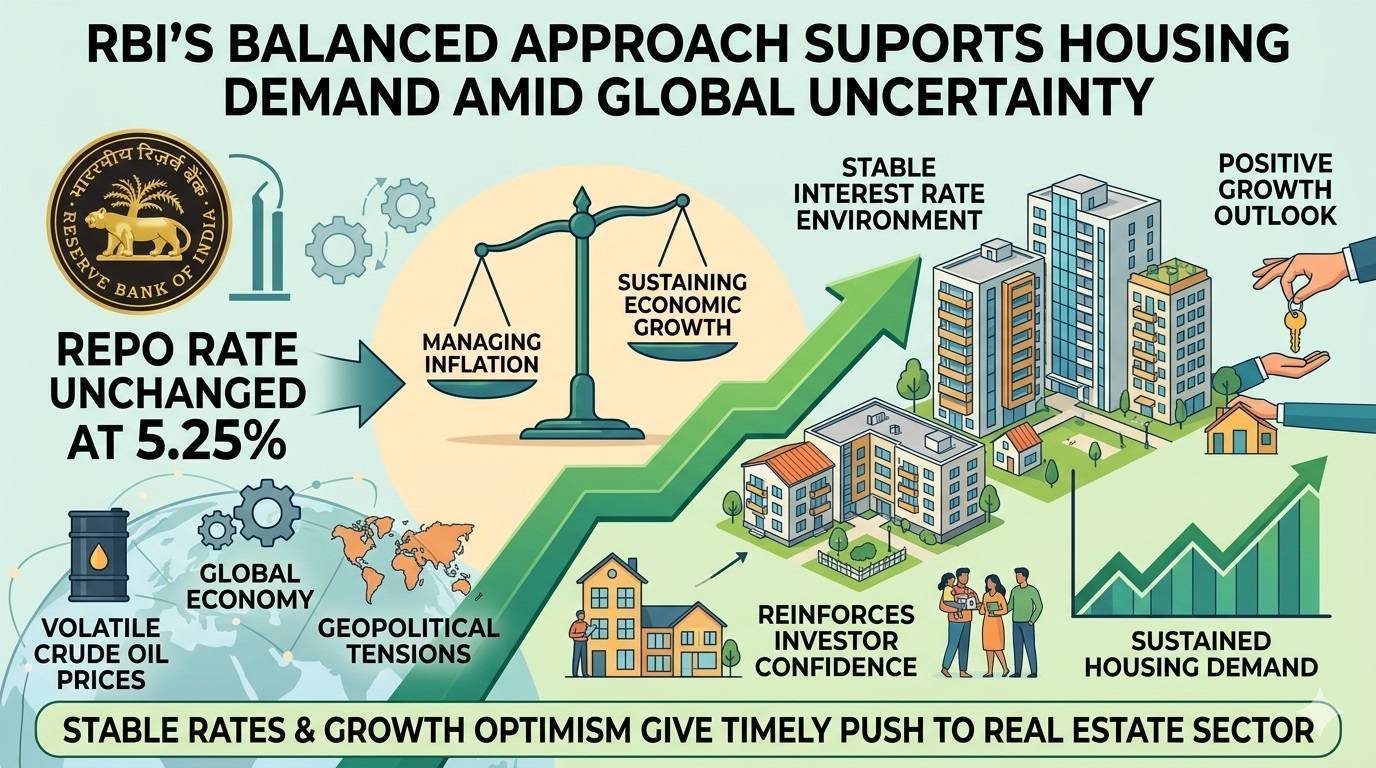
Favourable interest rate regime: One of the key tailwinds for residential real estate is the interest rate environment. The Reserve Bank of India cut policy rates by a cumulative 125 basis points in 2025, bringing the repo rate down to 5.25%. Lower borrowing costs have improved housing affordability and supported demand. While the rate-cutting cycle is nearing its end, market expectations suggest there may still be room for at least one more cut in 2026, providing further support to homebuyers.
Hedge against inflation: Real estate also serves as an effective hedge against inflation. Rental income and property prices tend to adjust upwards over time, helping investors preserve purchasing power. Unlike equities, where inflation can compress margins and valuations, real estate benefits from its direct linkage to replacement costs and income growth.
Diversification advantage: In addition, real estate offers diversification benefits as a tangible asset that is less correlated with financial markets. Residential properties provide utility value, steady rental income and long-term capital appreciation, making them suitable for both end-users and investors.
Positive tax framework: An added advantage lies in the tax framework supporting real estate investments. Deductions on home loan interest, depreciation benefits on rental properties, and exemptions on long-term capital gains—subject to reinvestment conditions—enhance post-tax returns, improving the overall investment proposition.
Conclusion
While no single asset class can address all investment objectives, residential real estate continues to stand out as a reliable anchor in a diversified portfolio.
In fact, recent data also suggest that residential real estate has delivered more competitive risk-adjusted returns than is often assumed. According to the 1 Finance Housing Total Return Index, India’s housing market generated nearly 15-20% total returns in 2025, supported by a combination of price appreciation and rental income. This performance compared favourably with benchmark equity indices during the same period. Strong absorption levels across major cities and sustained transaction volumes, which are estimated at over ₹1.5 lakh crore in the September quarter of 2025, highlight steady end-user demand, even as prices firmed in prime residential markets. Together, these trends point to a residential market that has remained resilient amid broader financial market volatility.
Heading into 2026, residential real estate will continue to grow, supported by sustained end-user demand, stable rental markets and limited quality supply in major cities. While returns may moderate, real estate is likely to continue appealing to investors seeking portfolio stability, predictable cash flows and long-term value creation amid ongoing volatility in financial markets.






.png)