

Along a narrow stretch of land in Tuticorin, Tamil Nadu, where maritime trade has long shaped the landscape, Wallmakers has realized a striking architectural experiment with the Petti Restaurant. Rooted in its context, the project transforms an abundant local byproduct, discarded shipping containers, into a spatial and environmental asset, creating a 200-seat dining destination that challenges conventional approaches to tropical architecture.
Building with Surplus: Containers as Structure
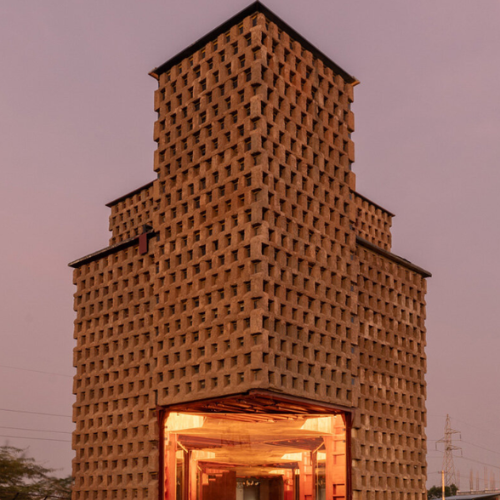
The design begins with a simple yet powerful observation: the steady accumulation of unused shipping containers in a port city. Instead of treating them as waste, Wallmakers integrates twelve reclaimed containers into the project’s structural system. However, rather than placing them horizontally as is typical, the containers are oriented vertically.
This shift in orientation dramatically alters their spatial potential. The vertical arrangement creates taller interior volumes, allowing for a sense of openness rarely associated with container architecture. Within a week, all twelve units were lifted, positioned, and welded into a cohesive structural framework, forming a sequence of tower-like volumes across the site.
Reinforced slabs were strategically inserted to stabilize the structure and support multiple levels of dining. The result is not just a building assembled from reused parts, but one where reuse becomes integral to its spatial identity.
Poured Earth as Climate Response
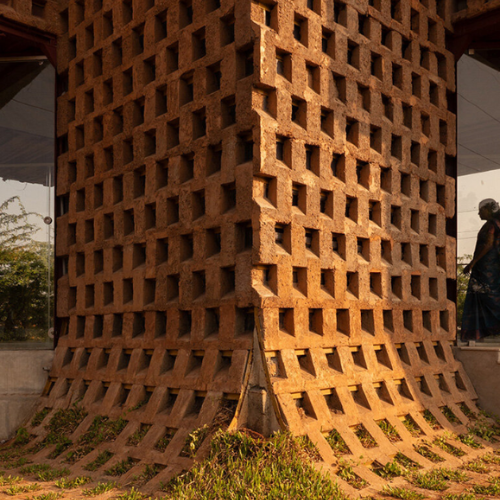
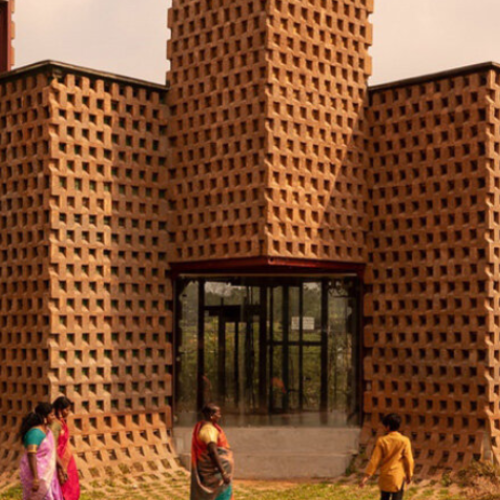
In Tuticorin’s hot and humid climate, thermal performance is critical. To address this, Wallmakers wrap the steel container framework in a thick, sculpted layer of poured earth. This outer skin is not merely aesthetic—it acts as a passive environmental system.
The compacted earth facade is shaped into a repeating recessed pattern, creating a porous surface that allows air to circulate while shading the steel structure beneath. This dual function reduces heat gain and minimizes reliance on mechanical cooling systems. The building leverages thermal mass, shadow, and ventilation rather than energy-intensive solutions.
The facade gently curves as it meets the ground, visually anchoring the building while reinforcing its material continuity. This interplay between industrial steel and natural earth creates a balanced system where each material compensates for the limitations of the other.
Spatial Experience and Interior Design
Inside, the building’s structural logic remains fully visible. Steel frames, timber finishes, and oxide flooring define a series of dining spaces embedded within the container grid. Rather than a single open hall, the restaurant is organized into a sequence of intimate zones.
Each seating area occupies a corner or edge condition, offering a sense of enclosure while maintaining visual continuity throughout the linear plan. This arrangement ensures that even within a 200-seat capacity, the experience remains personal and human-scaled.
Natural light plays a key role in shaping the atmosphere. Skylights puncture the structure, allowing daylight to filter through and shift across surfaces throughout the day. By evening, custom lighting fixtures—crafted from reused materials, introduce a warm, ambient glow that complements the earthy textures.
Passive Design Through Form and Orientation
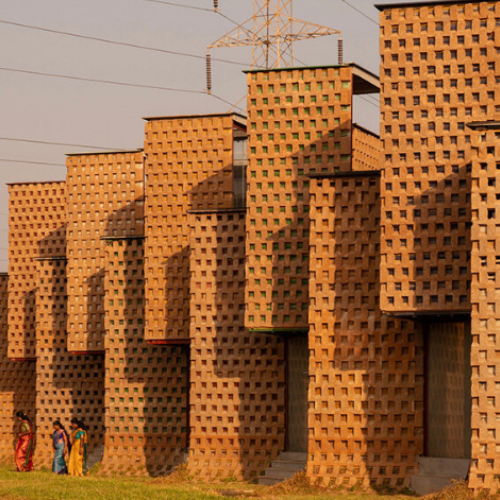
The staggered positioning of the containers creates shaded pockets and channels for cross-ventilation. South-facing volumes are treated as solid masses to reduce direct solar exposure, while upper sections facilitate airflow through the building.
This approach reflects a design philosophy rooted in adjustment rather than excess. Instead of relying on technology, the architecture uses form, thickness, and orientation to regulate temperature and comfort.
Rethinking Utopia Through Material Practice
Petti Restaurant demonstrates that sustainability in architecture can move beyond symbolism into performance. By combining reused steel containers with poured earth, Wallmakers establishes a hybrid system that is both structurally efficient and climatically responsive.
The project engages directly with its context, both environmental and industrial—turning surplus into opportunity. In doing so, it presents a compelling model for future construction in tropical regions, where resource constraints and climate challenges demand innovative thinking.
Rather than envisioning utopia as an abstract ideal, Wallmakers approaches it as a method grounded in real conditions. Through incremental decisions, material reuse, passive cooling, and contextual design, the Petti Restaurant proposes a practical and optimistic path forward for architecture.




.png)