

KOODU – Weaving a Nest Project Highlights:
- Socially Inclusive Design: A pro bono project for a single mother and two children, supported by PMAY and private sponsors, blending social responsibility with architectural innovation.
- Compact & Efficient Layout: Built on a 2-cent plot (71 sq. m), the house maximizes space with open-plan living, cleverly concealed staircases, and multifunctional areas.
- Structural Innovation: Features a rare asymmetrical brick groin vault providing stability, varied ceiling heights, and openness unusual for small-scale residential projects.
- Material & Climate Responsiveness: Exposed brick and jaalis control light, airflow, and privacy, reducing dependence on artificial lighting and mechanical cooling.
- Humane Interiors & Landscape Integration: Minimal, warm interiors with wood accents, pastel highlights, and tropical landscaping create a sense of serenity, connection with nature, and thoughtful living.
KOODU, Weaving a Nest, built in Eravipuram, Kerala, is a minimal yet significant residential project for NO Architects Designers and Social Artists. Formulated as a pro bono project for a single mom and two children, the project aims at addressing social responsibilities as well as architectural experimentation. The project is sponsored mainly by the Pradhan Mantri Awas Yojana (PMAY) and various sponsors, and it showcases the enhancement of the government initiative for housing schemes.
The site is situated in a densely populated area of town, and usually, a land parcel is about 2 to 3 cents. This way, the house occupies the major 2, cent plot with 1 cent given to the built up area. The difficulty here turned out to be a creative solution in terms of scaling and spatial organization.
Design Philosophy : Constraints as Catalysts
The philosophy of KOODU lies in the fact that economic constraints should never come in the way of good design. Budget, space, and resources should not be seen as challenges, but rather design stimuli. It is an investigation of how architecture should be humane, functional, and expressive with minimum means.
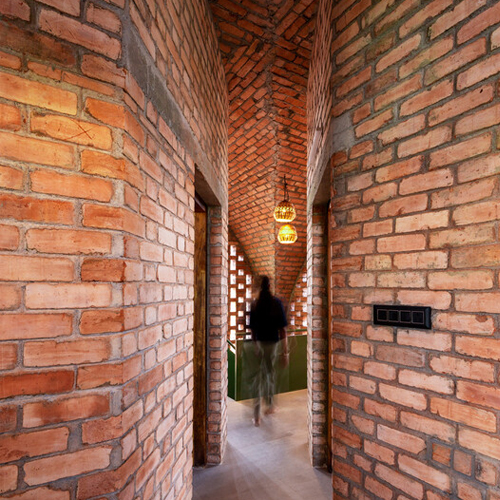
Taking the lead from the principles of Laurie Baker, the emphasis is on climate, responsive planning, revealing materials, and material, based constructive practices. Brick, which is easily accessible and within one's affordability, is the key structural and design component of this house. Instead of concealing the material, the architects choose to leave it in its raw form, thus propagating authenticity over unnecessary materials.
Structural Innovation: The Asymmetrical Groin Vault
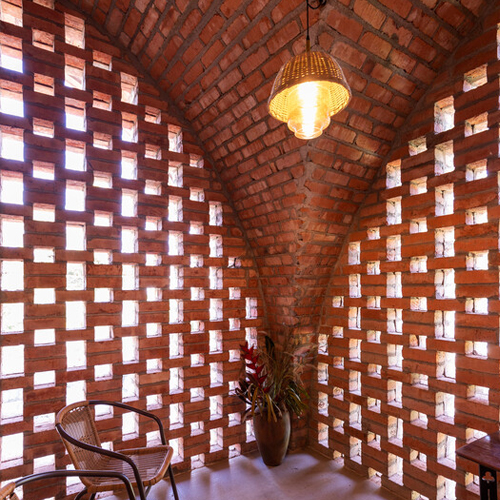
One of the outstanding characteristics of KOODU is its experimental asymmetrical groin vault. This is an extremely rare architectural element in small residential projects. There are hardly any examples worldwide of such a structural system, especially at such a compact scale. It is the vault that offers both the structural stability and different ceiling heights, and the openness that gives a high, quality space feeling.
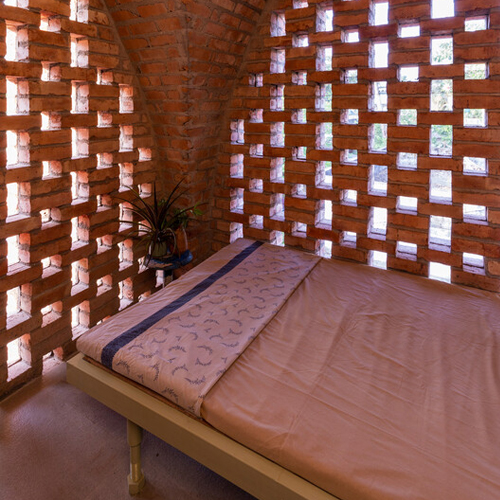
The brick vault is cleverly combined with brick jaalis to control the daylight, allow cross ventilation and at the same time, through the high density of the city, maintain privacy.
The design approach would lead to very little dependence on artificial lighting and mechanical cooling, thus making the house not only environmentally responsive but also energy efficient.
Spatial Planning and Functional Layout
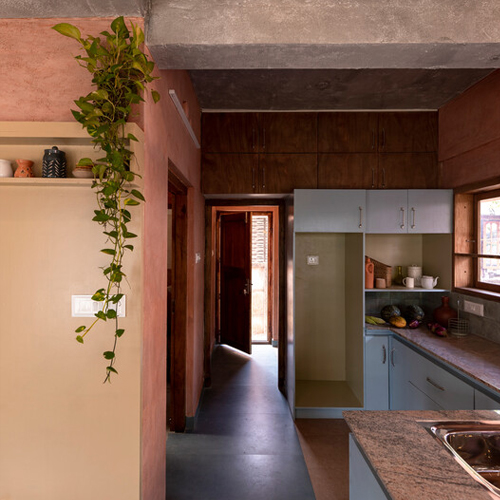
Though KOODU covers a small area of only 71 sq. m, it's cleverly planned to include all the necessary functions without giving a feeling of being cramped. The main floor of this home follows an open plan concept, where the living, dining, and kitchen areas are all merged into one space.
A ground floor bedroom with an attached toilet is also there, access being very convenient. Upstairs, the two bedrooms share a bathroom, and access is granted by a wooden, winding staircase that is very cleverly concealed within the design to save space for movement routes. Every route through the house has been laid out very thoughtfully with careful planning.
Material Palette and Interior Expression
The interiors of KOODU are very compact and yet warm in the material choice. Some of the defining features of the setting are brick walls with exposure, wooden accents, and a little touch of pastel colors. The pastel colors mainly serve two purposes, first, they play the role of dividing different areas in a plan that is open, and second, they tone down the potential harshness of the natural earthy materials that are in the space.
The furniture and built, ins that are functional are scheduled to be kept to a minimum and multifunctional, matching the ideology of living in a space- conserving way. Ornamentation of the detail is not the focus of the project, instead, the emphasis is on proportion, texture, and natural light.
Climate Responsiveness and Landscape Integration
The tropical climate of Kerala is one of the very influential factors for the designing aspects. The openings are purposefully arranged to receive the maximum of the wind flow, and the shaded parts and jaalis assist in lowering the heat that is coming. The architect has taken a tropical new, wave landscape approach reviving nature to visually blend the in and out spaces.
Besides drastically enhancing the thermal comfort, such a landscape integration elevates the mood of the occupants to a great extent. It is quite a rare situation that a house, even in a very cramped city layout, being so closely connected with nature, always gives a feeling of spaciousness and serenity.
KOODU challenges the prevailing perception of affordable housing as being essentially coven, dull, or without any character. It proposes an alternative, more design, led approach where design intelligence, craftsmanship, and empathy come together to create beautiful living environments.
The project illustrates how building can be a social inclusion tool, a source of innovation, and a way of delivering social impact, even at the tiniest scale. KOODU reinterprets what is possible in the budget housing frameworks by focusing on human loneliness. It is a nest, a home, carefully and lovingly made that bears the qualities of strength, kindness, and the enduring value of thoughtfully well designed.
Image- archdaily.com




.png)